Showing posts with label theology. Show all posts

Friday, April 22, 2011

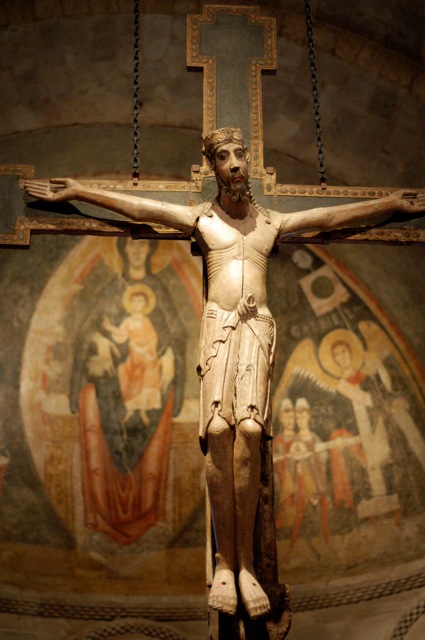
Christ Without a Cross Dies Twice


"For me, kind Jesus, was thine incarnation,
thy mortal sorrow, and thy life's oblation;
thy death of anguish and thy bitter passion.
for my salvation." --Johann Heermann tr. Robert Bridges

I.

Our culture denies death. Our culture denies death's power by saying that it is nothing, only a change. Our culture denies death's sorrow by making of it a celebration. And our culture makes of death's horror a cheap cologne that smells more like bacon than decomposition.

The challenge of Christ's death and resurrection is the greatest gift that the Christian church can give this culture, indeed any culture. But Christ without a cross, especially among his followers, dies two deaths: the actual death, and the death of relevance, for Jesus as just another man who died, another sucker whom the state overpowered, another dupe of the Caesar, no matter how many nice things he did or good things he taught, is doubly dead.

II.

The doctrine of atonement, the idea by which the death of Jesus makes good for the sins of the world, for our sins, is problematic for many to say the least. The idea that this act of Jesus, casting aside his Messianic crown for us, was in fact an act of divine child abuse, God killing God's own son, or the act of a political prisoner alone, seems to me fairly pervasive.

One powerful idea given me in seminary was that instead of a Mel Gibson-style pornographic torture fest, Christ's torture and death on the cross was an interchange of God's justice for our constitutional human injustice, happening through Jesus as through an electrical conduit. More than a felix culpa, a "happy fault," that "allows" God to build something better out of our faults, this interchange is an exchange of all that is just in God for all that is unjust in a creation that goes its own way. We get a better deal.

III.

I'm hardly a heavy-duty theologian, or a student of literature and art and cinema who can quote all of the concepts that I'm referring to here in the history of human achievement. But it seems pretty clear to me that many in the church, uncomfortable as we are with death, might seek to hide Jesus's death behind bunnies, eggs, candy, and parades.

What is an age-appropriate explanation of the crucifixion and resurrection to children? I'm by no means an expert, but talking directly about Jesus dying, and God bringing Jesus back from the dead, seems like it could be very powerful for those whom we often forget about when tragedy happens, because it seems even more difficult to explain it to children, who know something bad when they see, hear, feel, and experience it.

It seems to me that Christ without a cross dies twice, as I said above: his actual death, and the death of his relevance to us as Christians and to our or any culture, time or place. Our culture is not exclusively Christian, but it is one to which we might share a word from this perspective of death and resurrection, and at that a word of hope. Jesus without resurrection is Jesus without hope.

Perhaps we are ashamed because we cannot explain God's place in evil, either the evil of the crucifixion or the evil of natural disaster, war, famine, and other engineered acts of evil that we humans perpetrate on other humans?

Perhaps it is so difficult to believe in the resurrection that it is easier to sugarcoat it than try to explain it to others, much less ourselves and our own people? I can't say I understand the death and resurrection of Jesus all that well, but something in me believes beyond the need to sugarcoat my own impending death with the cross, to use the cross as a means of escape from reality, as must appear to many who do not share this same belief.

A church that sugarcoats the death and resurrection of Jesus with the candy of culture may well be as odious as a believer who uses the cross to deny his or her own death. But as Dietrich Bonhoeffer said famously in Cost of Discipleship:

"As we embark upon discipleship we surrender ourselves to Christ in union with his death--we give over our lives to death. Thus it begins; the cross is not the terrible end to an otherwise godfearing and happy life, but it meets us at the beginning of our communion with Christ. When Christ calls people, he bids them come and die....In fact every command of Jesus is a call to die, with all our affections and lusts. But we do not want to die, and therefore Jesus Christ and his call are necessarily our death as well as our life. The call to discipleship, the baptism in the name of Jesus Christ means both life and death" (Dietrich Bonhoeffer, The Cost of Discipleship, 89-90. New York: Macmillan, 1959, Touchstone ed. 1995).

There is a broader point of forgiveness and mutual burden-bearing to Bonhoeffer's message here, but the necessity of death, and of death in Christ for a Christian, is of central moment.

Any version of Christ that can escape the tomb without the cross is not the Christ. Any version of Christ that gets caught in torture without the work of God in resurrection from the tomb is not the Christ. But my sense is that our human tendency is more to liberate Christ and ourselves through him without taking the hardest steps to and through the cross.

IV.

I wonder if a failure to encounter Jesus in all of his shame on the cross, around the crucifixion, and jumping right to the resurrection, may not be an element of what has chased people away from church by the droves?

Not only has there been a cultural shift since the 1960s that shows a marked decline in the relevance of church in much of American society, but perhaps the church itself has aided in people leaving it through downplaying its own relevance through its core concepts, and through becoming a place of trying to make people feel good about themselves in a way that a gin and tonic could do much better.

As a kid, and as an adult, direct talk has engaged me much more than beating around the bush. I don't want to hear about a Jesus who is merely a glory-machine, triumphing over death without experiencing it. That kind of Jesus doesn't make much difference to me or anyone else.

I want to hear about a Jesus who went all the way, who experienced everything I have experienced, and who came through it in a way that I can know meant a lot to him, not only an insignificant key change in the tune he was whistling, but a whole shift in the reality of what death and our relationship with God means to me and to humanity.

We crucify Christ again by forgetting the cross. We crucify Christ again by forgetting the tomb. We crucify Christ again by forgetting the resurrection. It is only with each of these elements, and by accompanying Christ in these places, and in teaching this to our children, and in insisting on our reality to the wider culture, challenging first its denial of death, that we respect most profoundly the God who has given us Godself in human form, and who has loved us so much that even death can't separate us from God.

Loving Jesus, the tomb awaits, but not yet. Nor your glorious resurrection. Not yet. Keep me for a moment from it, that its power and glitter not overwhelm me. Keep me for a moment with you in death's embrace. Amen.


Monday, March 28, 2011

A Spontaneous, Inexhaustive Lutheran Credo

One of my friends posted a question on what her statement of "What Lutherans Believe," and in thinking of it, I was struck with a flurry of spontaneous Lutheran credology. My favorite statement here is the last. Here it goes:

  • Lutherans believe that Christ is the center and the center will hold.
  • Lutherans believe that no sin is original--they've all been tried before.
  • Lutherans believe that Christ showed his true colors on the cross, and we showed ours, yet God is above all seen in a rainbow of all colors.
  • Lutherans believe that "Love your neighbor as yourself" does not mean to keep using Jesus' name to attack that neighbor for any reason whatsoever.
  • Lutherans believe that the New Commandment doesn't supplant the 10 Commandments, but rather interprets law through the prism of the Gospel.
  • Lutherans believe that God forgives you first, and then you respond with works of charity and compassion out of thankfulness, rather than trying to buy God's favor through good works, which doesn't work anyway.
  • Lutherans believe that faith is a gift of the Holy Spirit and not a work that one Christian is better at than others.
  • Lutherans believe that humans are not fully good or fully bad, but fully both.
  • Lutherans believe that Jesus, and not Rob Bell, emptied hell of all sinners past, present, and future.
  • Lutherans believe that human beings struggle and are not perfect.
  • Lutherans believe three solas ("alones"), grace, scripture, and faith, but these are neither mutually exclusive nor exhaustive.
  • Lutherans believe that doubt is an asset, and not a liability, to faith.
  • Lutherans believe that Jesus really is present in communion, not just a memory.
  • Lutherans believe that God is gracious, even in judgment.
  • Lutherans believe that the Holy Spirit works today, and that God was not buried in the Bible.
And, most importantly:
  • Lutherans believe that God is still speaking, even if some Christians never shut up.

Saturday, September 11, 2010

My Ideas Should Not Depend on Yours for Their Validity

Another nocturnal walk brings another epiphany: My ideas should not have to depend on your believing them as I do in order for them to have validity, and vice-versa. It seems so simple, something that I have heard countless times, but tonight it is clicking in a new way for me.

A friend of mine, Matt, helped me to realize this today when he wrote in his blog about why he does not, shall we say, see religion in the same way I do. Check him out at www.themindofmatt.com. We agreed, however, that we can respectfully agree to disagree, and remain friends, indeed are even more respectful as a result.

We live in a time, of which we are reminded every 9/11, indeed every day, of extremely dysfunctional political, philosophical, and theological relationships. The red states (counties, cities) are getting redder, and the blue states are getting bluer, and I think that makes all of us both red and blue in our own way. The culture wars ratchet up, and only seem to be getting more intractable day by day and year by year. Congress deadlocks, court decisions are discounted as "activist," families are torn apart, and friendships seem impossible to form with those who don't believe exactly as we do.

It hasn't always been this way, and it doesn't have to be this way.

I.

Here is the epiphany: 1. Ideas (religious, political, or otherwise) become dangerous when we have to force them on others to validate them for ourselves; 2. If my beliefs do not depend on your believing them in order to gain their validity, and vice-versa, we can respect each others' independence of thought.

Let's play with this a bit. Suppose you are a Bible-believing Christian who does not allow for homosexuality as a variation of human sexuality because the Bible disapproves of it in at least seven passages (more, according to our friends at the Westboro Baptist Church). The Bible clearly states that a man who lies with a man as with a woman commits to'evah, an abomination, and the blood of the both shall be upon them; they shall both be put to death.

Short of actually working to carry out that rather horrific scene, what is wrong with believing this? As it turns out, plenty, if this belief is, as it often is, forced on others. Because this belief has had countless political consequences as a result of being "forced on" those who do not believe in this way. Parents have disowned their children, or rejected them, students have beaten and sexually abused other students, school districts, the military, churches, and other institutions have imposed a strangling code silence, and states have prevented marriage, all in the name of upholding the beliefs of some.

What would it look like to be truly "neutral" with regard to these beliefs?

It would look neutral if, and only if, I say to you that I believe this, but I am not going to impose this belief on you through curtailing your civil rights, insulting your personhood, tearing apart your families, firing you from your jobs, and preventing you from voicing your views. Why? Because you let me do the same as I let you: speak the truth as you see it.

Many things in the Bible are to'evah, not least of which is what comes almost immediately before Leviticus 20:13, the verse quoted above about men lying with men as being an act punishable by death. The act of which I am thinking is quoted more often throughout the Bible than "a man shall not lie with a man as with a woman."

Here it is in Exodus (21:7): "Anyone who curses his father or mother shall be put to death." Again, in Leviticus (20:9), "If anyone curses his father or mother, he must be put to death. He has cursed his father or his mother, and his blood will be on his own head (NIV)." Again in Proverbs (20:20): "If a man curses his father or mother, his lamp will be snuffed out in pitch darkness."

Even Jesus finds this verse important enough to repeat verbatim in Matthew (15:4) and Mark (7:10): "For God [or Moses, in Mark] said, 'Honor your father and mother,' and 'Anyone who curses his father or mother must be put to death.'" Jesus says this!! Nice, good Jesus.

How many children have cursed their fathers or mothers for any number of reasons? And how many of those children have we put to death, or driven to death by saying that we must hate their sin of cursing their father or mother, while loving them as sinners?

How many preachers are advocating that children, or adult children, be put to death for this cursing? How many "ministries" exist to "cure" children of cursing their fathers or mothers?

How many children are thrown out in the street for cursing their fathers or their mothers? And how many schools impose strict policies on their students and staff never to curse their fathers or their mothers?

I imagine the number is pretty low.

I wouldn't hate you for believing that your children should be put to death for cursing you. I'd think it an awfully strange thing to think, and I would oppose your imposing that thought on your children in a way that would damage them. I'd probably even say it's a good thing my Mom or Dad didn't toss me off a bridge at numerous points during my growing up. And I'm sure your Mom and/or Dad, or Mom & Mom, or Dad & Dad, would say the same thing about you.

II.

Why, I ask, must we force our views on others? Must we insist that if you do not believe as I do, that we should have nothing to discuss further? Must we insist that everyone throughout the world should live as we do, and should believe the same beliefs in the same way? Because there are indeed a large variety of beliefs, which, as long as they do not end up building walls of shame, walls of isolation, and literal walls around others, as long as they do not lead us to fly into towers or start wars, as long as they do not lead us to codify laws and policies to restrict others from expressing their own beliefs, as long as they do not lead us to think ourselves better people or more worthy of living than others, as long as they can be spoken in a way that do not start riots throughout the world, why not speak them?

I respect you, and you respect me, when we can agree to disagree on some things.

Building conversations on this basis, rather than on the basis of forcing each other to believe as we do, can build relationships, tear down walls, and save lives.

I cannot believe that my ideas are so weak that they must depend on your assent to them for validity, or vice-versa. I believe what I believe, from my experience, from what faith has been given me, from what my own human mind has been able to reason out, and there you have it: a thoughtful conclusion.

III.

I can see many ways in which people would disagree with me, or see this stance as being naive or untenable.

For one, people do, out of both fear and a will to dominate, impose their beliefs on others in countless ways. Whether it be through weakness of character or joy in domination, people seem invariably to fight to be right. I myself like being right and being agreed with when it comes to something that I find important. But, for example, because my friend Matt does not believe that this bread and this wine is the body and blood of Christ, that does not prevent me from believing that the elements are the real presence of Jesus Christ, the son of God, the savior.

For another, particularly from a religious point of view, those who do not believe as we do transgress, indeed break the law, that we ourselves must live by in order to have the kind of life that we feel we must live. But, for example, are heterosexual marriages so inherently weak that they cannot tolerate people living in same-sex marriages? Are same-sex relationships so inherently desirable that they will entice those who would otherwise be out making babies to stay home and make whoopee instead? Are your children so weak of mind and character that they will glom on to every view expressed to them, and try out every possibility floated in their direction?

It seems to me asinine, not to mention disproven by experience, that people will try everything and become anything to which they are exposed. If this were the case, we'd have a nation of rapists, drug addicts, and especially murderers, given the amount of this activity that is shown on television, let alone video games. I worry about how certain song lyrics and video games that extol violence against women give young people the impression that it is OK to rape. But I also fear the stance that mentioning a fun weekend at Valley Fair with your gay boyfriend will have any impact on a whole class of children's sexual development.

This is not merely a plea for tolerance, but for allowing others to live the lives that are given them, and trusting that, given plenty of lessons in respecting others, they will carry out that respect themselves.

Wednesday, January 7, 2009

What's in a Fine?

As far away as I feel from God these days, everything engenders an internal theological debate. God is ever-present in my thoughts.

Yesterday, I brought back four DVDs to the Minneapolis public library. I knew they were overdue. It was the first time I had checked out anything from the library here, and of course there would be fines. I just didn't think the fine would be $20.00. I asked that my fines might be reduced, since it was a first offense and I genuinely had no idea they charged $1.00 per day per item fine. But no deal. Their backs were against the wall, and they were not able to dispense any library-fine grace. The law was the law, and they had to enforce it. Fine. (Sorry, no pun intended here, but I'll get one in later on.)

So, since I cannot be reliable in returning the DVDs on time, and don't want another $20.00 fine, I told the folks at the library that I would certainly pay the fine, but that I wouldn't be checking out any more DVDs. Somehow I would subvert their very reason for having their holdings, by not availing myself of them. If people followed the categorical imperative on this one, they’d go under. Woah, a little vindictive?

Where does this get theological?

Sometimes it seems to me that people reject God because the cost of the penalties God seems to impose—e.g., hell—is too high, whether it be one's own prospect of going to hell, or the prospect of God damning even one person to an eternity of suffering and separation from God. My rightful, though exorbitant, $20.00 in library fines pales by comparison.

But I think this happens. I think people do throw away God because they believe that God would throw us away.

And that makes me sad. And I think, if God can be sad, it makes God sad too.

Perhaps it's a case of throwing the baby out with the bathwater: just be more timely in returning DVDs. Just be more careful in the way that you understand eternal damnation, adopt another view of God's role in it (i.e., that it's our own damn fault, pun intended, if we're damned), or disbelieve it entirely, i.e., don’t believe in hell. But really, something is there. A loving God and a loving person are separated because of someone's impossibly high expectations, perhaps those of both parties.

I could give a little. The Minneapolis public library could as well. And, I daresay, God and those who oppose God on account of fear could give a little. The Israelis could give a little, and Hamas could give a little. Those who oppose my full civil rights could give a little, and perhaps I could lighten up a bit as well.

I'm reminded of that scene from "On Golden Pond" when Chelsea asks Norman if they can be friends, after a lifetime of separation, enmity, anger, and confusion. "Does that mean you'll come around more often? It'd mean a lot to your mother," Norman replies, meaning it would mean a lot to him.

Reconciliation always means a lot. My prayer is that it might happen on all levels, from the mundane to the national, to those who have been disenfranchised into the franchise, to families set apart by disagreements and betrayals, from us to God, who has paid our existential fine in full.