"God hasn't brought you this far just to let you go now."
--Loretta Hernton
I.
Somehow, I got dragged back into church after foreswearing it for Aristotle.
It was going to be so neat and tidy: Let God be whatever God was supposed to be, which I supposed wasn't much, pray when I really needed something somehow expecting that would work, and stay in my rational mind as well as I possibly could. That was my "lifestyle choice" for a good long time. Looking back now, I mouthed the words of atheism, but my heart wasn't in it. It was like me trying to be heterosexual.
This is not to say that atheists, agnostics, humanists, and persons of dozens, if not hundreds, of world religions do not have a heart, and, indeed more of a heart than I. But I could never have come to the religious belief I have without being openly gay. Indeed, some of the most "Christian" people I know, and some of the better theologians, are atheists, and some of the beastliest things I've seen and heard have been done in the name of Jesus.
I've always been a doubter and a sceptic when it comes to faith. Indeed, faith without doubt is like pig iron; it is brittle, and breaks at the least trial. Doubt to faith is like the carbon that turns iron into steel, making it strong and pliable enough to shift without easily falling down.
II,
In college, I never felt like the church was any place for me to be. After I left home, I left the church as well, as many young people do, except to earn some money playing organ or piano for services here and there.
My family attended a Methodist church quite faithfully, each Sunday, so it was a part of my upbringing. In fact, I've not lived a day without being baptized, as I was baptized the very day I was born. It was a lifestyle choice, yes, first made by my parents, and then myself. But I never wanted to be a part of the "Christians" that I saw at college, because I knew that their company was no place for the likes of me. But "my religion" has become far more than a casual choice or accident of birth.
Strangely enough, in coming to understand the part of myself that had to come out of the closet, especially in the context of what really mattered in my life and in the universe from my vantage point, I couldn't escape the many elements that had affected my life through religion. Yet, even though I am certain I never went to a church service in which the pastor or priest said that homosexuals were going to hell, somehow I got that message through the air, or the airwaves, because enough other people were saying it: God condemns gays. I know that to be a lie, in some cases very carefully manufactured for maximal political effect, but it was a lie that helped keep me in the closet.
My first summer in New York, where I have lived 5 years of my adult life, I recall a subway evangelist (there were many) approach me on the uptown platform of the A train at 42nd Street. He said to me, "Do you have Jesus?" I answered, and can still clearly see and feel what I felt when I said it, "I already know I'm going to hell."
That frame of mind, however, is not where I would stay.
III.
As someone who went through seminary, I learned how to tell my "faith journey" while standing on one leg, like Ayn Rand claimed she could do and recite her whole philosophy (which I'm sure she could). And not only did I go to one seminary, but two: Yale Divinity School/Institute of Sacred Music for my "Masters of Divinity," a title to this day that makes me laugh with images of donning leather and picking up a whip to recite the Word of the Lord, and Pacific Lutheran Theological Seminary, which granted me a CATS, a Certificate of Advanced Theological Studies, which sounds like something between a pet and a medical procedure. Altogether, I became a Master of Divine Cats who could whip out a faith journey narrative like last-minute pancakes for unannounced company.
My path was somewhat untraditional, lacking a particular influential mentor, but common as well to others who went to seminary. I was raised in the church, left the church, left God, found out that I hadn't left God, got peppered with dreams and "coincidences" that forced me to think about God, as well as felt an increasing desire to know more about religion, to experience more, to become a pastor, at which I would have laughed when I was in college, and, after a time, to go to seminary.
I first came back to the church in Harlem, at the Convent Avenue Baptist Church on the corner of 145th and Convent Avenue. There was a big pink cross up in front, and a fiery preacher, Minister Grant, who along with the choirs made the Word of God come vibrantly to life. They let me use their piano to practice as I hadn't one of my own at the time, and it helped get me in the door on a Sunday morning when I wasn't doing anything else in particular. Piano of God #1.
Later, after I moved north of Harlem, I found the Lutheran church down the street from where I lived while looking for a piano to play. Piano of God #2. Something seemed to be at work to unite the place where my heart resided during my teenage years, in music, and where it was starting to find itself more and more, in a wider place within my being.
My interest in Greek, my undergraduate major, led me to pick up a Bible for the first time in years when I was shopping at the Chelsea Salvation Army in New York one Saturday afternoon. The teller gave it to me, saying, "We don't sell Bibles; just take it." The beautiful Greek characters brought the Scriptures to my mind fresh and alive, and made me want to know and experience more.
When I picked up that volume and looked at the title page, I saw the name of Bruce Metzger, who had led the committee that edited that Bible from the Greek manuscripts. Since he was still living in Princeton, where he taught for many years, I resolved to go and meet him. This desire led me to my first experience at a seminary, Princeton Theological Seminary. Before that visit, I hadn't even much of an idea what seminary was.
A dream during my visit to that seminary convinced me that I must go to seminary, but not yet, so soon after coming back to the church. I later learned that I dreamt a verse from the Book of Jonah (also found in Psalm 42):
and the flood was round about me;
all thy waves and thy billows
passed over me. (Jonah 2:3; RSV)
I passed through the overwhelming flood in that dream, which I had seen Fantasia-style, in the 3rd person, encapsulated safely in a gleaming crystal case. The waves rolled a mile over my head, but I was safe, as the waves all went over me. I woke feeling as though I had been washed deeply, like in a steam bath but without the sweat. It was as though I had been baptized again. It was if I had been Jonah, running from God, and right into the belly of a whale.
In these formative years, I learned to appreciate the energy and deep commitment of those in the National Baptist tradition at Convent Avenue. I also spent time with extremely conservative Mennonites; formed a small Bible study in which I translated the Greek version of the week's Gospel passage, complete with long footnotes describing theological concepts; took several courses at Fifth Avenue Presbyterian's Center for Christian Studies; discovered writing poetry there through a course on Modern Poetry and the Book of Hours; celebrated communion every day at St. Bartholomew's Episcopal Church on my lunch breaks; and hung out at Union Theological Seminary, all while starting to worship at a Lutheran Church.
Perhaps most powerfully, every morning in New York, I would also shut my eyes and pray on the A train on the way to work, envisioning myself encapsulated in a ball of light. Everyone in the train was part of that prayer, wishing them peace, healing, and love. It was the only time in my life I can say my prayers were regular and absolutely transformative. Not so after seminary.
IV.
Religion in America seems often to chase LGBT people away with dreadful visions of a tortured afterlife based on our particular "sin" in this life. I believe instead that these religious voices are simply making for a tortured life for us here on earth, and have nothing to do with the possible afterlife.
Shortly after my denomination, the ELCA, voted to allow open and partnered LGBT people to serve as ordained clergy in 2009, a series of articles popped up on the LGBT news-blog Queerty.com written by Lutherans about the changes voted in, which many in the church had been working hard to get enacted for many years.
Given the voices of hatred towards LGBT people from people calling themselves "Christian," it is no wonder to me why many would be forced away from the church, indeed run screamin. Personally, after the last several years of waiting for a church and wondering if this vocation to the ministry will ever pan out, or if I will just look like I was aimlessly drifting for 10 years, I can genuinely empathize with the feeling that churches can seem at best irrelevant and at worst actively, vocally, and indeed politically harmful, even deadly in their narrow and rigid messages of wide sin and narrow salvation.
So why go back to a religion that has spent so much energy on actively opposing me and millions of LGBT people?
Because God bewitched me, "jokester that she is," as one of my clergy acquaintances says.
V.
The brain in me that worked so hard to keep me in the closet for my first 10 years of knowing I was attracted to my same sex, which worked so hard on problems of philosophy, music theory, and politics, which reached out to the farthest reaches of the universe and tried to reach beyond, to the other side of the universe into whatever might be beyond, and that dismissed the possible reality of God, ended up taking a back seat to my gut and to my heart after I came out.
Why do we do what we do, think what we think, and feel what we feel? When I was younger, I thought that we human beings functioned best when we did not let our emotions get involved, but used as pure of reason as we could, unclouded by the irrational heart. But when my heart and mind connected, which I strongly feel was not until after I came out for the first time to other people, I dropped my insistence on pure reason, and learned I was a gut sort of person.
The heart has its own knowledge, the brain its own, the gut as well, the soul another, close to the spirit. If all lie in separate containers all the time, and do not converse, they can grow lonely, proud, and dictatorial, as each of us becomes without the benefit of kind and challenging human interaction, hearing various points of view, and feeling closely how our opinions affect the lives of others.
God works through our minds, but surpasses the bounds of reason. Sexuality, as well, cannot be the sole concern of one organ over another.
In coming out, I set myself on a path to connect with God in a way that never would have happened if I'd attempted to make sense of life with whatever share of reason I was given between my ears and behind my eyes.
And that path is not over yet. God hasn't brought me this far just to let me go now.
Showing posts with label Christ. Show all posts
Showing posts with label Christ. Show all posts
Tuesday, May 3, 2011


Friday, April 22, 2011
Christ Without a Cross Dies Twice
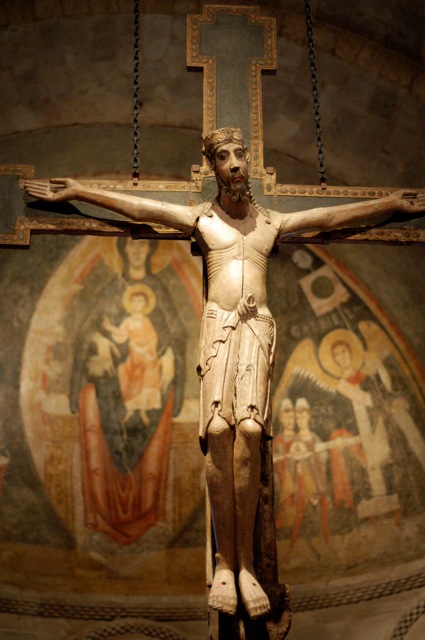
"For me, kind Jesus, was thine incarnation,
thy mortal sorrow, and thy life's oblation;
thy death of anguish and thy bitter passion.
for my salvation." --Johann Heermann tr. Robert Bridges
I.
Our culture denies death. Our culture denies death's power by saying that it is nothing, only a change. Our culture denies death's sorrow by making of it a celebration. And our culture makes of death's horror a cheap cologne that smells more like bacon than decomposition.
The challenge of Christ's death and resurrection is the greatest gift that the Christian church can give this culture, indeed any culture. But Christ without a cross, especially among his followers, dies two deaths: the actual death, and the death of relevance, for Jesus as just another man who died, another sucker whom the state overpowered, another dupe of the Caesar, no matter how many nice things he did or good things he taught, is doubly dead.
II.
The doctrine of atonement, the idea by which the death of Jesus makes good for the sins of the world, for our sins, is problematic for many to say the least. The idea that this act of Jesus, casting aside his Messianic crown for us, was in fact an act of divine child abuse, God killing God's own son, or the act of a political prisoner alone, seems to me fairly pervasive.
One powerful idea given me in seminary was that instead of a Mel Gibson-style pornographic torture fest, Christ's torture and death on the cross was an interchange of God's justice for our constitutional human injustice, happening through Jesus as through an electrical conduit. More than a felix culpa, a "happy fault," that "allows" God to build something better out of our faults, this interchange is an exchange of all that is just in God for all that is unjust in a creation that goes its own way. We get a better deal.
III.
I'm hardly a heavy-duty theologian, or a student of literature and art and cinema who can quote all of the concepts that I'm referring to here in the history of human achievement. But it seems pretty clear to me that many in the church, uncomfortable as we are with death, might seek to hide Jesus's death behind bunnies, eggs, candy, and parades.
What is an age-appropriate explanation of the crucifixion and resurrection to children? I'm by no means an expert, but talking directly about Jesus dying, and God bringing Jesus back from the dead, seems like it could be very powerful for those whom we often forget about when tragedy happens, because it seems even more difficult to explain it to children, who know something bad when they see, hear, feel, and experience it.
It seems to me that Christ without a cross dies twice, as I said above: his actual death, and the death of his relevance to us as Christians and to our or any culture, time or place. Our culture is not exclusively Christian, but it is one to which we might share a word from this perspective of death and resurrection, and at that a word of hope. Jesus without resurrection is Jesus without hope.
Perhaps we are ashamed because we cannot explain God's place in evil, either the evil of the crucifixion or the evil of natural disaster, war, famine, and other engineered acts of evil that we humans perpetrate on other humans?
Perhaps it is so difficult to believe in the resurrection that it is easier to sugarcoat it than try to explain it to others, much less ourselves and our own people? I can't say I understand the death and resurrection of Jesus all that well, but something in me believes beyond the need to sugarcoat my own impending death with the cross, to use the cross as a means of escape from reality, as must appear to many who do not share this same belief.
A church that sugarcoats the death and resurrection of Jesus with the candy of culture may well be as odious as a believer who uses the cross to deny his or her own death. But as Dietrich Bonhoeffer said famously in Cost of Discipleship:
"As we embark upon discipleship we surrender ourselves to Christ in union with his death--we give over our lives to death. Thus it begins; the cross is not the terrible end to an otherwise godfearing and happy life, but it meets us at the beginning of our communion with Christ. When Christ calls people, he bids them come and die....In fact every command of Jesus is a call to die, with all our affections and lusts. But we do not want to die, and therefore Jesus Christ and his call are necessarily our death as well as our life. The call to discipleship, the baptism in the name of Jesus Christ means both life and death" (Dietrich Bonhoeffer, The Cost of Discipleship, 89-90. New York: Macmillan, 1959, Touchstone ed. 1995).
There is a broader point of forgiveness and mutual burden-bearing to Bonhoeffer's message here, but the necessity of death, and of death in Christ for a Christian, is of central moment.
Any version of Christ that can escape the tomb without the cross is not the Christ. Any version of Christ that gets caught in torture without the work of God in resurrection from the tomb is not the Christ. But my sense is that our human tendency is more to liberate Christ and ourselves through him without taking the hardest steps to and through the cross.
IV.
I wonder if a failure to encounter Jesus in all of his shame on the cross, around the crucifixion, and jumping right to the resurrection, may not be an element of what has chased people away from church by the droves?
Not only has there been a cultural shift since the 1960s that shows a marked decline in the relevance of church in much of American society, but perhaps the church itself has aided in people leaving it through downplaying its own relevance through its core concepts, and through becoming a place of trying to make people feel good about themselves in a way that a gin and tonic could do much better.
As a kid, and as an adult, direct talk has engaged me much more than beating around the bush. I don't want to hear about a Jesus who is merely a glory-machine, triumphing over death without experiencing it. That kind of Jesus doesn't make much difference to me or anyone else.
I want to hear about a Jesus who went all the way, who experienced everything I have experienced, and who came through it in a way that I can know meant a lot to him, not only an insignificant key change in the tune he was whistling, but a whole shift in the reality of what death and our relationship with God means to me and to humanity.
We crucify Christ again by forgetting the cross. We crucify Christ again by forgetting the tomb. We crucify Christ again by forgetting the resurrection. It is only with each of these elements, and by accompanying Christ in these places, and in teaching this to our children, and in insisting on our reality to the wider culture, challenging first its denial of death, that we respect most profoundly the God who has given us Godself in human form, and who has loved us so much that even death can't separate us from God.
Loving Jesus, the tomb awaits, but not yet. Nor your glorious resurrection. Not yet. Keep me for a moment from it, that its power and glitter not overwhelm me. Keep me for a moment with you in death's embrace. Amen.
Subscribe to:
Posts (Atom)