Showing posts with label hope. Show all posts

Thursday, November 8, 2012

Full Circle, with Tears and Joy

"By and by, when the morning comes,
When the Saints of God are gathered home,
We'll tell the story of how we've overcome,
and we'll understand it better by and by."


I began this blog 4 years ago, in the aftermath of the passage of Prop 8 in California, when the country took a turn towards equality in its election of Barack Obama as our president, while some of our states took a sharp turn away.

On Tuesday, my home state of Minnesota took a turn towards equality when we voted down a similar amendment to our constitution by a margin of 52-48%, the first time any state in the union overturned an effort to dehumanize LGBT people in its state constitution. We shouted and laughed and wept tears of joy.

But underneath it all, for me at least and I think for many others, were another kind of tears. These are tears for those who didn't make it to see this day, who died of AIDS and suicide, those young people who didn't make it to see their high school graduations like Justin Aaberg, whose death pierced my heart as it pierced the hearts of many. The following is my reflection on this experience:

TEARS. 

What I hear and feel most deeply around the defeat of the anti-gay marriage amendment in Minnesota is how deep it has hit so many of us in our souls, and how that power has come out of our eyes through those gentle drops of soul-rain. 

Having to prove one's humanity again, and again, and again to those who deny it is not only tiring, not only demeaning, not only frustrating. It is also deeply sad. It is sad for me and it is sad for those who cannot be moved, whose binders and blinders are so thick that they cannot see what is in front of them: LOVE. 

And that makes me sob like a baby.

And I think, man, I've been at this for 25 years, what about those who have hit this soul-draining homophobia for 35, 45, 55, 65, 75 years, those who died who never had a moment like we had on Tuesday night/Wednesday morning when this cursed proposed amendment took a header down the stairs of history?

What about those who deal with multiple stigma being put on them from the outside of their beautiful bodies and souls that grows inside them like a mold that grows out of control, about those throughout the world who do not have time to worry about their sexual orientation oppression because that is too much of a first-world problem, about those who have scarce dared to tell another soul what is most on their heart? 

What about those who suffered in silence or out loud, those young people who were made to feel like villains for being who they were, who were physically, spiritually, and sexually abused, who took their lives rather than living another day in a world that they felt could do nothing but hate them?

And then I see them: The Saints of God.

Those who are streaming in from all times and from all places, who have been washed in the tears that Jesus has for those who have undergone torment not only *in* his name, but *under* his name. Those whose faith has been kicked down the stairs along with their bodies, spirits, and souls, all the while those who are doing the kicking are repeating: JESUS, JESUS, JESUS, seized with anger or laughter or just plain blank-slate horror in the name of the Lord.

And the Saints stream in from all times and from all places, singing in the name of LOVE. 

And they know. 

They understand. 

They in glory shine. 

They have seen what there is to see. 

And they have overcome.

By and by, when the morning comes. When the saints of God are gathered home. We'll tell the stories of how we've overcome. And we'll understand it better by and by. 


"Festival of Lights," © 2000 John August Swanson


Saturday, May 7, 2011

15 for 15 VI: The First Time, or I'm Finally Out!


The day had to come.

Earlier that day, I was agonizing, as I did every day, over the guy I was in love with but didn't, or couldn't, tell.  When he told me that he was in love with another guy, I told him how I felt about him, and there it was.

Out.

Finally.

I.

But the one to whom I am out and whom I love loves another.  I want to laugh and cry and vomit.
                                                                                                    --May 6, 1996

Those were the hardest years of my life, so far, both preceding and following that statement.

Since that time, I've come to think that emotional puberty, which happens around age 20, is harder than physical puberty.  I went into a cocoon, psychologically, and to some degree physically as well.

Like many young men of that age, I grew out my hair, on my face as well as on my head.  I actually had hair to grow out back then.

Along with this growth of hair around me, I continued growing barriers around myself psychologically to keep people out.  I became so good at it, that by age 21, I could say that I hadn't kept any friends consistently since I was a kid, and although I made friends in college, it would be some time before I worked on those friendships at all.  Mostly, I was insecure, overly-competitive, and didn't want anyone to know I was gay.

It all ended that night.

II.


My view of the world has changed so drastically, I can't.  This is the night I have been waiting for for so long...


I knew after that night that something more than my sexuality had come out.  I had come out, started to destroy the cocoon of secrecy that I'd built around myself with hundreds or thousands of "saves," putting my mind to work several moves ahead of where a conversation might be going so that I would not have to answer certain questions or lie.

The piano had been my adolescent lover, and the eccentric pianist Glenn Gould had been my "virtual" lover, long before the idea of virtual had come to my mind.  I was safely hidden behind an intellectual exterior in which I could be busy thinking about things, or practicing the piano.  I became enveloped in the works of Ayn Rand, who, from her physical and emotional grave, egged me on to be different and alone.  Being an individual was the most important thing to me, so much so that when I went to college, I wanted to do an "individualized major," which at the time was kooky, although has caught on since.

Through all of the nights that I had gone to sleep for 10 years wondering if I was hopelessly lost, or if I was "the only one," I knew in those moments, on that night 15 years ago, that I was never going to be the only one again.

The first time I came out was like returning from a long, lonely exile in a foreign land, whose customs I sort of knew, and whose language I spoke with great difficulty because I kept tripping over the words, but whose food I didn't enjoy, and whose oppressive culture I could not wait to escape.

This feeling of exile, of not being welcomed in your homeland, is perhaps common to a lot of people for a lot of reasons.  People can challenge this feeling only in the company of those who are "like" them, or perhaps in books, movies, other media, or characters of their own making.  But it's not the same as connecting in person, with real, live people whom you know are enough like you so that you don't have to mouth a barely familiar language that everyone else seems to know fluently.

My whole perspective on the world changed, because that night I no longer had to think in terms of dynamic equivalence, translating the lives of others, and particularly the loves of others, into something that made sense to me in my own mind and deeply felt experience.   My world changed that night because it finally became my world.

III.


I'm so confused and elated and nervous and sick and ecstatic.  Sleep seems light years away.

A million feelings went through my mind and heart all at once, so powerful that I felt like I was going to go insane or literally explode, internally combust, go up in the flames of gay fabulosity before I knew what those even could be.

I felt, in that moment, that I had crossed over a threshold of experience that I thought I would never cross, and entered a world I could only sense existed, but had been there all the time.  And what I wanted felt further out of reach than ever, because my feelings were not returned.

Feelings are a funny thing--substantial, but not quantifiable; ephemeral, but lasting; they are the ultimate paradox.

And feelings seem to give us permission to act in any way that we wish.  I did that, and was not proud of how my feelings affected the object of those feelings.  Objectifying another, especially one about whom we feel strongly, seems impossible to avoid, but in the cold light of long reflection, I would have acted quite differently.  At that time, though, I simply could not.  One learns not to repeat certain mistakes, even though some of those mistakes seem to fall into a pattern of action that, no matter how many times one tries to reason his or her way out of them, seems to keep coming back the same way.  It is almost like an addiction, and the effects can perhaps be just as harmful.

Still, I came to value those feelings only by finally experiencing them, and putting them out there in the world.  If they are returned, that is somehow a bonus, but there is no way in which one can or should force another person to feel what one does not feel.

Being forced into feeling what one does not feel is precisely the aim of the closet.  It is not only a place of privacy and safety, but it is a place that often compels people to feel that that is the only place in which they can be safe.  And that is not right.

IV.

Many first times have come since that one those many years ago:  first lovers, first boyfriends, first poems, first culinary delights, first times being without a home, being on my own and unsure of what to do next, first trips to Europe and Africa, first times walking the streets of Paris and New York and San Francisco, dreamlike places that I never thought I'd be, but that have come to define my personality and my life in ways similar to this lived sexual orientation.

First times are indeed very special, even if they aren't anything special in and of themselves.  I remember the first time I changed a headlight on a car, the feeling of accomplishment that I had, and the feeling of empowerment.  First times can, but do not always, empower us to try for higher levels of experience, and  make us realize that what never seemed possible actually is something we just haven't tried yet.  Of course, that doesn't go for everything.  Like eating liver.

Tonight, I celebrated these many years of being out, and all the gifts and challenges that have come with it, at the lovely Nicollet Island Inn restaurant in Minneapolis.  Here was one of the fabulous courses with which my table was adorned:

The colors, the flavors!  This was living.  And this is what life can be like:  a colorful, delicious feast.

For we are called to the great feast, to the Gospel feast, to the feast of honesty and integrity that adds all of the flavor to life.  Facing one's areas of pain and struggle honestly, and for a long time, can yield much greater treasures that can be bought and paid for with money.

And you are always welcome at my feast.

Friday, April 22, 2011

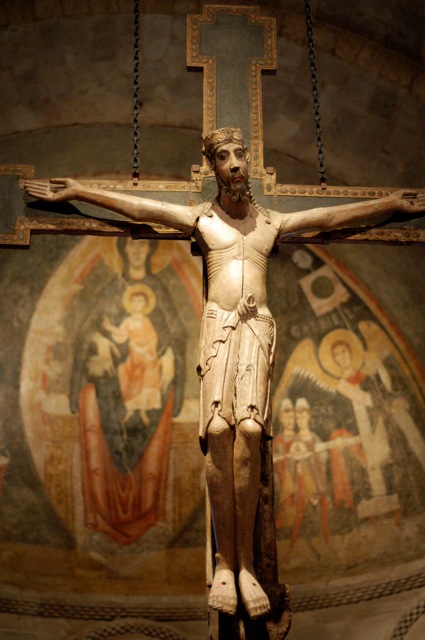
Christ Without a Cross Dies Twice


"For me, kind Jesus, was thine incarnation,
thy mortal sorrow, and thy life's oblation;
thy death of anguish and thy bitter passion.
for my salvation." --Johann Heermann tr. Robert Bridges

I.

Our culture denies death. Our culture denies death's power by saying that it is nothing, only a change. Our culture denies death's sorrow by making of it a celebration. And our culture makes of death's horror a cheap cologne that smells more like bacon than decomposition.

The challenge of Christ's death and resurrection is the greatest gift that the Christian church can give this culture, indeed any culture. But Christ without a cross, especially among his followers, dies two deaths: the actual death, and the death of relevance, for Jesus as just another man who died, another sucker whom the state overpowered, another dupe of the Caesar, no matter how many nice things he did or good things he taught, is doubly dead.

II.

The doctrine of atonement, the idea by which the death of Jesus makes good for the sins of the world, for our sins, is problematic for many to say the least. The idea that this act of Jesus, casting aside his Messianic crown for us, was in fact an act of divine child abuse, God killing God's own son, or the act of a political prisoner alone, seems to me fairly pervasive.

One powerful idea given me in seminary was that instead of a Mel Gibson-style pornographic torture fest, Christ's torture and death on the cross was an interchange of God's justice for our constitutional human injustice, happening through Jesus as through an electrical conduit. More than a felix culpa, a "happy fault," that "allows" God to build something better out of our faults, this interchange is an exchange of all that is just in God for all that is unjust in a creation that goes its own way. We get a better deal.

III.

I'm hardly a heavy-duty theologian, or a student of literature and art and cinema who can quote all of the concepts that I'm referring to here in the history of human achievement. But it seems pretty clear to me that many in the church, uncomfortable as we are with death, might seek to hide Jesus's death behind bunnies, eggs, candy, and parades.

What is an age-appropriate explanation of the crucifixion and resurrection to children? I'm by no means an expert, but talking directly about Jesus dying, and God bringing Jesus back from the dead, seems like it could be very powerful for those whom we often forget about when tragedy happens, because it seems even more difficult to explain it to children, who know something bad when they see, hear, feel, and experience it.

It seems to me that Christ without a cross dies twice, as I said above: his actual death, and the death of his relevance to us as Christians and to our or any culture, time or place. Our culture is not exclusively Christian, but it is one to which we might share a word from this perspective of death and resurrection, and at that a word of hope. Jesus without resurrection is Jesus without hope.

Perhaps we are ashamed because we cannot explain God's place in evil, either the evil of the crucifixion or the evil of natural disaster, war, famine, and other engineered acts of evil that we humans perpetrate on other humans?

Perhaps it is so difficult to believe in the resurrection that it is easier to sugarcoat it than try to explain it to others, much less ourselves and our own people? I can't say I understand the death and resurrection of Jesus all that well, but something in me believes beyond the need to sugarcoat my own impending death with the cross, to use the cross as a means of escape from reality, as must appear to many who do not share this same belief.

A church that sugarcoats the death and resurrection of Jesus with the candy of culture may well be as odious as a believer who uses the cross to deny his or her own death. But as Dietrich Bonhoeffer said famously in Cost of Discipleship:

"As we embark upon discipleship we surrender ourselves to Christ in union with his death--we give over our lives to death. Thus it begins; the cross is not the terrible end to an otherwise godfearing and happy life, but it meets us at the beginning of our communion with Christ. When Christ calls people, he bids them come and die....In fact every command of Jesus is a call to die, with all our affections and lusts. But we do not want to die, and therefore Jesus Christ and his call are necessarily our death as well as our life. The call to discipleship, the baptism in the name of Jesus Christ means both life and death" (Dietrich Bonhoeffer, The Cost of Discipleship, 89-90. New York: Macmillan, 1959, Touchstone ed. 1995).

There is a broader point of forgiveness and mutual burden-bearing to Bonhoeffer's message here, but the necessity of death, and of death in Christ for a Christian, is of central moment.

Any version of Christ that can escape the tomb without the cross is not the Christ. Any version of Christ that gets caught in torture without the work of God in resurrection from the tomb is not the Christ. But my sense is that our human tendency is more to liberate Christ and ourselves through him without taking the hardest steps to and through the cross.

IV.

I wonder if a failure to encounter Jesus in all of his shame on the cross, around the crucifixion, and jumping right to the resurrection, may not be an element of what has chased people away from church by the droves?

Not only has there been a cultural shift since the 1960s that shows a marked decline in the relevance of church in much of American society, but perhaps the church itself has aided in people leaving it through downplaying its own relevance through its core concepts, and through becoming a place of trying to make people feel good about themselves in a way that a gin and tonic could do much better.

As a kid, and as an adult, direct talk has engaged me much more than beating around the bush. I don't want to hear about a Jesus who is merely a glory-machine, triumphing over death without experiencing it. That kind of Jesus doesn't make much difference to me or anyone else.

I want to hear about a Jesus who went all the way, who experienced everything I have experienced, and who came through it in a way that I can know meant a lot to him, not only an insignificant key change in the tune he was whistling, but a whole shift in the reality of what death and our relationship with God means to me and to humanity.

We crucify Christ again by forgetting the cross. We crucify Christ again by forgetting the tomb. We crucify Christ again by forgetting the resurrection. It is only with each of these elements, and by accompanying Christ in these places, and in teaching this to our children, and in insisting on our reality to the wider culture, challenging first its denial of death, that we respect most profoundly the God who has given us Godself in human form, and who has loved us so much that even death can't separate us from God.

Loving Jesus, the tomb awaits, but not yet. Nor your glorious resurrection. Not yet. Keep me for a moment from it, that its power and glitter not overwhelm me. Keep me for a moment with you in death's embrace. Amen.


Tuesday, April 19, 2011

"The Stone that the Builders Rejected"

"The stone that the builders rejected has become the chief cornerstone." --Psalm 118:22

I.

For some reason, I thought this line appeared at some point during the Holy Week readings, but as it is, the only time we who follow the Revised Common Lectionary will be hearing it this year is on Easter.

Yet this phrase informs the whole Holy Week leading up to the crucifixion of Jesus, and particularly what happens through God's raising of Jesus on the third day. The stone, which didn't look like much, which was mis-shapen, mistaken, mis-heard, the stone that rolled the wrong way down the hill, that didn't quite seem to fit the tomb, those stones from which God would raise up children, all these stones were rejected. Those in charge, the builders, didn't happen to think the stones would fit, or that they should properly be included in the plans for such a magnificent building.

Not only did the rejected stone end up being used, but it became the most important stone of all, on which the entire edifice was built. What this edifice is, who the builders were, who the stones were, is all part of the Christian faith tradition, and important questions to wrestle with. But for now, simply, I'm hearing the stone that was rejected, and marveling at how it became a cornerstone.

II.

It's hard not to read myself into this line, and perhaps a bit perilous at the same time. We all experience rejection, and few are probably really spectacularly happy at being rejected. I fear reaching out to people whom I think might reject me, because that has happened plenty. I'm cautious of putting my written work out there in the fear that it might be rejected, which is pretty much what generally happens to written work for which people seek publication. I'm self-conscious about talking about a faith in a loving and graceful God that challenges the view of God and Jesus presented by many who go by the name "Christian," even though sharing that graceful vision of God is more vital now, more life and death, than ever.

The stone has been rejected. Accounted unworthy by those who are supposed to know what is worthy and what isn't. Rightly tossed to the side, and thankfully out of the way.

I would not be the only person who has been at some point rejected, in many ways, not least of which by the church. I have also been accepted in many ways, by many people, and not least of which by the church.

But instead of the rejection stopping the stone, it becomes the cornerstone. It risks everything and comes out ahead. I don't know if I'm that adventuresome, or just wish to hold on to what I have, modest as it might be. The stone could have stayed stuck.

The time comes to risk it all does come, and at that point, rejection cannot be a defining issue.

III.

I've been questioning lately whether that time is coming for me. My job, at which I'm gratefully accepted, will not last forever, and I must find new employment in the next 6 months. Plenty of time not to have that end come as a shock, but I need to get serious about ministry, if that is to become the calling in reality for which I've been called, educated, and sent into a land of limbo. This is not so different from a lot of people who have been affected by the down economy of the last 3 years. To have employment has been a blessing that I am not unaware of.

Many of us, no matter our sexual orientations, have faced this challenge of being rejected in many ways at many times.

I've recently become aware that a lot more people than just myself have been waiting for years for their first calls to become pastors in the ELCA. A number of these people mention how difficult it has been to piece together a life while trying to retain hope that God indeed is back there somewhere, having something to do with this lengthening road that seems not to be leading anywhere.

In times when you still hear that there's a clergy shortage, we would be hard-pressed to understand why, when sitting as rejected stones next to the road. But perhaps we will become the cornerstones of the new buildings, the new ways in which the church will need to be in the time to come?

IV.

Many question, rightly, the place and shape of the church in the years to come. My work church is joining my worship church and another church in a 3-way configuration in which each church will have its own worship space, retain its own identity, and share space. The reason is because each of these churches built their buildings and envisioned their futures with about 90% more people than they have now. The old ways, as the old buildings, are crumbling. New people with new ideas are going to be key in bringing the Gospel to new generations who will not be content just to debate the curtains in the library or whether or not mums should be the flower on the altar Sunday mornings.

What are the words that we stones, whether we've been rejected, included, or are yet becoming, can speak to a church that often seems to stand in stone-deaf silence to the needs of its people?

I was grateful the other day to share an idea for a welcoming church start in an area that has no LGBTQ-publicly welcoming Lutheran churches with the bishop of the local ELCA synod here. He listened patiently, kindly, and said that my idea would be hard to implement. I responded that truth that what would make it a hard proposition is what would make it especially necessary.

Congregations that proclaim their welcome most earnestly, and are often welcoming in many ways, often fall short when it comes to LGBTQ people. That is one reason why there are still only about as many ELCA congregations that are publicly welcoming of LGBTQ people as there were congregations that left the ELCA in order to be particularly unwelcoming or because they felt the ELCA had abandoned its Biblical principles.

What God will make of us stones is yet to be seen. But our church needs us, as it needs every potential leader, ordained or lay, who prayerfully feels compelled to make a difference, because the time for that difference to be made is passing us by.

If we do not wish harsher varieties of Christianity to control the public perception of "Christian" for good, some of us have to start speaking up more, and some of our churches and denominations need to get behind us and figure out how best to use our gifts.

In the meantime, this stone is open to being included, open to listening to other stones that have been or have felt rejected, as well as to pushing his agenda for God's grace and justice onto the builders who need to hear it.

Gracious God of all that we are and all that we can ever be, lift us up to be there for your people who are lost in the night, who wait for you as watchers wait for morning, who feel that you hate them, that your are angry at them, that you wish them destruction, that you are damning them to an eternity of torment for some arbitrary reason. Is this your will, God, that people doubt you because you seem cruel and whimsical? I have a harder time believing that than that you do not exist at all. In whatever way you can, work through each of us to raise up another dear stone who has felt rejected, that we might build up your cathedral of grace on earth as it is in heaven. Through Jesus, the rejected stone who became the chief cornerstone in your plan for reconciliation, we pray. Amen.

Monday, August 23, 2010

ELCA Churchwide: One Year Later, and Still Waiting

Last Friday marked one year since last year's vote at the ELCA Churchwide Assembly on allowing open and partnered gay and lesbian persons to serve officially as pastors, without the fear of being witch-hunted out, put on trial, and defrocked ("derostered").

In reality, not a huge number of people or congregations have left the church, but although the laws of the ELCA have changed, the reality for gay and lesbian pastors, I'm guessing particularly for those awaiting their first calls like myself, is still "in process."

Today, Minnesota Public Radio's News-Q posted a series of reflections on what life is like in the ELCA now, at the One-year mark. It includes a brief piece on me, as I am three-and-a-half years into waiting for my first call, far longer than any of my seminary colleagues.

I will reflect more thoroughly in the next few days, but for now, here is the link to MPR's story. Each segment is worth a look: http://minnesota.publicradio.org/projects/2010/08/church-divided/new-welcome.shtml

Tuesday, January 20, 2009

Odetta & Loretta: In Loving Memory on a Day of Joy


I.

My life has been deeply affected and shaped by many, many people, but most deeply by several Black women. Most are living, but some are gone from this vale of tears. And all I can sense are standing up and cheering this day for our new President, who will lead in a new era in race relations, and help to define a love that we can share as human beings of all races that takes into account the past, and shapes a future of the Beloved Community that past generations, and even our own today, could only have hoped for.

One passed 7 weeks ago, on Tuesday, December 2nd, 2008. Another in 2007, on the 24th of September. Both I wish could have lived to see this day, and are, I believe, watching from the place of their eternal reward.

One was one of the dearest people in my life, whom I never visited or telephoned enough, but who was always full of love for me and most everyone in her life. Another I did not know personally, and only met once in my life, but has given my soul a dimension of deep and loving experience as well.

One was famous and known throughout the world, traveling all over and affecting thousands and perhaps millions of lives. Another was known well to her friends and family, to her neighbors, to all whom her outgoing and dear personality endeared he; she was born, lived, and died in Harlem.

Both were women whose strength and souls were shaped by Jesus.

Both were women whose love was evident from most every word that I ever heard from them.

Both were women whose wisdom came through experiences I could never know or understand. But, in their own ways, each welcomed me into their lives in a way that I cannot repay but with gratitude and story.

One was Odetta Felious Holmes Gordon. One was Loretta Hernton. Odetta and Loretta.

II.

Loretta Hernton was born in Harlem Hospital on March 2, 1936. She grew up in Harlem, and was a memeber of Walker Memorial Baptist Church in the Bronx, which she joined in 1947. She worked and lived in Harlem her whole life. And she died at the Jewish Home and Hospital, only 30 blocks from where she was born, on September 24, 2007, at the age of 71.

I met her when I was filling in as protestant worship service leader at the Fort Tryon Nursing Home for a period of months before entering seminary in 2002. After one service, she had asked me if I might share with her one of the hymns we had sung during the service. When I came by her room at the Home to bring the hymn, she was in the process of being discharged. Brother Evans and Brother Russell had come by from the Prayer Team of Walker Memorial Baptist Church in the Bronx, where Loretta had become a member in 1947. But had I come by an hour later, I would have missed her altogether, and my life would have been much poorer.

Loretta loved. That is the only way I can say it. Every time I visited her, she would ask after my mother, my father, my sister, and my grandma. She would tell me whom she had been in touch with of our mutual acquaintance, from her roommate at Ft. Tryon, to Brothers Evans and Russell, to her sweetheart whom she’d met at Ft. Tryon, to aged Mr. Davis, who was, I believe, registrar at City University of New York many years ago, and a man who had followed FDR’s funeral train as a young man, after having been discharged from a recently integrated army unit.

III.

Odetta Felious Holmes was born on what would become my own birthday, December 31st, 1930. Although I’m a fan, I don’t know her life verbatim, and would commend you to the grand wisdom of the internet to learn about her. But this is what I know about her.

I know that she sang from an amazing heart that took in everything from segregation and true oppression, nearly to the heights of this inaugural day. This was to be part of the arc of her life.

I say that Odetta’s voice had the power to wound and heal simultaneously. The wounding was not one which she was inflicting, but one which she was uncovering. It was a moment of honesty that she could bring out through the sounds that her own body made, but were sung through years of silent tears.

Thanks by to God and Andy L., I got to see, hear, and meet Odetta once in my life, last April, when she came to sing with Pete Seeger and a group of wonderful 4th graders in Beacon, NY. It is an experience I will never forget, hearing her live and in person. Most moving were the songs “Something Inside So Strong” (“I know I can make it, but you’re doing me wrong, so wrong”), sung to challenge the society of apartheid in South Africa, and “Any Way You Can Make it, Baby” (“You gotta keep on movin' it on. If you can’t run, walk! If you can’t walk, crawl! If you can’t crawl, roll! Any old way you can make it baby, you gotta keep on movin it on.”).

I’m trying to think of the way to describe those places in Odetta’s voice that only she could make, those spaces in which you could meet her and generations of those who shaped her physical structure that could bring her to us, and those who for better or worse, made her who she was.

She had mansions in her body’s temple, and mansions in her soul. She had a place where you could enter and just sit and be.

She had spaces in her voice that would wrap you in velvet, and spaces that would wrap you in a bush of prickly cotton.

She could, in a breath, bring you into a space of discomfort that she has faced in her own life, and lay on the salve that God gave her and gave to us through her.

Odetta had long, thin fingers, and her frailty was stronger than my strength. She wished me all the best, and I will carry her benediction with me my whole life long.

IV.

Odetta and especially Loretta have been present in my silent tears since Barack Hussein Obama was elected and now has assumed the high office of President of the United States. They both came so close to seeing this day. Loretta would have been smiling and shouting, so happy in her bed, sending out a loud HALLELUIA! when he finally ascended to the high office of President of the United States.

They would be so proud, and I with them, holding the hands of their spirit and the spirits of those who have given their lives, both literally and metaphorically, to see this day arrive.
The words of the Sacred Harp tradition have also been nourishing to my soul, and I wish to let them join together the past and the present times in a song of joy:

Text by Charles Wesley:

O what are all my sufferings here,
If, Lord, Thou count me meet
With that enraptured host to appear,
And worship at Thy feet!
Give joy or grief, give ease or pain,
Take life or friends away,
But let me find them all again
In that eternal day.

AND I’LL SING HALLELUJAH!
AND YOU’LL SING HALLELUJAH!
AND WE’LL ALL SING HALLELUJAH!
WHEN WE ARRIVE AT HOME!

May this land of America once again be ALL our home, and a home in the world for the homeless, placeless, nameless who burn with the passion of self-definition and other-regarding love.

May this home be from here into eternity, that for which all being has longed, a place of dignity, a place of prosperity for the hungry, and poverty for the rich.

May this home be one of grace for all, enmity toward none, and a home where even in our hardest times is one of perpetual HALLELUIA!

Sunday, January 18, 2009

This Land is Your Land! This Land is My Land!

I.

"A voice was chanting,
As the fog was lifting,
This land was made for you and me."
--Woody Guthrie

I am listening in tears as Pete Seeger and Bruce Springsteen sing "This Land is Your Land." Seeger's nearly 90-year-old voice speaking out the wonderful words of Woody Guthrie's old song, and YES! This land is my land! This land is your land! Woody is present in song at Obama's inauguration. Odetta is here in great spirit. Would that her voice, that had the power to would and heal simultaneously, be cascading down upon the crowd in this very moment.

We are getting our country back, to give back to the world. That is the whole liberation that we have found in sending Dick Cheney and George Bush away. No more will that lip of Cheney curl in a strange mixture of disdain and frustration that he's not getting just what he wants when he wants it.

No more will we have to choose between cheering on George Bush against his many critics, and booing, laughing at, or generally deriding a man who seems not to have quite left the frat house on a squalid Sunday morning with a pile of stale beer-puke as his only pillow on a cold, hard floor, only to wake up in these circumstances as the most powerful man in the world.

We can both give thanks that there have been no more 9-11s, no bombs in the subways of New York, no planes crashing into the White House or Capitol building, but also regret that America has been greatly diminished in her power and grandeur, in her ability to broker peace and support nations in need, diminished in being a voice of tolerance and acceptance rather than high-handed moralism of a very certain and narrow stamp.

I find myself thoroughly ready to give Cheney the gentleman's boot out the front door and not mourning him landing on his foie-gras-padded ass bought with the blood of American servicemen and -women as well as tens of thousands of Iraqis, and yet not able to do anything but pity Bush, who, beyond his Ivy League-saturated anti-intellectualism, had some really good ideas that got lost in the shuffle of putting our Constitution to bed for a long midnight's nap.

But the dawn is now breaking above the fruited plain.

For eight long years, this land has been their land.

But now, "This Land is Your Land; This Land is My Land." There is a grandeur in these United States that is both dangerous to behold, and empowering to our own country and to the whole world.

II.

"America! America!
God mend thine ev'ry flaw,
Confirm thy soul in self-control,
Thy liberty in law."
--Katherine Lee Bates

This grand old nation could use a return to self-control and liberty through the law that was this country’s birthright, but has been flouted for seven years in the name of national security.

Self-control is both something we have lacked as a society, and also as individuals. If you can’t afford the mortgage, don’t buy the house, no matter how much you want your own home. Rent, for God’s sake. It’s not so bad. I've done it for years. If you can’t afford those SUV or car payments, buy something a little less expensive, or, God forbid, use public transportation if you can. If you can’t afford the flat-screen HDTV that is as big as the side of a barn, and costs as much as a herd of cattle, for goodness sakes don’t blow $5000 + on it—just get something within your means! Of course, there are health emergencies that could wipe out one's savings in the blink of an eye, no matter how hard one tries to save.
Italic
It’s easy to say, and not as easy to do. But with big daddy in the White House doing whatever the h-e-double hockey sticks he wanted, it seemed fitting that we should as well.

But now, America, this land is your land once again. And you’ve got some payments to make on it.

III.

"O beautiful for heroes prov'd
In liberating strife,
Who more than self their country loved,
And mercy more than life."

Many have given their lives in down payment out of love for their country. I am a mere armchair citizen, but they are those who go out when the rubber hits the road.

You know, I would like to serve in the armed forces as a chaplain, but it is not allowed under the current “Don’t ask, don’t tell” policies. I’m not one to not ask, nor not tell. This land may be my land, but it’s yet to fully embrace me.

Barack Obama may help us get to that promised land of full participation in this land that puts the realities of life, liberty, and the pursuit of happiness as bedrock rather than mountaintop experiences. But he can’t do it all by himself.

IV.

"This land was made for you and me."

And you know, dammit, the man is right. This land is not just George Bush’s, Dick Cheney’s, Rick Warren’s, Gene Robinson’s, Barack Obama’s, Caroline Kennedy’s, Bill Gates’s, not just the land of those who have large bank accounts and vast connections and high name recognition, who are inheritors of great legacies or forgers of their own legacies, damn the torpedoes.

This land is the land of a lot more people. The “you” may indeed have much more potential breadth than we’ve ever felt possible. And the “me,” notice how it is preceded by “and,” and comes second, not first, may too be much larger than just each of our individual selves.

The coming of Obama is not the coming of a savior, but the turning of a page in a long book whose last chapter has yet to be written. Hope comes in many ways.

We have taken some, perhaps well-deserved, licks. We have not lived up to the potential that this society has always kept as a problematic possibility, rather than a crystal-clear reality. We have, in the words of a rather harsh New Zealand Episcopalian liturgy, “violated your creation, abused one another, and rejected your love,” but instead of doing this towards God per se, we have done it to the rest of the world as well as ourselves.

But there is a new chance not to do that quite as much as we have. There is a new possibility to take some of the God-shed grace from one end of this beautiful country to the other, and from one end of this needful world to another.

May the fog lift from this land, and may the hungry for food, freedom, and equality, be well fed. May this land truly be yours and mine, and may we give it as a gift of great price to those yet to come who will share our dreams and ideals.

Wednesday, November 26, 2008

Blast Some God-forsaken Closets

"If a bullet should enter my brain, let that bullet destroy every closet door."

--Harvey Milk

I.

Prophetic words only become so when experience proves them. Sometimes that experience comes soon, and sometimes it takes lifetimes, deathtimes, and a lot of mundanity and action in between.

Tonight, Gus Van Sant's biopic of Harvey Milk premiered across much of the nation, including at the art deco landmark theater, the Uptown, which is 3 blocks from where I live in Minneapolis. It's a fabulous movie, and I hope it wins wide crossover support, like Milk himself did. Go see it if you can!

But it reminds me that there's been a movement for equal gay rights for many, many years now. It is growing closer to winning certain inalienable rights, those rights which cannot be "alienated, surrendered, or transferred," according to the Merriam-Webster Dictionary.

Alienated. A word that stands alone to describe the condition of a human being without community, whose community has been taken away, or has cast her out.

Human beings are alienated when their rights are abbreviated, rescinded, withheld, or just plain laughed at, particularly when these rights are supposedly inalienable.

One might say there's a big difference between rights being surrendered and rescinded, voted down, taken away, trampled on by the big wheels of popularity. Since when are rights open to a popular vote?

Prop 8 passed. Prop 6 was defeated *thirty (30) years ago*. What's wrong with this picture? The same tactics were used then as now, only then they didn't work. Why now?

II.

Milk's words were prophetic. He was assassinated. And yet the bullet did not shatter all closet doors.

It was in carefully-crafted closets that Prop 8 developed its power, because the authentic voices of faithful gay and lesbian people that opposed it were too few, unheard, or just plain silenced.

"Milk" helped to make the point that the "leaders" of the movement at the time considered Milk's unabashed faggotry too much, too out, too embarrassing and provocative to change minds and win people over. They were wrong, and 30 years later, they are forgotten. What about the people who are our leaders today? Who even are they? And where are they in the church? God’s forsaken some closet doors, so let’s hear about it.

My church, the Evangelical Lutheran Church in America, supposedly prides itself on inclusivity and living the words of Christ, but instead supports closets more than it supports gay and lesbian people living openly, unafraid, and completely mundane lives.

It was these closets that helped pass Prop 8.

Church closets passed Prop 8. And I don't mean closets where the communion plates and candles are kept, the choir robes and the acolytes' torches, the stale wafers and banners, the vestments and other finery that helps make church what church is to people, no matter their traditions.

I mean those closets that "well-meaning" persons of power and privilege throughout the church put their pastors in in order to "not disturb the waters."

I mean those closets that bishops put their pastors into when they make them choose between being pastors or being people.

I mean those closets that suffocate the very people who wish to serve Jesus and his people, who love their people and would lay down their lives for them, but who are given the command by their church to sacrifice their humanity instead of their lives, to bury themselves in their service, and to make themselves less than 3/5 human.

III.

Church closets passed Prop 8, because without the enforced silence of great numbers of gay and lesbian people of faith, the lie would stand revealed, and this is the lie used against us: that we are out *en masse* to harm children and families, that we hate God, and that our families and relationships are not of equal worth. Once this lie is shot to the ground as it should be, the case against full, equal civil rights for gay and lesbian people would fall to the floor and only a handful of people would vote against equality for us and our families.

It is clear that we need a voice around which to unite, like Harvey Milk’s. Such voices exist, and some of them are calling out with similar words of anger, hope, and kindness. Milk said, "You gotta give 'em hope," and he was right.

Hope comes from realistically dealing with anger, meeting it with love, and directing loving anger into constructive paths of action.

Anger can drive hope in a way that nothing else can. Because anger points out the space between the words that elevate and the actions that denigrate.

Anger can drive hope 12 blocks down Market Street to City Hall and blow open closet doors without bullets. It can fill those 12 blocks with thousands and thousands of people to grieve and remember when bullets are brought to bear. And it can turn apathetic hearts to action that makes certain dignity doesn't go down without a great fight.

IV.

It almost seems like movements are most effective when they are small but well-organized, when a thousand people can be called together in fifteen minutes (as was said in “Milk” the movie), when the soapbox is just a foot off the street.

So what is our organization to be? What our voices? And what is impeding them? How can we organize to blast those closet doors off and find the liberation that just about any of us can struggle to achieve, hope that a boring financial worker can transform into a brilliant political career, and hope that any couple may have the same mundane respect for their relationship as any other couple?

What shape will this movement take, that will give hope to millions of gay and lesbian people who are still told that their relationships, that their lives together and their individual lives, are at best second-class, and at worst worth destroying?

That hope is out there, and it lies in the prophetic future that will prove the dreams of thousands of people and hundreds of years, to be free, to live in a state of basic, human respect, in which you don't have to choose between your work and your husband, your calling and your family, your integrity and your willingness to make this world a better place.

You gotta give 'em hope. You gotta love your people, too. Let's do it. Tell me your ideas for this movement, for finding voices, for channeling loving anger, for acting in ways that are not just a blip on the nightly news, but change hearts and minds, and finally, change laws.