Showing posts with label reflection. Show all posts

Thursday, November 8, 2012

Full Circle, with Tears and Joy

"By and by, when the morning comes,
When the Saints of God are gathered home,
We'll tell the story of how we've overcome,
and we'll understand it better by and by."


I began this blog 4 years ago, in the aftermath of the passage of Prop 8 in California, when the country took a turn towards equality in its election of Barack Obama as our president, while some of our states took a sharp turn away.

On Tuesday, my home state of Minnesota took a turn towards equality when we voted down a similar amendment to our constitution by a margin of 52-48%, the first time any state in the union overturned an effort to dehumanize LGBT people in its state constitution. We shouted and laughed and wept tears of joy.

But underneath it all, for me at least and I think for many others, were another kind of tears. These are tears for those who didn't make it to see this day, who died of AIDS and suicide, those young people who didn't make it to see their high school graduations like Justin Aaberg, whose death pierced my heart as it pierced the hearts of many. The following is my reflection on this experience:

TEARS. 

What I hear and feel most deeply around the defeat of the anti-gay marriage amendment in Minnesota is how deep it has hit so many of us in our souls, and how that power has come out of our eyes through those gentle drops of soul-rain. 

Having to prove one's humanity again, and again, and again to those who deny it is not only tiring, not only demeaning, not only frustrating. It is also deeply sad. It is sad for me and it is sad for those who cannot be moved, whose binders and blinders are so thick that they cannot see what is in front of them: LOVE. 

And that makes me sob like a baby.

And I think, man, I've been at this for 25 years, what about those who have hit this soul-draining homophobia for 35, 45, 55, 65, 75 years, those who died who never had a moment like we had on Tuesday night/Wednesday morning when this cursed proposed amendment took a header down the stairs of history?

What about those who deal with multiple stigma being put on them from the outside of their beautiful bodies and souls that grows inside them like a mold that grows out of control, about those throughout the world who do not have time to worry about their sexual orientation oppression because that is too much of a first-world problem, about those who have scarce dared to tell another soul what is most on their heart? 

What about those who suffered in silence or out loud, those young people who were made to feel like villains for being who they were, who were physically, spiritually, and sexually abused, who took their lives rather than living another day in a world that they felt could do nothing but hate them?

And then I see them: The Saints of God.

Those who are streaming in from all times and from all places, who have been washed in the tears that Jesus has for those who have undergone torment not only *in* his name, but *under* his name. Those whose faith has been kicked down the stairs along with their bodies, spirits, and souls, all the while those who are doing the kicking are repeating: JESUS, JESUS, JESUS, seized with anger or laughter or just plain blank-slate horror in the name of the Lord.

And the Saints stream in from all times and from all places, singing in the name of LOVE. 

And they know. 

They understand. 

They in glory shine. 

They have seen what there is to see. 

And they have overcome.

By and by, when the morning comes. When the saints of God are gathered home. We'll tell the stories of how we've overcome. And we'll understand it better by and by. 


"Festival of Lights," © 2000 John August Swanson


Wednesday, February 22, 2012

We are All Made of Stars--a Reflection for Ash Wednesday


I.

A report came to me on the way home from Ash Wednesday service at St. Mark’s Episcopal Cathedral in Minneapolis about another two journalists being killed while reporting from Syria about the brutal crackdown of President Assad.  In some ways, it was hard to tell at first that they were talking about one of these reporters’ deaths, because they were saying how funny she was, how caring and full of life.  

But you knew what they were saying.  Marie Colvin was dead, killed in the line of her duty, while being a witness of violence against one’s own people in a part of the world that has seen much violence.  As one mentioned, she was covering this story, and had now become part of it.  

“You are dust, and to dust you shall return.”

Marie Colvin was not dust yesterday.  At least nobody would have said so.  

Today, hearing these words, “you are dust,” sounds demeaning, diminishing, depressing, and final.  But I am here to hear them said, and here to pronounce them:  Child of God, whether or not you believe in God, however you believe or not, you are dust, and to dust you shall return.

Some days, it is true, I do not feel much above the level of dust.  I don’t know what I am doing, where I am going, how I will bring my life to amount to much more than a pile of dust when it is all said and done.  

Sometimes, it seems like all my dreams are but dust, all my accomplishments, dust to the wind, all my caring for others, dust to brush off one’s sandals.

Sometimes, dusty roads are the only ones that seem to lie ahead.

The problem with that is--whenever you try to hold on too tight to a handful of dust, it breaks free and takes to the wind.  Dust calls to dust at the thunder of dustbowl storms, and all the dust has gone over us.  

Because we are all made of stars.

II.


My ancestors fascinate me, because they are now dust, and yet they blipped across the screen of the world for some great moments.  I have images of some of them, back about 130 years at most.  

These ancestors were made of stardust, and part of my image of them is that once again, their souls returned back to the stars, to the structure of space that is all in God.  My dust comes from them, and theirs comes down a path that extends billions of years into the past.  And the past extends to the maker of what is, was, and is to come.

Pages on which information about my ancestors is written crumble, as do their pictures.  People who do not value these things throw these pictures away, and the ground or a fire claims them.  They were somewhere, and now, like my ancestors themselves, many of these mementos of them are also dust.  

In some time, objects and humans come to resemble each other.  But although we are made of stars, we’re made of more than makes up our things, mementos, pictures, records of our existence.  

We are also made of memory, and possibility, made of hydrated dust, but also of the starlight of life that shines from God through the prisms of our bodies, and into the future. 

III.


The message of Ash Wednesday, which pronounces such harsh words, also calls us to release our tight grip over the dust of our lives, and not to worry so much about where we will go when we return to dust, because all of that dust is in God.  

“People they come together, people they fall apart...”

Moby’s song “We Are All Made of Stars” says it all.  

Christians turn again to the face of God explicitly on Ash Wednesday, but each of us must to daily, hourly, practically by the nanosecond, given our instinctive need to turn away from God, to run right straight into the sun, and experience all of the separation and desolation that our desperate hearts can give us.  

But those hearts are made for loving as well; they are filled with the water of oceans as well as the dust of stars.  God would not give us lives to live if all they were is dust.  We would have stayed in the stars.  

Today is another day to live, to struggle with continuing to live in the face of trying conditions, to mourn those who are not living, to anticipate the day when we and our loved ones will not live, and yet, to live with all of the strength in us that fights to keep the flame of life alive, set ablaze by the spark of God's love.   

Blessed friends, we are all made of stars.  Let your star shine with the internal light of love given you before the ages began, and the eternal light of the one who made this universe and everything in it.        

Saturday, May 7, 2011

15 for 15 VI: The First Time, or I'm Finally Out!


The day had to come.

Earlier that day, I was agonizing, as I did every day, over the guy I was in love with but didn't, or couldn't, tell.  When he told me that he was in love with another guy, I told him how I felt about him, and there it was.

Out.

Finally.

I.

But the one to whom I am out and whom I love loves another.  I want to laugh and cry and vomit.
                                                                                                    --May 6, 1996

Those were the hardest years of my life, so far, both preceding and following that statement.

Since that time, I've come to think that emotional puberty, which happens around age 20, is harder than physical puberty.  I went into a cocoon, psychologically, and to some degree physically as well.

Like many young men of that age, I grew out my hair, on my face as well as on my head.  I actually had hair to grow out back then.

Along with this growth of hair around me, I continued growing barriers around myself psychologically to keep people out.  I became so good at it, that by age 21, I could say that I hadn't kept any friends consistently since I was a kid, and although I made friends in college, it would be some time before I worked on those friendships at all.  Mostly, I was insecure, overly-competitive, and didn't want anyone to know I was gay.

It all ended that night.

II.


My view of the world has changed so drastically, I can't.  This is the night I have been waiting for for so long...


I knew after that night that something more than my sexuality had come out.  I had come out, started to destroy the cocoon of secrecy that I'd built around myself with hundreds or thousands of "saves," putting my mind to work several moves ahead of where a conversation might be going so that I would not have to answer certain questions or lie.

The piano had been my adolescent lover, and the eccentric pianist Glenn Gould had been my "virtual" lover, long before the idea of virtual had come to my mind.  I was safely hidden behind an intellectual exterior in which I could be busy thinking about things, or practicing the piano.  I became enveloped in the works of Ayn Rand, who, from her physical and emotional grave, egged me on to be different and alone.  Being an individual was the most important thing to me, so much so that when I went to college, I wanted to do an "individualized major," which at the time was kooky, although has caught on since.

Through all of the nights that I had gone to sleep for 10 years wondering if I was hopelessly lost, or if I was "the only one," I knew in those moments, on that night 15 years ago, that I was never going to be the only one again.

The first time I came out was like returning from a long, lonely exile in a foreign land, whose customs I sort of knew, and whose language I spoke with great difficulty because I kept tripping over the words, but whose food I didn't enjoy, and whose oppressive culture I could not wait to escape.

This feeling of exile, of not being welcomed in your homeland, is perhaps common to a lot of people for a lot of reasons.  People can challenge this feeling only in the company of those who are "like" them, or perhaps in books, movies, other media, or characters of their own making.  But it's not the same as connecting in person, with real, live people whom you know are enough like you so that you don't have to mouth a barely familiar language that everyone else seems to know fluently.

My whole perspective on the world changed, because that night I no longer had to think in terms of dynamic equivalence, translating the lives of others, and particularly the loves of others, into something that made sense to me in my own mind and deeply felt experience.   My world changed that night because it finally became my world.

III.


I'm so confused and elated and nervous and sick and ecstatic.  Sleep seems light years away.

A million feelings went through my mind and heart all at once, so powerful that I felt like I was going to go insane or literally explode, internally combust, go up in the flames of gay fabulosity before I knew what those even could be.

I felt, in that moment, that I had crossed over a threshold of experience that I thought I would never cross, and entered a world I could only sense existed, but had been there all the time.  And what I wanted felt further out of reach than ever, because my feelings were not returned.

Feelings are a funny thing--substantial, but not quantifiable; ephemeral, but lasting; they are the ultimate paradox.

And feelings seem to give us permission to act in any way that we wish.  I did that, and was not proud of how my feelings affected the object of those feelings.  Objectifying another, especially one about whom we feel strongly, seems impossible to avoid, but in the cold light of long reflection, I would have acted quite differently.  At that time, though, I simply could not.  One learns not to repeat certain mistakes, even though some of those mistakes seem to fall into a pattern of action that, no matter how many times one tries to reason his or her way out of them, seems to keep coming back the same way.  It is almost like an addiction, and the effects can perhaps be just as harmful.

Still, I came to value those feelings only by finally experiencing them, and putting them out there in the world.  If they are returned, that is somehow a bonus, but there is no way in which one can or should force another person to feel what one does not feel.

Being forced into feeling what one does not feel is precisely the aim of the closet.  It is not only a place of privacy and safety, but it is a place that often compels people to feel that that is the only place in which they can be safe.  And that is not right.

IV.

Many first times have come since that one those many years ago:  first lovers, first boyfriends, first poems, first culinary delights, first times being without a home, being on my own and unsure of what to do next, first trips to Europe and Africa, first times walking the streets of Paris and New York and San Francisco, dreamlike places that I never thought I'd be, but that have come to define my personality and my life in ways similar to this lived sexual orientation.

First times are indeed very special, even if they aren't anything special in and of themselves.  I remember the first time I changed a headlight on a car, the feeling of accomplishment that I had, and the feeling of empowerment.  First times can, but do not always, empower us to try for higher levels of experience, and  make us realize that what never seemed possible actually is something we just haven't tried yet.  Of course, that doesn't go for everything.  Like eating liver.

Tonight, I celebrated these many years of being out, and all the gifts and challenges that have come with it, at the lovely Nicollet Island Inn restaurant in Minneapolis.  Here was one of the fabulous courses with which my table was adorned:

The colors, the flavors!  This was living.  And this is what life can be like:  a colorful, delicious feast.

For we are called to the great feast, to the Gospel feast, to the feast of honesty and integrity that adds all of the flavor to life.  Facing one's areas of pain and struggle honestly, and for a long time, can yield much greater treasures that can be bought and paid for with money.

And you are always welcome at my feast.

Friday, May 6, 2011

15-for-15 V: Who I Am, or Identity, Equality, and Value

I know who I am.  More or less.

I.

It's easy to say that sexuality is just a small part of our lives, that it's not "who we are."  It's also easy to say that sexuality is our entire life, that it's all we are.

When I say that I am gay, and thereby oppose the words that headline the first entry in this series, I equate myself with my sexual orientation, I own that part of myself, and I use it to define myself.  I am Chris, but saying that is not quite the same way of defining self, because "Chris" doesn't have a definition in itself.

Saying "I am cold," similarly, describes a passing state or feeling.  "I am rich," or "I am poor," too, might get at something true for a while, which shapes who we are and how we are, but these descriptors are not necessarily identity characteristics.  Our "net worth" does not come in how much money we have in the bank the day before the stock market crashes and wipes out our assets.

Yet people debate the extent to which sexuality is a passing phase, essential to our beings or a choice, or a product of our doing.

I think that sexuality is a very big part of our lives, because it affects how we relate to ourselves, others, our society, religions, and to every huge factor in our lives.  Sexuality goes far beyond those with whom one has sex, far beyond one's private domain, and indeed beyond one's "personal preferences" or "lifestyle choice."  The term "lifestyle choice," in fact, has always been both nebulous and insulting, highlighting an ornamental, act-based idea of sexuality that somehow people might chose out of boredom with the "normal" way of life.  It doesn't get at such a large part of what I think is connoted by the term "sexual identity"--the source of one's passions.

What "turns you on"?  What "floats your boat"?  What gets your blood pumping, and what paints your sky? What brings a flush to your cheek, or a spring to your step? Sexuality is in our blood, and blood is thicker than water. The sinoatrial node might physically produce the electrical force behind the beating of our hearts, but sexuality is the metaphoric animating principle behind that and every aspect of our creative lives.

Sexuality goes a long way beyond T & A.  (Especially if you're gay.)

II.  Defined by Difference?  Enlivened by Equality?

Being different gives a person the opportunity to spend a lot of time thinking about things that people who are not different probably don't think much about.  Some might take exception with my use of the term "different."  But when you're defined in ways that lead to a different set of rules for how you can live your life, you're different.

Difference, in the case of sexual identity, means that you do not necessarily follow the life patterns and roles that are set in place for you when you're born.  The consequence of that difference is that society sets out for you the same expectations, but a different set of rules.

I'll be the first to own that sometimes those of us with this difference of sexuality, or any difference, spend too much time thinking and talking about it, and not enough time living it.  That is because justice has not yet come for many of us, and because our siblings in difference around the world and on our own shores are still being mocked, beaten, assaulted, shamed into self-hatred and worse, and indeed put to violent death.  We think about this difference because our world won't let us forget.

In thinking about this difference, we often talk about "equality."  Frankly, the more I think of it, the more insulting the idea of asking for "equality" is.


It is insulting to argue for equality, because we are equal, and we don't ask anyone else to be equal to us. I would never look at someone and say, "Prove that you are equal to me."  People who don't realize that LGBT people are fully equal in our humanity and our relationships are fully equal in their legitimacy will not do so because we say they are.  

We spend so much time defending, and that leaves less time actually to live.

My leap came when I realized the value of my own feelings, at least to myself, not that they were equal, but that they were valuable.

III.

Sexuality is a value.  And one person's sexuality is no more a value than another's.

Sexuality is a value in what it does to enliven and paint the skies of our lives.  It is also a value in how it challenges and points out our brokenness.  Everyone has a broken aspect to their sexuality.  This is one of the chief reasons why same-sex attraction scares people--because thinking of it as an attraction that is fully broken, wrong, diseased, or criminal, gives people who think like that a way to avoid confronting their own brokenness.

It's hard to name all of the discrete experiences of our lives that name our sexuality in one way or another.  Holding hands in the movie show, as one old song put it, is something that people without a difference would not think twice about doing, and might indeed take pleasure and gain social status by being seen "together."

One can name one's sexuality in any number of subtle ways, in a look or a few carefully placed words, in whose names one mentions casually in conversation, in pictures that adorn one's public spaces, or in the stories that we tell about important experiences in our lives that involve other people.

People who cannot be public about their sexuality find any number of ways to avoid it becoming known.  My most potent memory from my high school years involved sitting in the library on a study break with some guys who began talking about how a girl was admiring another guy's ass.  I interjected, without realizing that I was in danger of totally outing myself to some of the not nicer people:  "Oh, she could do better."  Snap!

This comment did not escape their attention.  One shot back with a look on his face that I've seen a couple of other times, in dangerous situations where they see the gay within you and don't like what they see. The words exploded, "Oh yeah??  Who??!"

A breathless moment passed.  It seemed like they had gotten me, and that all I had feared would now come to pass.

From out of nowhere, the word came into my head and out my mouth with as little thought as I had given when I initiated this crisis just seconds ago:

"Me."

And with that, they laughed their asses off, and I breathed an internal sigh of release.  Way too close for comfort.

That's such an innocuous experience, and yet given the context of being forced to avoid saying any little thing that might "tip them off," I had just dodged what I feared would be metaphoric and literal bullets.

Just imagine all of the experiences, in all of the years, that all of those who do not want to be "found out" go through, and the weight that puts on one's shoulders.

Every experience that one might have to pass through in order to stay in the closet is an experience in which sexuality makes itself known outwardly in our lives.

Who I am, who you are, is partially defined by the weight we carry, what we do with it, and what we let it do to us.

But we are also defined by what lifts us.

And someday, hopefully within my lifetime, the widest part of our society will support the enlivening force that takes us through each day, that connects with the Holy Spirit and taps us into God, that is our muse for writing, singing, and creating beautiful things, the enlivening force that makes our relationships live, and our words take flight, that sends our rockets to the farthest reaches of physical space, and gives us the energy to dream a better world, while living with greater fulfillment in the one we have.

Who will we be then?

Tuesday, May 3, 2011

15-for-15 IV: Gaining My Religion

"God hasn't brought you this far just to let you go now."
                                               --Loretta Hernton

I.

Somehow, I got dragged back into church after foreswearing it for Aristotle.

It was going to be so neat and tidy:  Let God be whatever God was supposed to be, which I supposed wasn't much, pray when I really needed something somehow expecting that would work, and stay in my rational mind as well as I possibly could.  That was my "lifestyle choice" for a good long time.  Looking back now, I mouthed the words of atheism, but my heart wasn't in it.  It was like me trying to be heterosexual.

This is not to say that atheists, agnostics, humanists, and persons of dozens, if not hundreds, of world religions do not have a heart, and, indeed more of a heart than I.  But I could never have come to the religious belief I have without being openly gay.  Indeed, some of the most "Christian" people I know, and some of the better theologians, are atheists, and some of the beastliest things I've seen and heard have been done in the name of Jesus.

I've always been a doubter and a sceptic when it comes to faith.  Indeed, faith without doubt is like pig iron; it is brittle, and breaks at the least trial.  Doubt to faith is like the carbon that turns iron into steel, making it strong and pliable enough to shift without easily falling down.

II,

In college, I never felt like the church was any place for me to be.  After I left home, I left the church as well, as many young people do, except to earn some money playing organ or piano for services here and there.

My family attended a Methodist church quite faithfully, each Sunday, so it was a part of my upbringing.  In fact, I've not lived a day without being baptized, as I was baptized the very day I was born.  It was a lifestyle choice, yes, first made by my parents, and then myself.  But I never wanted to be a part of the "Christians" that I saw at college, because I knew that their company was no place for the likes of me.  But "my religion" has become far more than a casual choice or accident of birth.

Strangely enough, in coming to understand the part of myself that had to come out of the closet, especially in the context of what really mattered in my life and in the universe from my vantage point, I couldn't escape the many elements that had affected my life through religion.  Yet, even though I am certain I never went to a church service in which the pastor or priest said that homosexuals were going to hell, somehow I got that message through the air, or the airwaves, because enough other people were saying it:  God condemns gays.  I know that to be a lie, in some cases very carefully manufactured for maximal political effect, but it was a lie that helped keep me in the closet.

My first summer in New York, where I have lived 5 years of my adult life, I recall a subway evangelist (there were many) approach me on the uptown platform of the A train at 42nd Street.  He said to me, "Do you have Jesus?"  I answered, and can still clearly see and feel what I felt when I said it, "I already know I'm going to hell."

That frame of mind, however, is not where I would stay.

III.

As someone who went through seminary, I learned how to tell my "faith journey" while standing on one leg, like Ayn Rand claimed she could do and recite her whole philosophy (which I'm sure she could).  And not only did I go to one seminary,  but two:  Yale Divinity School/Institute of Sacred Music for my "Masters of Divinity," a title to this day that makes me laugh with images of donning leather and picking up a whip to recite the Word of the Lord, and Pacific Lutheran Theological Seminary, which granted me a CATS, a Certificate of Advanced Theological Studies, which sounds like something between a pet and a medical procedure.   Altogether, I became a Master of Divine Cats who could whip out a faith journey narrative like last-minute pancakes for unannounced company.

My path was somewhat untraditional, lacking a particular influential mentor, but common as well to others who went to seminary.  I was raised in the church, left the church, left God, found out that I hadn't left God, got peppered with dreams and "coincidences" that forced me to think about God, as well as felt an increasing desire to know more about religion, to experience more, to become a pastor, at which I would have laughed when I was in college, and, after a time, to go to seminary.

I first came back to the church in Harlem, at the Convent Avenue Baptist Church on the corner of 145th and Convent Avenue.  There was a big pink cross up in front, and a fiery preacher, Minister Grant, who along with the choirs made the Word of God come vibrantly to life.  They let me use their piano to practice as I hadn't one of my own at the time, and it helped get me in the door on a Sunday morning when I wasn't doing anything else in particular.  Piano of God #1.

Later, after I moved north of Harlem, I found the Lutheran church down the street from where I lived while looking for a piano to play.  Piano of God #2.   Something seemed to be at work to unite the place where my heart resided during my teenage years, in music, and where it was starting to find itself more and more, in a wider place within my being.

My interest in Greek, my undergraduate major, led me to pick up a Bible for the first time in years when I was shopping at the Chelsea Salvation Army in New York one Saturday afternoon.  The teller gave it to me, saying, "We don't sell Bibles; just take it."  The beautiful Greek characters brought the Scriptures to my mind fresh and alive, and made me want to know and experience more.

When I picked up that volume and looked at the title page, I saw the name of Bruce Metzger, who had led the committee that edited that Bible from the Greek manuscripts. Since he was still living in Princeton, where he taught for many years, I resolved to go and meet him.  This desire led me to my first experience at a seminary, Princeton Theological Seminary.  Before that visit, I hadn't even much of an idea what seminary was.

A dream during my visit to that seminary convinced me that I must go to seminary, but not yet, so soon after coming back to the church.  I later learned that I dreamt a verse from the Book of Jonah (also found in Psalm 42):

and the flood was round about me;
all thy waves and thy billows
passed over me.  (Jonah 2:3; RSV)


I passed through the overwhelming flood in that dream, which I had seen Fantasia-style, in the 3rd person, encapsulated safely in a gleaming crystal case.  The waves rolled a mile over my head, but I was safe, as the waves all went over me.  I woke feeling as though I had been washed deeply, like in a steam bath but without the sweat.  It was as though I had been baptized again.  It was if I had been Jonah, running from God, and right into the belly of a whale.

In these formative years, I learned to appreciate the energy and deep commitment of those in the National Baptist tradition at Convent Avenue.  I also spent time with extremely conservative Mennonites; formed a small Bible study in which I translated the Greek version of the week's Gospel passage, complete with long footnotes describing theological concepts; took several courses at Fifth Avenue Presbyterian's Center for Christian Studies; discovered writing poetry there through a course on Modern Poetry and the Book of Hours; celebrated communion every day at St. Bartholomew's Episcopal Church on my lunch breaks; and hung out at Union Theological Seminary, all while starting to worship at a Lutheran Church.

Perhaps most powerfully, every morning in New York, I would also shut my eyes and pray on the A train on the way to work, envisioning myself encapsulated in a ball of light.  Everyone in the train was part of that prayer, wishing them peace, healing, and love.  It was the only time in my life I can say my prayers were regular and absolutely transformative.  Not so after seminary.

IV.

Religion in America seems often to chase LGBT people away with dreadful visions of a tortured afterlife based on our particular "sin" in this life.  I believe instead that these religious voices are simply making for a tortured life for us here on earth, and have nothing to do with the possible afterlife.

Shortly after my denomination, the ELCA, voted to allow open and partnered LGBT people to serve as ordained clergy in 2009, a series of articles popped up on the LGBT news-blog Queerty.com written by Lutherans about the changes voted in, which many in the church had been working hard to get enacted for many years.

Given the voices of hatred towards LGBT people from people calling themselves "Christian," it is no wonder to me why many would be forced away from the church, indeed run screamin.  Personally, after the last several years of waiting for a church and wondering if this vocation to the ministry will ever pan out, or if I will just look like I was aimlessly drifting for 10 years, I can genuinely empathize with the feeling that churches can seem at best irrelevant and at worst actively, vocally, and indeed politically harmful, even deadly in their narrow and rigid messages of wide sin and narrow salvation.

So why go back to a religion that has spent so much energy on actively opposing me and millions of LGBT people?

Because God bewitched me, "jokester that she is," as one of my clergy acquaintances says.

V.

The brain in me that worked so hard to keep me in the closet for my first 10 years of knowing I was attracted to my same sex, which worked so hard on problems of philosophy, music theory, and politics, which reached out to the farthest reaches of the universe and tried to reach beyond, to the other side of the universe into whatever might be beyond, and that dismissed the possible reality of God, ended up taking a back seat to my gut and to my heart after I came out.

Why do we do what we do, think what we think, and feel what we feel?  When I was younger, I thought that we human beings functioned best when we did not let our emotions get involved, but used as pure of reason as we could, unclouded by the irrational heart. But when my heart and mind connected, which I strongly feel was not until after I came out for the first time to other people, I dropped my insistence on pure reason, and learned I was a gut sort of person.

The heart has its own knowledge, the brain its own, the gut as well, the soul another, close to the spirit.  If all lie in separate containers all the time, and do not converse, they can grow lonely, proud, and dictatorial, as each of us becomes without the benefit of kind and challenging human interaction, hearing various points of view, and feeling closely how our opinions affect the lives of others.

God works through our minds, but surpasses the bounds of reason.  Sexuality, as well, cannot be the sole concern of one organ over another.

In coming out, I set myself on a path to connect with God in a way that never would have happened if I'd attempted to make sense of life with whatever share of reason I was given between my ears and behind my eyes.

And that path is not over yet.  God hasn't brought me this far just to let me go now.

Friday, April 29, 2011

15 for 15: 15 Meditations for 15 Years of Being Openly Gay

"Mourn your losses, because they will be many.  But celebrate your victories, because they will be few."
                     - Debbie Novotny (Sharon Gless), Queer as Folk (Showtime, 2003)


I.


I don't know whether this line, which I know from the Showtime series "Queer as Folk," is actually original to it, or quoted from elsewhere.  But it is right on the money.


There are few occasions for celebrating anniversaries in our lives:  marriage or relationship, sobriety, the opening of a successful business, and ordination are the ones that immediately come to my mind.  As of today, I cannot celebrate any of those in my life.  But there's one I can celebrate, which is coming up a week from today.


15 years ago, on May 6, 1996, I came out to another person as being gay for the first time in my life.  I had come out to myself, actually admitted to myself that I was gay, only two years before.  The homophobia that I had learned over my first 19 years, which came from many sources, was deeply a part of me when I wrote: 


I have heretofore not revealed my most innermost thoughts and secrets, not to these pages, let alone anyone else.  I'm afraid that the pages may fall into the hands of others, after I have written what I shall write and my secret will be revealed to all.  For now, I will reveal it only to these pages--a large step indeed.  


I have known since puberty that I am attracted to the male, and not the female, body....It is definitely not a choice that I have made--not as some homosexuals, I would choose not to be one.  My attitude would bring me severe reprimands from most other homosexuals, and my inclinations would obviously bring me nothing but hardship from all of my friends and family. 


...I am definitely not gay, in the strict sense of the word.  I do not act faggishly.... I merely find the male body sexually attractive. ...I do not particularly want to form a true love relationship with another man.  I do not want to marry another male, just as I do not want to become involved in the traditional gay causes--the psychotic activities of many of these politically active homosexuals sickens, surprises, and depresses me.   --6.24.1994, 9:45pm.


To look back on these words, as I have from time to time over the years, both saddens me, that I ever felt that way, and gives me a feeling of empathy for so many who "struggle" with homosexuality, whether because they are gay or lesbian themselves, or because they oppose even the slightest positive mention of homosexuality.  They also give me an imperfect empathy for others who struggle because others seek to marginalize them.


How I get from that day nearly 17 years ago, through the anniversary whose original day came some two years later, to today, is complicated, and yet it is part of the most important work I have done in my life:  coming to terms with something in myself that up until 2003 in these United States, could be punishable under the law.  I have come a long way personally, and attitudes across the nation have changed significantly, in these 15+ years.


Thankfully, as Dan Savage said, it gets better.


II.


I write these following meditations over the next 2 weeks to recognize this journey of my own, which is the journey of so many, even those who are not gay or lesbian, for the closet, the suffocating privacy that we impose upon ourselves because we fear what will happen if we don't do that, is the reality for many who suffer through their lives in silence.  


I don't mean these meditations to be a judgment on those who do live in the closet--they must do what they must do, as I must do what I must do.  If anything, I would want any invective here to go towards those who enforce the closet on others, because my guess is that many who inhabit this liminal place between being secret and being known would choose to be who they are in public, if they felt, as I did not at the time I came out to myself, that they would not incur wide wrath, loss of key relationships, jobs, homes, personal injury, and even death.  Death and significant harm still comes to people who are gay and lesbian for that very fact alone.  


III.


Over the next 15 days, from tonight until two Fridays for now, I will write one meditation each night on some aspect of this journey.  In each case, I will not identify the others who are a part of my journey at this time by their real names.  
My plan for the structure of these writings will occur as follows:
1. 15-4-15: 15 days of meditations for 15 years of being openly gay
2. Bully or It Gets Better


3. Honesty
4. Gaining My Religion
5. Who I Am
6. The First Time 
7. Pride
8. Why I Must Be Out
9. Coming Out Everyday
10. Stereotypes:  Lonely & Sad
11. Stereotypes: Promiscuity: Fuck Them All
12. Stereotypes: The Homosexual Menace
13. Self-Acceptance
14. Other-Acceptance
15. Anti-Bully or Walk Hand-in-Hand

This exploration will be framed by the experience of bullying, and working against bullying, which is ongoing work for me and for many.  The way we treat others does depend to a great degree on the way in which others treat us, and in the way we treat ourselves.  The crisis of anti-gay bullying is something that has become much more public in the last 6 months, but is something that goes back millennia, and something that may take more than a lifespan to repair.  


My ultimate aim, besides making this experience public and, hopefully, resonant with some others, is reconciliation:  self-reconcilation, other-reconciliation, and communal reconciliation.  I don't know how I will accomplish some of that at this point, and some is just part of a long-term process that cannot be completed in a couple of weeks.


It is my hope that any who choose to read this will find it in some way helpful and worth reading.  Even if that is not the case, it will be a helpful exercise for me, and, I hope, might inspire one or another person to undertake a similar project with themselves.


Ultimately, love, of self, others, community, and God, takes leaps as must faith, and, in the words of one of my favorite spiritual figures, Father James Huntington, "Love must act as light must shine and fire must burn."  


I appreciate your company, dear reader, along the way.


Friday, April 22, 2011

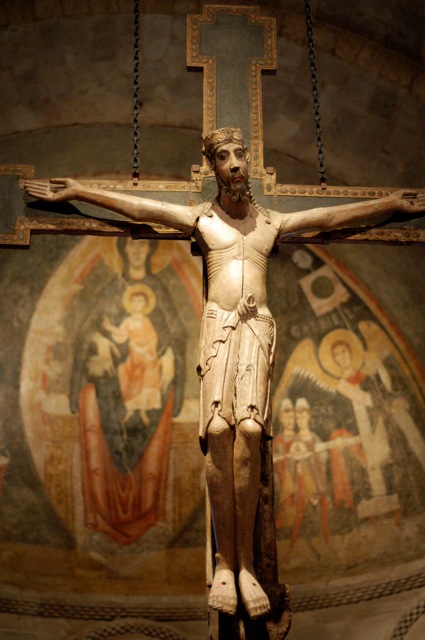
Christ Without a Cross Dies Twice


"For me, kind Jesus, was thine incarnation,
thy mortal sorrow, and thy life's oblation;
thy death of anguish and thy bitter passion.
for my salvation." --Johann Heermann tr. Robert Bridges

I.

Our culture denies death. Our culture denies death's power by saying that it is nothing, only a change. Our culture denies death's sorrow by making of it a celebration. And our culture makes of death's horror a cheap cologne that smells more like bacon than decomposition.

The challenge of Christ's death and resurrection is the greatest gift that the Christian church can give this culture, indeed any culture. But Christ without a cross, especially among his followers, dies two deaths: the actual death, and the death of relevance, for Jesus as just another man who died, another sucker whom the state overpowered, another dupe of the Caesar, no matter how many nice things he did or good things he taught, is doubly dead.

II.

The doctrine of atonement, the idea by which the death of Jesus makes good for the sins of the world, for our sins, is problematic for many to say the least. The idea that this act of Jesus, casting aside his Messianic crown for us, was in fact an act of divine child abuse, God killing God's own son, or the act of a political prisoner alone, seems to me fairly pervasive.

One powerful idea given me in seminary was that instead of a Mel Gibson-style pornographic torture fest, Christ's torture and death on the cross was an interchange of God's justice for our constitutional human injustice, happening through Jesus as through an electrical conduit. More than a felix culpa, a "happy fault," that "allows" God to build something better out of our faults, this interchange is an exchange of all that is just in God for all that is unjust in a creation that goes its own way. We get a better deal.

III.

I'm hardly a heavy-duty theologian, or a student of literature and art and cinema who can quote all of the concepts that I'm referring to here in the history of human achievement. But it seems pretty clear to me that many in the church, uncomfortable as we are with death, might seek to hide Jesus's death behind bunnies, eggs, candy, and parades.

What is an age-appropriate explanation of the crucifixion and resurrection to children? I'm by no means an expert, but talking directly about Jesus dying, and God bringing Jesus back from the dead, seems like it could be very powerful for those whom we often forget about when tragedy happens, because it seems even more difficult to explain it to children, who know something bad when they see, hear, feel, and experience it.

It seems to me that Christ without a cross dies twice, as I said above: his actual death, and the death of his relevance to us as Christians and to our or any culture, time or place. Our culture is not exclusively Christian, but it is one to which we might share a word from this perspective of death and resurrection, and at that a word of hope. Jesus without resurrection is Jesus without hope.

Perhaps we are ashamed because we cannot explain God's place in evil, either the evil of the crucifixion or the evil of natural disaster, war, famine, and other engineered acts of evil that we humans perpetrate on other humans?

Perhaps it is so difficult to believe in the resurrection that it is easier to sugarcoat it than try to explain it to others, much less ourselves and our own people? I can't say I understand the death and resurrection of Jesus all that well, but something in me believes beyond the need to sugarcoat my own impending death with the cross, to use the cross as a means of escape from reality, as must appear to many who do not share this same belief.

A church that sugarcoats the death and resurrection of Jesus with the candy of culture may well be as odious as a believer who uses the cross to deny his or her own death. But as Dietrich Bonhoeffer said famously in Cost of Discipleship:

"As we embark upon discipleship we surrender ourselves to Christ in union with his death--we give over our lives to death. Thus it begins; the cross is not the terrible end to an otherwise godfearing and happy life, but it meets us at the beginning of our communion with Christ. When Christ calls people, he bids them come and die....In fact every command of Jesus is a call to die, with all our affections and lusts. But we do not want to die, and therefore Jesus Christ and his call are necessarily our death as well as our life. The call to discipleship, the baptism in the name of Jesus Christ means both life and death" (Dietrich Bonhoeffer, The Cost of Discipleship, 89-90. New York: Macmillan, 1959, Touchstone ed. 1995).

There is a broader point of forgiveness and mutual burden-bearing to Bonhoeffer's message here, but the necessity of death, and of death in Christ for a Christian, is of central moment.

Any version of Christ that can escape the tomb without the cross is not the Christ. Any version of Christ that gets caught in torture without the work of God in resurrection from the tomb is not the Christ. But my sense is that our human tendency is more to liberate Christ and ourselves through him without taking the hardest steps to and through the cross.

IV.

I wonder if a failure to encounter Jesus in all of his shame on the cross, around the crucifixion, and jumping right to the resurrection, may not be an element of what has chased people away from church by the droves?

Not only has there been a cultural shift since the 1960s that shows a marked decline in the relevance of church in much of American society, but perhaps the church itself has aided in people leaving it through downplaying its own relevance through its core concepts, and through becoming a place of trying to make people feel good about themselves in a way that a gin and tonic could do much better.

As a kid, and as an adult, direct talk has engaged me much more than beating around the bush. I don't want to hear about a Jesus who is merely a glory-machine, triumphing over death without experiencing it. That kind of Jesus doesn't make much difference to me or anyone else.

I want to hear about a Jesus who went all the way, who experienced everything I have experienced, and who came through it in a way that I can know meant a lot to him, not only an insignificant key change in the tune he was whistling, but a whole shift in the reality of what death and our relationship with God means to me and to humanity.

We crucify Christ again by forgetting the cross. We crucify Christ again by forgetting the tomb. We crucify Christ again by forgetting the resurrection. It is only with each of these elements, and by accompanying Christ in these places, and in teaching this to our children, and in insisting on our reality to the wider culture, challenging first its denial of death, that we respect most profoundly the God who has given us Godself in human form, and who has loved us so much that even death can't separate us from God.

Loving Jesus, the tomb awaits, but not yet. Nor your glorious resurrection. Not yet. Keep me for a moment from it, that its power and glitter not overwhelm me. Keep me for a moment with you in death's embrace. Amen.


Tuesday, April 19, 2011

"The Stone that the Builders Rejected"

"The stone that the builders rejected has become the chief cornerstone." --Psalm 118:22

I.

For some reason, I thought this line appeared at some point during the Holy Week readings, but as it is, the only time we who follow the Revised Common Lectionary will be hearing it this year is on Easter.

Yet this phrase informs the whole Holy Week leading up to the crucifixion of Jesus, and particularly what happens through God's raising of Jesus on the third day. The stone, which didn't look like much, which was mis-shapen, mistaken, mis-heard, the stone that rolled the wrong way down the hill, that didn't quite seem to fit the tomb, those stones from which God would raise up children, all these stones were rejected. Those in charge, the builders, didn't happen to think the stones would fit, or that they should properly be included in the plans for such a magnificent building.

Not only did the rejected stone end up being used, but it became the most important stone of all, on which the entire edifice was built. What this edifice is, who the builders were, who the stones were, is all part of the Christian faith tradition, and important questions to wrestle with. But for now, simply, I'm hearing the stone that was rejected, and marveling at how it became a cornerstone.

II.

It's hard not to read myself into this line, and perhaps a bit perilous at the same time. We all experience rejection, and few are probably really spectacularly happy at being rejected. I fear reaching out to people whom I think might reject me, because that has happened plenty. I'm cautious of putting my written work out there in the fear that it might be rejected, which is pretty much what generally happens to written work for which people seek publication. I'm self-conscious about talking about a faith in a loving and graceful God that challenges the view of God and Jesus presented by many who go by the name "Christian," even though sharing that graceful vision of God is more vital now, more life and death, than ever.

The stone has been rejected. Accounted unworthy by those who are supposed to know what is worthy and what isn't. Rightly tossed to the side, and thankfully out of the way.

I would not be the only person who has been at some point rejected, in many ways, not least of which by the church. I have also been accepted in many ways, by many people, and not least of which by the church.

But instead of the rejection stopping the stone, it becomes the cornerstone. It risks everything and comes out ahead. I don't know if I'm that adventuresome, or just wish to hold on to what I have, modest as it might be. The stone could have stayed stuck.

The time comes to risk it all does come, and at that point, rejection cannot be a defining issue.

III.

I've been questioning lately whether that time is coming for me. My job, at which I'm gratefully accepted, will not last forever, and I must find new employment in the next 6 months. Plenty of time not to have that end come as a shock, but I need to get serious about ministry, if that is to become the calling in reality for which I've been called, educated, and sent into a land of limbo. This is not so different from a lot of people who have been affected by the down economy of the last 3 years. To have employment has been a blessing that I am not unaware of.

Many of us, no matter our sexual orientations, have faced this challenge of being rejected in many ways at many times.

I've recently become aware that a lot more people than just myself have been waiting for years for their first calls to become pastors in the ELCA. A number of these people mention how difficult it has been to piece together a life while trying to retain hope that God indeed is back there somewhere, having something to do with this lengthening road that seems not to be leading anywhere.

In times when you still hear that there's a clergy shortage, we would be hard-pressed to understand why, when sitting as rejected stones next to the road. But perhaps we will become the cornerstones of the new buildings, the new ways in which the church will need to be in the time to come?

IV.

Many question, rightly, the place and shape of the church in the years to come. My work church is joining my worship church and another church in a 3-way configuration in which each church will have its own worship space, retain its own identity, and share space. The reason is because each of these churches built their buildings and envisioned their futures with about 90% more people than they have now. The old ways, as the old buildings, are crumbling. New people with new ideas are going to be key in bringing the Gospel to new generations who will not be content just to debate the curtains in the library or whether or not mums should be the flower on the altar Sunday mornings.

What are the words that we stones, whether we've been rejected, included, or are yet becoming, can speak to a church that often seems to stand in stone-deaf silence to the needs of its people?

I was grateful the other day to share an idea for a welcoming church start in an area that has no LGBTQ-publicly welcoming Lutheran churches with the bishop of the local ELCA synod here. He listened patiently, kindly, and said that my idea would be hard to implement. I responded that truth that what would make it a hard proposition is what would make it especially necessary.

Congregations that proclaim their welcome most earnestly, and are often welcoming in many ways, often fall short when it comes to LGBTQ people. That is one reason why there are still only about as many ELCA congregations that are publicly welcoming of LGBTQ people as there were congregations that left the ELCA in order to be particularly unwelcoming or because they felt the ELCA had abandoned its Biblical principles.

What God will make of us stones is yet to be seen. But our church needs us, as it needs every potential leader, ordained or lay, who prayerfully feels compelled to make a difference, because the time for that difference to be made is passing us by.

If we do not wish harsher varieties of Christianity to control the public perception of "Christian" for good, some of us have to start speaking up more, and some of our churches and denominations need to get behind us and figure out how best to use our gifts.

In the meantime, this stone is open to being included, open to listening to other stones that have been or have felt rejected, as well as to pushing his agenda for God's grace and justice onto the builders who need to hear it.

Gracious God of all that we are and all that we can ever be, lift us up to be there for your people who are lost in the night, who wait for you as watchers wait for morning, who feel that you hate them, that your are angry at them, that you wish them destruction, that you are damning them to an eternity of torment for some arbitrary reason. Is this your will, God, that people doubt you because you seem cruel and whimsical? I have a harder time believing that than that you do not exist at all. In whatever way you can, work through each of us to raise up another dear stone who has felt rejected, that we might build up your cathedral of grace on earth as it is in heaven. Through Jesus, the rejected stone who became the chief cornerstone in your plan for reconciliation, we pray. Amen.

Wednesday, April 7, 2010

Reflections on the Word: Readings of April 11, 2010


“[Jesus said,] If you forgive the sins of any, they are forgiven them; if you retain the sins of any, they are retained.” –John 21:23

In amongst Thomas’s doubting Jesus’ resurrection is this fascinating line: forgive (release) sins and you let go; hold on to them, and you keep your grip, on both the sins themselves and the person who has sinned. This word for “retained” relates to the Greek word for power, κρατέω, seen, for example, in the word “democracy.” Holding onto the sins of others gives you power, but also takes power from you. Releasing these sins gives freedom to you and to the sinner over whom you have power.

Forgiving God, give us the freedom to release our grip on the judgment of others, and on ourselves. Judge us alone with grace and understanding, in the light of the resurrection. Amen.

© 2010 CW

Wednesday, March 10, 2010

Reflections on the Word: From Lectionary readings for 3/21

“Mary took a pound of costly perfume made of pure nard, anointed Jesus’ feet, and wiped them with her hair. The house was filled with the fragrance of the perfume.” –John 12:3


The beautiful smell that pervaded Lazarus’ home was that of Jesus’ death to come. The sense of smell is perhaps our strongest and most meaningful; it goes to our deepest places and memories. What about your faith life engages your sense of smell? For some, incense powerfully symbolizes God’s presence. But for many of us, this sense goes unused in spiritual practice. Why is that? What prevents multi-sensory worship?


Creating God, you have given us our several senses with which to engage the world around us. May they help us to appreciate the splendor of your creation, more and more each day. Amen.


Tuesday, February 23, 2010

Reflections on the Word for 3.7.10

“Jesus asked them, “Do you think that because these Galileans suffered in this way they were worse sinners than all other Galileans? No, I tell you; but unless you repent, you will all perish as they did.” --Luke 13: 2-3

Reflection: “Repent or perish” frankly scares me. Lent is about reflection and change, but my unease persists around these words, because as soon as I repent, I sin again. This is the human condition. Jesus says here “their sins were no worse than yours, but you all must change.” We are often aware of the need to change, but the means can still elude us. “Lord, have mercy” remains our refrain each day.

Prayer: Lord, you love your entire creation, and hate not that which you have made. When we stray, gently correct us, that we may live into the promises you have made, which remain faithful even when we are not. Amen.

© 2010 CW

Thursday, February 4, 2010

Reflections on the Word for 2.7.10

“And they came and filled both boats, so that they began to sink. But when Simon Peter saw it, he fell down at Jesus’ knees, saying, ‘Go away from me, Lord, for I am a sinful man!’”
--Luke 5: 7b-8

Reflection: Sin was thought of in Old Testament times like a disease that could be spread. This is seen in Leviticus and other books of law, and some today still feel this to be the case in their moral concern. Peter worried about contaminating Jesus with his sin. But Jesus came to show not so much that our sin is strong, but that his love is stronger than our sin. Forgiveness first, then repentance.

Prayer: Lord, cast us not off from you as sinners, for sinners we are. Yet take us in as those you have redeemed for your own love’s sake. For though our sins may overwhelm us, they cannot overwhelm you. Amen.

© 2010 CW

Note: I'm not sure if I've posted any of these here yet. I write them for the church newsletter of the church where I work. Since I tend toward long-windedness, these brief reflections are a valuable exercise in being concise! I will try to include them going forward.