"What have you done today to make you feel proud?" --Heather Small
"You can take away my job, my vocation, my marriage, my home, and my life, but you can't take away my pride." --C. W.
I.
"I'm on my way, can't stop me now. And you can do the same." Pride may be one of the seven deadly sins, but frankly, there are a lot of deadly sins that are not counted among these seven sins, such as hate, fear, and pity.
I say, let's redefine these deadly sins. What have you done today to make you feel proud?
To say I'm fan of Showtime's series "Queer as Folk" is an understatement. When my friend, David, a fellow Minnesotan and a life mentor, first lent me his recorded episodes on VHS tapes back in New York City more than 10 years ago, I knew I loved this rag-tag bunch of metro-homosexuals. It is sexy, edgy, real, funny, semi-pornographic at times, but that is the reality of our lives. No apologies, no regrets.
Just now, I finished watching the series finale (the last scene is in the link to the above quotation), which ended with the song above--"What have you done today to make you feel proud?" Not "make me feel proud." Not "make God feel proud." Not "make your parents, your teachers, your employers feel proud." But you. The very you who is reading this sentence right now, and who is typing it. Because feeling proud is something new every day, like God's manna from heaven, something not just to re-live, or re-make, but something that comes up as a requirement for us to live as flourishing, loving, proud, and fierce human beings.
II.
I've taken a few weeks' sabbatical on this series of writing 15 reflections on 15 years of being out. In the meantime, I visited the scene of my coming out, my alma mater, Lawrence University. I hadn't been there in nearly 10 years, and many people have come and gone since then. Many buildings are new, many people are new, but as I approached college avenue and rode past Main Hall, the cobwebs fell from my eyes, and I saw the place that was so formative in my life--not just my intellectual life, but my emotional life, and the life that I found worth fighting for after so many years of fear.
Every corner of this university, especially the Conservatory of music, had a memory, or many memories. The friends I made, the friends I lost, the people I loved, hated, the people I passed who have themselves passed on to another dimension, those places that are now silent, that used to be the center of activity. "Mozzi sticks!!!" I could hear one saucy Union kitchen lady yelling as I waited for one of the dearest friends in my life that I haven't talked to now in 10 years. Now, silent, a closed door, like that friendship feels.
But pride is on the other side, waiting to open the door.
I wasn't exactly proud of myself when I got to college at age 18. My parents were proud of me, and for that I'm both grateful and fortunate. The pathway to 18 and beyond is filled with so many possible wrecking points, that in some ways I think it is a miracle that as many people make it to that one, lone spot as do. But the hardest times do not pass when one makes the first forays out onto one's "own."
It's coming to own one's own that can present some of the tightest spots of our lives. And the road there is lined with those who have made it only part of the way, not because of their own faults, but because others made the road so damned impassable. But the road is not *necessarily* impassable. There are angels who can help you get through, if you can open your eyes when they are most tightly closed and see.
And we need to help those angels along, and to be those angels of our better natures.
III.
I put writing this entry off because in many ways it is the hardest one to write. The time I've taken getting here mirrors the time I've taken getting to any place in my life where I can be proud both of who I am, as well as what I've done.
It's hardest, sometimes, to cut oneself some slack, let alone others. In fact, I think we often treat ourselves with harshness that would make us go to the mat for our friends and loved ones if we saw them being treated the same way that we sometimes treat ourselves.
So pride is not such an easy thing, for a number of reasons, for a number of people. Being told you're worthless, scum, lowest of the low, perverted, wrong, abnormal, sick, damned, and a whole host of other horrible things, seems to sink in with some time, and sinks us. A lot of people who are not themselves LGBTQ have experienced this kind of soul-murder. So why does so much of the animus come to those of us who are LGBTQ?
Because, I sense, we expose the beauty and diversity that is each person's in this life, that so many are afraid will give them such fulfillment, that it will literally blow their minds.
People are diverse, they're not of one mind, they know themselves often much better than they are known, in short, people are not on one standard track of being recognized, comfortable, productive, and beneficent to themselves first, as well as to others.
And the LGBTQ community, as far as we are a community, is the exemplar of this diversity. While our sexuality, "lifestyles," and the choices that we make to live more fabulously every day make us part of who we are, we live, each of us, being "repairers of the breach," reconcilers, and living those lives away from the quiet desperation that makes people die a death much worse than that of the body: the death of their spirits in their limited time in this life.
IV.
Those who wish to say that our relationships, that our lives, in all their color, do not count as much as theirs, miss one of the greatest gifts of this brief life: that life does not all have to be the same, and that we have agency in making of our lives what God would, I don't just think but am certain, want us to make of our lives: as absolutely much as we can.
Many of those who couch their opposition under the name of the God of all life, look at gay pride parades and festivals as the exemplars of our shame: leather daddies, open sexuality, sodomites laughing and parading their difference through the streets, people who are one step away from taking us all down the fast road to hell.
Well, I have a message for these purveyors of doom: those who fear the rainbow are bound to be crushed by it. Not crushed by the triumph of "fag enablers," but by their very own, human, and misguided fear. And that makes me pity them, although I know that fear as well as they do.
I remember my first pride well, in the summer of 1998 in New York City. It was the first time in my life that, for just a few hours, in a small part of the world, I felt like everyone in the world was LGBT or Q, where nobody had to explain anything about what I had felt all my life, where I could feel, even if briefly, the home that is so common to so many people, where I came home from a lifelong exile. And that feeling is not something to fear, but to celebrate.
This pride is the pride that we take in our own lives, in our own feelings, in the exultation that each of us and a human being can feel in our humanity, not in the humanity that is imposed upon us, but in what we ourselves know is our truth.
V.
Pity, not humility, is the antithesis of pride.
I know pity well--I'm prone to self-pity, one of my deepest flaws. Self-pity, in feeling that I have not made enough of my life, that I have not attained my calling as a minister of the Word of God, that I have not sustained a long-term relationship or marriage, that I have not yet peaked in the arc of my living, afflicts me as it does many, and seeks to quash the beauty that my life can, and often does, have and has to give. This feeling of self-pity almost kept me from going back to Lawrence, the goal of which was to celebrate the awesome life and contribution of one of the most fabulous Lawrentians ever, our late archivist, Carol Butts.
I am eternally glad that I opposed the poisoned source from which these impediments derived, to avert what would have been a true pity: missing out on this fabulous celebration and reunion.
I was proud that day that we gathered Carol's family, friends, and colleagues, to celebrate her memory and contributions, as she has so long deserves. I only wish she could have been there with us to enjoy a well-deserved honor.
Now, this is hard to say, but I think it is the truth: LGBTQ people are often trained more in pity than we are in pride. We are made the victims of people who cannot accept the truths of their own lives, let alone the lives of others, and we cry out altogether too often in the pain that others inflict on us, and that we inflict on ourselves. But we also shout from the rooftops, and within the halls of power, that God indeed does love us in equal measure, that we are human in equal measure, and that our relationships are equal, not because we fight for them to be, but because they just are.
I had the chance to be proud for a while last week, in the midst of fighting against a vote by the Minnesota State Legislature to hand off for the people to decide what rights we should all have under the law. I am grateful to Rep. Debra Kiel, freshman representative of district 1B, my home district, for hearing me out. I hope truly that she thinks and prays about what I had to say to her.
The most important thing I had to tell her was this: We are equal in our humanity, and we are equal in our baptisms (those of us who are Christian), but we are not equal under the law, and the law is very important, and something that our representatives, such as herself, have in their hands.
Hundreds who protested this anti-gay constitutional amendment made me proud, standing, singing, and shouting for our rights at the very door of power. Organizations like OutFront Minnesota, Project 515, and the new Minnesotans United for All Families, are all helping to gather the power of our communities around making justice for all families a reality in Minnesota.
A few Republican representatives made me especially proud, most notably Rep. John Kriesel, whose experience in the war in Iraq, and particularly serving with a gay soldier who was killed, made him see that this anti-gay amendment must be opposed at all costs. (His speech is here.) He said "I'm proud of this, because this is the right thing to do." And he was absolutely right.
My parents, each in writing their representatives, made me proud as well, just one of many times.
VI.
Pride is not just doing what you're told. Pride is knowing that you are worth more than others say you are, that your worth is from a source beyond yourself, beyond your own family and community, beyond your own accomplishments, from a source that reaches out to all of humanity, the wonderful and the awful, that for those of us who believe reaches to God and comes from God.
This kind of pride feeds our lives and gives them meaning. It's not a sin. The hate that challenges who we are, that hate is a deadly sin, literally. And that is what Jesus came on this earth to oppose.
We hit the mat for a moment when the MN State Legislature passed this sorry bill (a.k.a. SF 1308 and HF 1615). But we are not going to stay down.
We're going to kick such ass on this anti-marriage amendment. Not because we're going to be louder, tougher, and more determined than those who oppose our relationships, but because we're simply going to love them more than they hate us.
We are going to love their scared selves into a place of salvation.
Jesus is not going to come down from the sky to save them from us, but, rather, Jesus is going to work through us to redeem them, until there is no more "us" and "them," but only "we."
And that's something to be proud of.
Showing posts with label reconciliation. Show all posts
Showing posts with label reconciliation. Show all posts
Tuesday, May 24, 2011


Sunday, May 1, 2011
15-for-15 III: Honesty
"It's not lying if they make you lie."
--Brian Kinney (Gale Harold), "Queer as Folk" (Showtime)
I.
Now, be honest. You might not rejoice in the death of Osama bin Laden, but is there no part of you that was at least relieved to hear that he had finally been killed? And if relieved, grateful? A seed of inappropriate glee, perhaps, that would taint you as someone who can't quite live up to the great martyrs of peace of the past?
The last thing most of us would want is for people to know all of our true feelings all the time, because a lot of those feelings could affect our relationships, jobs, and general reputations should they be known. So we have to be selective in what we tell others. Honesty, true, unadulterated, 24/7/365 honesty, is nearly impossible to have within the recesses of our own minds and souls, and quite impossible to achieve in dealing with others.
But some level of honesty, with others, about ourselves and our views, is absolutely essential to who we are. We must select what we will present, and in presenting, create the "I" that others see through their eyes.
Honesty is central in coming out of the closet, but it is not simple. It begins with people being honest with themselves about their true feelings, and that may lead into a crisis that may or may not resolve itself with becoming honest with others. Some may come out, at an early age, without any complications in their own minds--I've met people for whom this is the case. But for many others who are gay or lesbian, a wide variety of complex factors and fears affects this kind of honesty with others.
II.
Foremost are the factors of one's fear of losing close relationships with people they think might not take this news well and decide to end the relationship. And this has indeed happened with a number of people who have come out as gay or lesbian, particularly before the last two decades. It has happened with me.
At one time, not long ago, and indeed still to this day, the economic factors of losing one's job or not being able to gain employment were key to keeping people in the closet. I worried, and am not proud of doing so, that I would be disowned if my parents knew I was gay, and I did not see how I could pay for college if I were to come out when I was still in high school. I sensed anyway that I would become like Stephen King's Carrie had I come out in high school, with a bucket of blood hanging over my head at every turn, ready to end forever any cool factor that I had built up.
The fear of being beaten or abused has also been central to people not coming out, for this is still a realistic fear for many who are young, and more who have moved on into their own lives, yet live within tight restrictions on their expression within those lives.
Even in a society as tolerant as ours, we are far from living in a "safe" place as openly gay and lesbian people everywhere we go. Where we might choose to hold hands, might give in public the most innocuous signs of affection towards those for whom we feel affection, things that I would guess every heterosexual person takes for granted, is still greatly limited, in many cases only in those establishments that openly accept or cater to gays and lesbians or the neighborhoods immediately around them.
In vast parts of our country, we're still sitting in the Stonewall Inn on June 26, 1969, when the police could come in at any moment and take everything in our lives away at their whim. Police raids have famously happened within the last few years in Fort Worth, TX, and Atlanta, GA, hardly small and conservative towns.
The fear of not being able to follow out one's calling in life, whether as a pastor, a professional athlete, a teacher, an actor or actress, musician, business person, or in many other walks of life that still carry a heavy expectation of being heterosexual for the sake of those for whom the business or organization is run, still keeps people in the closet and in relationships that begin as relationships of "convenience," though might develop into more.
One of the hardest things to do is to be honest with oneself about the hard things within oneself, let alone to be frank with others. But both are essential, I would say, to living other than a life of quiet desperation, in the words of Thoreau.
III.
I first was compelled to be honest with myself about being gay because of an overwhelming sexual attraction I had to someone, who although I didn't know, I knew was gay. I saw him every day on the bus that I took from the St. Paul University of Minnesota "farm" campus to the main campus in Minneapolis, on the east bank, when I was there in the summer of 1994.
Perhaps it was his mannerisms that first tripped my nascent gaydar. Perhaps it was the sticker on his bag that said "I fuck to come, not to conceive." But soon I heard him talking about being gay to someone else on the bus. That cinched it for me.
I remember getting off that bus and walking behind him, trying to come up with even a lame pick-up line. But I was afraid of sex, and afraid of contracting HIV, which in 1994 could still be a death sentence for many who were living with it, before the arrival of most anti-retroviral drugs. Fear of many kinds kept the lid on a boiling pot of hormones and emotions for yet another period of time when it could have come off. The result was the journal entry that I shared in my first entry in this series.
Later, I was compelled to be honest with others about what I felt, because I learned that those feelings went beyond mere sexual attraction. I learned that I had feelings for someone else that were just like those feelings that I had watched in most every movie ever made, and that were described in the vast majority of songs ever written. If people could make those movies, and sing those songs, then I deserved to value and honor those feelings in myself, as imperfectly even as I expressed them at that time, as well.
I became honest with others when my heart connected, perhaps for the first time, to my head, and I could no longer deny that I, too, had a claim to my feelings and had needs that issued from them, and not only from my penis or my brain. I still hadn't experienced anything that I longed to experience physically, but I knew what it was that I wanted, to be with another man, and what I could never have: a Jane to my John, a Mrs. to my Mr.
As deeply as I had tried to feel romantic attachments to girls, and then to young women, nothing could connect with my deeper reality. No kiss with a girl could do anything more for me than leave me feeling weird, and that wasn't fair to either of us. No amount of visual stimulation could have any effect beyond moving my retinas from one part of a page or screen to another.
For a long time, I thought there was just something wrong with me, that I needed to try harder, and I'll be honest, I never prayed to God that things were different--I didn't even think to do so. Some have described this feeling as noticing at some point that you had boarded the wrong airplane, flying to the wrong destination, yet without any way to alter the course.
It would be a long time before I sat back and enjoyed the flight.
IV.
The quotation above, which the character Brian Kinney says several times in the TV series "Queer as Folk," resonates with me on many levels. Lying, and the moral approbation that might be attached to it, is morally wrong only so long as you have any other option at all. It is like the legitimate defense of killing only when one's life is in immediate danger, only in the case of outing oneself, it's everything that attaches to one's life, and in some cases, one's physical life itself. This is a fear that some gay and lesbian people carry with themselves every day.
I tend to judge those who have not come out most especially when I do not remember what it was like before I came out. It's easy to cast such stones when you forget that you were once (and perhaps sometimes are still) afraid of being hit with them yourself.
If everyone who could come out would come out, in all circumstances, to all people, all the time, there would be no closets, not because there wouldn't be anyone in them, but because there would be no need for them. That area of privacy in one's life is there almost exclusively because of the possible repercussions and fears that I stated above.
"It's nobody's business but my own" only so long as were that business to be made known, there would be negative consequences. Inconsequential business has no need of privacy. Otherwise, why not put up that picture of your hottie love muffin in the office, like everyone else does, or talk about your weekend, or mention your wife or husband in your sermon, or talk about that experience that changed your life and the person who was there to hold your hand when it happened?
But reality remains: it's not safe for everyone to come out in every circumstance at all times. The closet is still a place of cold refuge for many, many people.
V.
I do carry a rather unattractive chip on my shoulder about the consequences of honesty I have faced in my own calling to being an ordained Lutheran minister, as one who is yet neither ordained, nor a Lutheran minister. I have the same training, with the same professors and mentors, as dozens of my seminary colleagues who are now ordained and in church calls. Yet, my last four years of waiting for even an interview for a first call in my present denomination looks like this:
--Brian Kinney (Gale Harold), "Queer as Folk" (Showtime)
I.
Now, be honest. You might not rejoice in the death of Osama bin Laden, but is there no part of you that was at least relieved to hear that he had finally been killed? And if relieved, grateful? A seed of inappropriate glee, perhaps, that would taint you as someone who can't quite live up to the great martyrs of peace of the past?
The last thing most of us would want is for people to know all of our true feelings all the time, because a lot of those feelings could affect our relationships, jobs, and general reputations should they be known. So we have to be selective in what we tell others. Honesty, true, unadulterated, 24/7/365 honesty, is nearly impossible to have within the recesses of our own minds and souls, and quite impossible to achieve in dealing with others.
But some level of honesty, with others, about ourselves and our views, is absolutely essential to who we are. We must select what we will present, and in presenting, create the "I" that others see through their eyes.
Honesty is central in coming out of the closet, but it is not simple. It begins with people being honest with themselves about their true feelings, and that may lead into a crisis that may or may not resolve itself with becoming honest with others. Some may come out, at an early age, without any complications in their own minds--I've met people for whom this is the case. But for many others who are gay or lesbian, a wide variety of complex factors and fears affects this kind of honesty with others.
II.
Foremost are the factors of one's fear of losing close relationships with people they think might not take this news well and decide to end the relationship. And this has indeed happened with a number of people who have come out as gay or lesbian, particularly before the last two decades. It has happened with me.
At one time, not long ago, and indeed still to this day, the economic factors of losing one's job or not being able to gain employment were key to keeping people in the closet. I worried, and am not proud of doing so, that I would be disowned if my parents knew I was gay, and I did not see how I could pay for college if I were to come out when I was still in high school. I sensed anyway that I would become like Stephen King's Carrie had I come out in high school, with a bucket of blood hanging over my head at every turn, ready to end forever any cool factor that I had built up.
The fear of being beaten or abused has also been central to people not coming out, for this is still a realistic fear for many who are young, and more who have moved on into their own lives, yet live within tight restrictions on their expression within those lives.
Even in a society as tolerant as ours, we are far from living in a "safe" place as openly gay and lesbian people everywhere we go. Where we might choose to hold hands, might give in public the most innocuous signs of affection towards those for whom we feel affection, things that I would guess every heterosexual person takes for granted, is still greatly limited, in many cases only in those establishments that openly accept or cater to gays and lesbians or the neighborhoods immediately around them.
In vast parts of our country, we're still sitting in the Stonewall Inn on June 26, 1969, when the police could come in at any moment and take everything in our lives away at their whim. Police raids have famously happened within the last few years in Fort Worth, TX, and Atlanta, GA, hardly small and conservative towns.
The fear of not being able to follow out one's calling in life, whether as a pastor, a professional athlete, a teacher, an actor or actress, musician, business person, or in many other walks of life that still carry a heavy expectation of being heterosexual for the sake of those for whom the business or organization is run, still keeps people in the closet and in relationships that begin as relationships of "convenience," though might develop into more.
One of the hardest things to do is to be honest with oneself about the hard things within oneself, let alone to be frank with others. But both are essential, I would say, to living other than a life of quiet desperation, in the words of Thoreau.
III.
I first was compelled to be honest with myself about being gay because of an overwhelming sexual attraction I had to someone, who although I didn't know, I knew was gay. I saw him every day on the bus that I took from the St. Paul University of Minnesota "farm" campus to the main campus in Minneapolis, on the east bank, when I was there in the summer of 1994.
Perhaps it was his mannerisms that first tripped my nascent gaydar. Perhaps it was the sticker on his bag that said "I fuck to come, not to conceive." But soon I heard him talking about being gay to someone else on the bus. That cinched it for me.
I remember getting off that bus and walking behind him, trying to come up with even a lame pick-up line. But I was afraid of sex, and afraid of contracting HIV, which in 1994 could still be a death sentence for many who were living with it, before the arrival of most anti-retroviral drugs. Fear of many kinds kept the lid on a boiling pot of hormones and emotions for yet another period of time when it could have come off. The result was the journal entry that I shared in my first entry in this series.
Later, I was compelled to be honest with others about what I felt, because I learned that those feelings went beyond mere sexual attraction. I learned that I had feelings for someone else that were just like those feelings that I had watched in most every movie ever made, and that were described in the vast majority of songs ever written. If people could make those movies, and sing those songs, then I deserved to value and honor those feelings in myself, as imperfectly even as I expressed them at that time, as well.
I became honest with others when my heart connected, perhaps for the first time, to my head, and I could no longer deny that I, too, had a claim to my feelings and had needs that issued from them, and not only from my penis or my brain. I still hadn't experienced anything that I longed to experience physically, but I knew what it was that I wanted, to be with another man, and what I could never have: a Jane to my John, a Mrs. to my Mr.
As deeply as I had tried to feel romantic attachments to girls, and then to young women, nothing could connect with my deeper reality. No kiss with a girl could do anything more for me than leave me feeling weird, and that wasn't fair to either of us. No amount of visual stimulation could have any effect beyond moving my retinas from one part of a page or screen to another.
For a long time, I thought there was just something wrong with me, that I needed to try harder, and I'll be honest, I never prayed to God that things were different--I didn't even think to do so. Some have described this feeling as noticing at some point that you had boarded the wrong airplane, flying to the wrong destination, yet without any way to alter the course.
It would be a long time before I sat back and enjoyed the flight.
IV.
The quotation above, which the character Brian Kinney says several times in the TV series "Queer as Folk," resonates with me on many levels. Lying, and the moral approbation that might be attached to it, is morally wrong only so long as you have any other option at all. It is like the legitimate defense of killing only when one's life is in immediate danger, only in the case of outing oneself, it's everything that attaches to one's life, and in some cases, one's physical life itself. This is a fear that some gay and lesbian people carry with themselves every day.
I tend to judge those who have not come out most especially when I do not remember what it was like before I came out. It's easy to cast such stones when you forget that you were once (and perhaps sometimes are still) afraid of being hit with them yourself.
If everyone who could come out would come out, in all circumstances, to all people, all the time, there would be no closets, not because there wouldn't be anyone in them, but because there would be no need for them. That area of privacy in one's life is there almost exclusively because of the possible repercussions and fears that I stated above.
"It's nobody's business but my own" only so long as were that business to be made known, there would be negative consequences. Inconsequential business has no need of privacy. Otherwise, why not put up that picture of your hottie love muffin in the office, like everyone else does, or talk about your weekend, or mention your wife or husband in your sermon, or talk about that experience that changed your life and the person who was there to hold your hand when it happened?
But reality remains: it's not safe for everyone to come out in every circumstance at all times. The closet is still a place of cold refuge for many, many people.
V.
I do carry a rather unattractive chip on my shoulder about the consequences of honesty I have faced in my own calling to being an ordained Lutheran minister, as one who is yet neither ordained, nor a Lutheran minister. I have the same training, with the same professors and mentors, as dozens of my seminary colleagues who are now ordained and in church calls. Yet, my last four years of waiting for even an interview for a first call in my present denomination looks like this:
- Make sure you file everything on time.
- Thank you for filing everything on time and completing your requirements.
- We approve you for ordination and think you will be an excellent pastor. You have wonderful gifts for ministry.
- Why did you have to put your sexual orientation in your paperwork? Nobody else does.
- No church will give you an interview unless you "fly under the radar," "don't lead with your sexual orientation," and "feel things out as far as their attitudes go before you say anything about being gay."
- We don't have any churches for you, but your name comes up all the time in our conversations about churches looking for first calls.
- That church would be great for you, but it is not a first call church.
- We gave that church to someone as a first call even though it wasn't a first call church--it just fit them.
- There are no churches at the moment that would be open to someone like you.
- We're afraid of even recommending you to that church, so why would you want to interview there?
- Any church would be lucky to have you as its pastor.
- The bishop has said that he can do nothing for you.
- The bishop has your paperwork and will follow up with you shortly.
- You're too outspoken.
- All of the bishops admired your integrity, but they cannot do anything as long as you say you will not be in compliance with the rules.
- There are too many other candidates waiting for a first call for you to be considered in our synod.
- We gave that church to someone who wasn't in our synod because it was a good match for them, even though we have several other candidates waiting for call.
- You have demonstrated maturity, compassion, and extraordinary patience throughout this process. We admire your consistent positive attitude.
- A lot of people are affected by the economy because pastors are not retiring since they have lost their pensions. But we still placed 5 of 6 candidates whom we received in the Fall draft in first calls.
It goes on like this, and it is little wonder that a part of my spiritual life has atrophied. But, to be honest, that is also my responsibility to say "enough is enough," and move on with my life.
Honesty has not been the best policy in my dealings with the church, and something seems wrong with that.
Honesty has not been the best policy in my dealings with the church, and something seems wrong with that.
Thankfully, the Evangelical Lutheran Church in America has moved into a new period of honesty in which it can value the honesty of its clergy and commissioned lay persons and stop forcing its pastors and candidates for ordination to lie about being gay or lesbian, as it did for more than 20 years. Before August 21, 2009, a pastor could be brought up on trial for publicly admitting he or she was gay or lesbian and in a relationship, and a church could be completely removed from the ELCA in an expensive and embarrassing church trial; thankfully this is no longer the case.
Yet the pre-change reality remains in the ELCA, and no change has happened in many other denominations. And gay and lesbian persons are by no means the only people who are disadvantaged in the current ELCA system of approval, call, and ordination.
Yet the pre-change reality remains in the ELCA, and no change has happened in many other denominations. And gay and lesbian persons are by no means the only people who are disadvantaged in the current ELCA system of approval, call, and ordination.
VI.
Being honest, as being a bully, is not a simple issue. It's not the picture of George Washington and the cherry tree, or of "Honest Abe," whose early business practices, though unsuccessful, were apparently unflinchingly honest. These stereotypes of being honest are not such that any mortal can attain, just as no human besides Jesus could be sinless, and I question what that meant for Jesus.
The issue of marriage, beyond being an issue of civil rights for gay and lesbian people, is an issue of honesty: being able to be publicly honest about who your better half indeed is, as well as being honest about the limitations and realities of any marriage.
The main argument that I would lift up in favor of same-sex marriage is not even equality, because we are equal, and to debate our equality and the equality of our relationships is an insult. I think a better argument is to state the honest reality: that conservative moralists are imposing unreachable expectations on those marriages that they do allow, while at the same time, by opposing same-sex marriages, they suggest that these "traditional" marriages could be blown over by the first stiff gay wind to hit them. I want to think heterosexual relationships are stronger than this.
There are also a vast number of people who vote against same-sex marriage, and a vast number of politicians who introduce this as a wedge issue into political discourse, who are far from being honest about their motives.
Each Minnesota legislator who has voted in favor of advancing a constitutional amendment against same-sex marriage, as in all 30 states that ban same-sex marriage in their constitutions, and each citizen voter, should face a crisis of honesty on their position against same-sex marriage. Is a same-sex marriage going to "destroy" opposite-sex marriages, or are a host of factors already in place, from no-fault divorce, to economic injustice, to exceedingly high societal demands, threatening these marriages?
Bad relationships, impossible demands of perfection, and economic adversity, among other things, destroy marriage, not gay and lesbian relationships.
VII.
Perhaps death is the most honest thing there is. There's no saying it is anything that it is not. There may be many varieties of death, but when someone is stone cold dead, that's that. Which is why it is so important to live your life while you have it.
I wonder sometimes what it would be like if honesty were more constitutionally a part of who we are. It's not a natural human state, but must be taught by instilling a guilty conscience as constant punishment for not being honest.
Being who one is honestly should not entail being guilty. Some things about ourselves could benefit from change. Sexual orientation is not one of them.
What, for you, are the most difficult things to be honest about with yourself, dear reader? And what in your life has initiated a crisis of honesty in dealing with others? I think we all have substantial experience in debating these questions within ourselves, and some of these parts of ourselves have forced us into our own versions of the closet. Closets are not just for people of a particular sexual orientation: there are endless varieties of closets.
My hope is that we might someday very soon reach a new level of honesty in our national discourse on sexual orientation, race, gender discrimination, and a host of other issues that can get better only when we start being honest with ourselves and with others about what we think and how we feel, without descending into banning people's relationships constitutionally, breaking off relationships because we disagree, and falling deeper into a pit of partisan tar.
Each Minnesota legislator who has voted in favor of advancing a constitutional amendment against same-sex marriage, as in all 30 states that ban same-sex marriage in their constitutions, and each citizen voter, should face a crisis of honesty on their position against same-sex marriage. Is a same-sex marriage going to "destroy" opposite-sex marriages, or are a host of factors already in place, from no-fault divorce, to economic injustice, to exceedingly high societal demands, threatening these marriages?
Bad relationships, impossible demands of perfection, and economic adversity, among other things, destroy marriage, not gay and lesbian relationships.
VII.
Perhaps death is the most honest thing there is. There's no saying it is anything that it is not. There may be many varieties of death, but when someone is stone cold dead, that's that. Which is why it is so important to live your life while you have it.
I wonder sometimes what it would be like if honesty were more constitutionally a part of who we are. It's not a natural human state, but must be taught by instilling a guilty conscience as constant punishment for not being honest.
Being who one is honestly should not entail being guilty. Some things about ourselves could benefit from change. Sexual orientation is not one of them.
What, for you, are the most difficult things to be honest about with yourself, dear reader? And what in your life has initiated a crisis of honesty in dealing with others? I think we all have substantial experience in debating these questions within ourselves, and some of these parts of ourselves have forced us into our own versions of the closet. Closets are not just for people of a particular sexual orientation: there are endless varieties of closets.
My hope is that we might someday very soon reach a new level of honesty in our national discourse on sexual orientation, race, gender discrimination, and a host of other issues that can get better only when we start being honest with ourselves and with others about what we think and how we feel, without descending into banning people's relationships constitutionally, breaking off relationships because we disagree, and falling deeper into a pit of partisan tar.
Friday, April 22, 2011
Christ Without a Cross Dies Twice
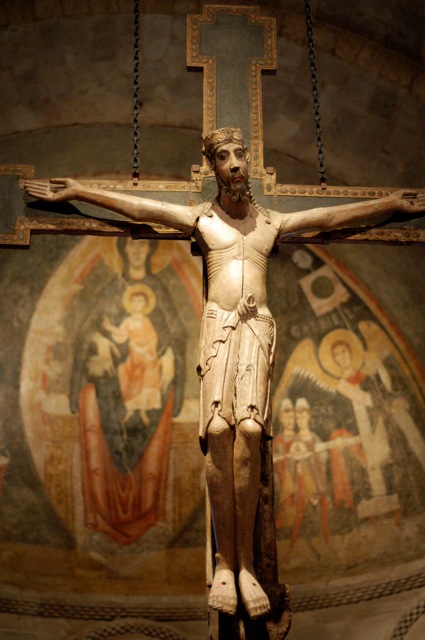
"For me, kind Jesus, was thine incarnation,
thy mortal sorrow, and thy life's oblation;
thy death of anguish and thy bitter passion.
for my salvation." --Johann Heermann tr. Robert Bridges
I.
Our culture denies death. Our culture denies death's power by saying that it is nothing, only a change. Our culture denies death's sorrow by making of it a celebration. And our culture makes of death's horror a cheap cologne that smells more like bacon than decomposition.
The challenge of Christ's death and resurrection is the greatest gift that the Christian church can give this culture, indeed any culture. But Christ without a cross, especially among his followers, dies two deaths: the actual death, and the death of relevance, for Jesus as just another man who died, another sucker whom the state overpowered, another dupe of the Caesar, no matter how many nice things he did or good things he taught, is doubly dead.
II.
The doctrine of atonement, the idea by which the death of Jesus makes good for the sins of the world, for our sins, is problematic for many to say the least. The idea that this act of Jesus, casting aside his Messianic crown for us, was in fact an act of divine child abuse, God killing God's own son, or the act of a political prisoner alone, seems to me fairly pervasive.
One powerful idea given me in seminary was that instead of a Mel Gibson-style pornographic torture fest, Christ's torture and death on the cross was an interchange of God's justice for our constitutional human injustice, happening through Jesus as through an electrical conduit. More than a felix culpa, a "happy fault," that "allows" God to build something better out of our faults, this interchange is an exchange of all that is just in God for all that is unjust in a creation that goes its own way. We get a better deal.
III.
I'm hardly a heavy-duty theologian, or a student of literature and art and cinema who can quote all of the concepts that I'm referring to here in the history of human achievement. But it seems pretty clear to me that many in the church, uncomfortable as we are with death, might seek to hide Jesus's death behind bunnies, eggs, candy, and parades.
What is an age-appropriate explanation of the crucifixion and resurrection to children? I'm by no means an expert, but talking directly about Jesus dying, and God bringing Jesus back from the dead, seems like it could be very powerful for those whom we often forget about when tragedy happens, because it seems even more difficult to explain it to children, who know something bad when they see, hear, feel, and experience it.
It seems to me that Christ without a cross dies twice, as I said above: his actual death, and the death of his relevance to us as Christians and to our or any culture, time or place. Our culture is not exclusively Christian, but it is one to which we might share a word from this perspective of death and resurrection, and at that a word of hope. Jesus without resurrection is Jesus without hope.
Perhaps we are ashamed because we cannot explain God's place in evil, either the evil of the crucifixion or the evil of natural disaster, war, famine, and other engineered acts of evil that we humans perpetrate on other humans?
Perhaps it is so difficult to believe in the resurrection that it is easier to sugarcoat it than try to explain it to others, much less ourselves and our own people? I can't say I understand the death and resurrection of Jesus all that well, but something in me believes beyond the need to sugarcoat my own impending death with the cross, to use the cross as a means of escape from reality, as must appear to many who do not share this same belief.
A church that sugarcoats the death and resurrection of Jesus with the candy of culture may well be as odious as a believer who uses the cross to deny his or her own death. But as Dietrich Bonhoeffer said famously in Cost of Discipleship:
"As we embark upon discipleship we surrender ourselves to Christ in union with his death--we give over our lives to death. Thus it begins; the cross is not the terrible end to an otherwise godfearing and happy life, but it meets us at the beginning of our communion with Christ. When Christ calls people, he bids them come and die....In fact every command of Jesus is a call to die, with all our affections and lusts. But we do not want to die, and therefore Jesus Christ and his call are necessarily our death as well as our life. The call to discipleship, the baptism in the name of Jesus Christ means both life and death" (Dietrich Bonhoeffer, The Cost of Discipleship, 89-90. New York: Macmillan, 1959, Touchstone ed. 1995).
There is a broader point of forgiveness and mutual burden-bearing to Bonhoeffer's message here, but the necessity of death, and of death in Christ for a Christian, is of central moment.
Any version of Christ that can escape the tomb without the cross is not the Christ. Any version of Christ that gets caught in torture without the work of God in resurrection from the tomb is not the Christ. But my sense is that our human tendency is more to liberate Christ and ourselves through him without taking the hardest steps to and through the cross.
IV.
I wonder if a failure to encounter Jesus in all of his shame on the cross, around the crucifixion, and jumping right to the resurrection, may not be an element of what has chased people away from church by the droves?
Not only has there been a cultural shift since the 1960s that shows a marked decline in the relevance of church in much of American society, but perhaps the church itself has aided in people leaving it through downplaying its own relevance through its core concepts, and through becoming a place of trying to make people feel good about themselves in a way that a gin and tonic could do much better.
As a kid, and as an adult, direct talk has engaged me much more than beating around the bush. I don't want to hear about a Jesus who is merely a glory-machine, triumphing over death without experiencing it. That kind of Jesus doesn't make much difference to me or anyone else.
I want to hear about a Jesus who went all the way, who experienced everything I have experienced, and who came through it in a way that I can know meant a lot to him, not only an insignificant key change in the tune he was whistling, but a whole shift in the reality of what death and our relationship with God means to me and to humanity.
We crucify Christ again by forgetting the cross. We crucify Christ again by forgetting the tomb. We crucify Christ again by forgetting the resurrection. It is only with each of these elements, and by accompanying Christ in these places, and in teaching this to our children, and in insisting on our reality to the wider culture, challenging first its denial of death, that we respect most profoundly the God who has given us Godself in human form, and who has loved us so much that even death can't separate us from God.
Loving Jesus, the tomb awaits, but not yet. Nor your glorious resurrection. Not yet. Keep me for a moment from it, that its power and glitter not overwhelm me. Keep me for a moment with you in death's embrace. Amen.
Monday, March 22, 2010
Wake Up and Smell the Spikenard!
Sermon on John 12: 1-8; Salem English Lutheran Church, Minneapolis, MN; March 21, 2010
[Note: the scent of spikenard was an essential part of this sermon as it was preached. It is available in essential oil form, or could be found cheaper in Indian groceries, as the plant is harvested mostly in India and China. I used essential oil and both diffused it throughout the worship space, as well as passed it around the congregation in its bottle for people to get a closer smell.]
Let us pray: Creating God, you have given us our five senses to appreciate your wondrous world around us. In this Lenten time, help us to walk in love, as Christ loved us, and gave himself for us, a fragrant offering to you. Send now your Spirit into our midst, we pray, that we might come closer to that blessed and eternal mind of Christ. Through his name we pray, Amen.
I.
It seems so basic to living, these five senses that we are given. Some live with challenges to them, some live without one or more of them. One constant throughout life is that we experience the world through the senses we have. And yet it seems rare that we stop to appreciate our senses in their relation to our faith lives and journeys.
Age may dull or sweeten some of our senses. Surgeries or other correctives may fix flaws and allow us to see or hear what we have been missing. We might lose one or another sense through illness or injury. The sight we might have relied on more as a young person may grow into deepened sense of hearing in later years as that sight fades. We might develop new tastes that we never thought we would have, or lose such basic abilities of sense that we always thought we would have. Senses, so basic, are yet vital and changing.
This week, one sensuous line from today’s reading particularly struck me: “and the house was filled with the fragrance of the ointment.”
Here in the house of Lazarus, Jesus was being prepared for the last and most difficult leg of his journey to the cross. This moment in Jesus’ life is so important, that it appears in all four Gospels, although with some significant differences in each account. Indeed, only here in John do we get this detail: “And the house was filled with the fragrance of the ointment.”
In John’s telling of it, Jesus is being given a dinner party in his honor after raising Lazarus from the dead, which he had just done to the glory of God. Mary and Martha are there, and Lazarus himself, quite the greatest miracle of Jesus’ brief ministry. Those who mourned Lazarus have been comforted by his being raised from the dead, and many are now believing that Jesus is indeed the son of God through this very miracle.
Mary does what Mary does best—she immediately goes to sit at the feet of Jesus. But this time, she goes way overboard, and pours a whole jar of expensive perfumed oil on his feet—more than an extravagance—and something that probably made everyone present gasp in surprise. I can hear more than one of them saying “What is this woman doing??!?” Indeed, Judas feigns moral outrage at such an apparent waste. But no, this is no wasteful time: it is the time of anointing the “anointed one” with precious oil to prepare him for his ultimate, inexorable fate.
II.
“And the house was filled with the fragrance of the ointment.”
Smell seems to me the most neglected of the senses. If you were given the choice of what sense to keep, your sight, hearing, or smell, I cannot imagine many would sacrifice sight or hearing for the ability to smell. And when have you ever heard of one who provided “nose-witness testimony” in a court of law? We can be just as mistaken in what we think we have seen, as in what we think we have smelled, so why is it not given equal status as eye-witness testimony? We know the geniuses of painting and sculpture, of music, of cooking and cuisine, but who are the smell geniuses? Where is their place in the pantheon of human greatness?
In contrast to the great importance placed on all other senses, I would say that smell is the most evocative and powerful of all our senses, reaching the deepest parts of ourselves, bypassing our rational understanding and going straight to the most elemental, animal part of ourselves, awakening deep memories, or opening up new worlds in our imaginations.
When I think of it, this last week was the first time I’ve ever gone out of my way to get a particular fragrance, when I ordered through the internet some essential oil of spikenard, the smell that you are smelling now, the one which filled the house that Jesus was in.
I got excited thinking about being able to make that deepest of sense connections with the place where Jesus was that night. Because, think about it: even though the house itself can no longer be seen, the voices of Jesus and his friends can never be heard, the dinner can never be eaten again, and the feeling of Mary’s hair wiping in the ointment can never be felt exactly in the same way, the two things that exist still about that night, besides the eternal living Christ, are what was written about it, and this particular scent. What we are smelling now is without any doubt the same scent that Jesus smelled that night, a smell that no doubt stayed with him through that last, memorable week of life as we know it. Through this scent, we enter into the mind of Christ in a way no other experience can bring us.
III.
“And the house was filled with the fragrance of the ointment.” Smells can fill a space, in pleasant and unpleasant ways, much like light and sound, transmitting barely-visible particles from their origin to deep into our bodies. Smell transcends time and space with an immediacy that no other sense can match.
Take a moment in your imagination just to be with Jesus in this time and place, imagining what it would be like to be there with him, what the light, flickering low that evening, lighting less of the house than the smell would reach, with those surprised guests who thought they saw something wasteful, when actually they saw Jesus in life being prepared for death. Let the sense world of this scene come alive to you as I read this passage once again.
Saturday, February 6, 2010
A Sinful Man
“But seeing this [great haul of fish], Simon Peter fell down at Jesus’ knees, saying, “Go away from me, because I am a sinful man, Lord.” --Luke 5: 7b-8
I.
This line has struck a chord with me this week, after using it in the devotional you may find below this entry. It comes only once in the Gospels, here in Luke Chapter 5, and is yet one of those compelling, heartbreaking, transient moments that shows us how one of the disciples really felt about himself in relation to Jesus.
We ask so often, what would Jesus have thought of this? What would Jesus have done? What would God want me to do? Here we find out.
To Peter’s statement, Jesus says, as he so often does, “Do not be afraid.” He follows it up with the famous line from this passage, “ἀπὸ τοῦ νῦν ἀνθρώπους ἔσῃ ζωγρῶν.” Now things are different, Peter. Now, from this point on, you will be catching people.
What was the fear that Jesus was responding to in Peter’s reaction? His fear of the fish? His fear of what he would do with his life? Or of being sinful?
I have a great fear of being sinful. I am afraid of driving people away if they get to know me too well and don’t like what they see when they look too close. Is this not a pretty common fear, the same one that Peter confesses to Jesus? It is a rather silly and condescending fear. Of course I am sinful. Duh! Like anyone isn’t? simul iustus et peccator, simultaneously saint and sinner. This is the human condition.
There is no intimacy without honesty. And yet, I think a great block to an intimate relationship with Jesus is a fear of confessing who we really are in all of our glory and shame, to our very creator, who already knows these things about us. As though being honest with God will somehow scare God away?
Yet this is just how people have been taught to be before God: clean, upright, upstanding, and stultifyingly nice.
The next reformation of the church will be one of honesty.
“Go away from me, for I am a sinful man, Lord.” I am a man who is, by his nature, a sinner. Unclean. Unworthy. Unjustified. Nasty. Dirty. Out of the norm. Out of bounds. Out of control. Out of luck. Dingy. Ditchy. Switchy, and itchy. I am shady and skanky. Ridiculous, rank, and somehow *less* than holy.
Christian self-abnegation is no more attractive, nor particularly any more effective, than any other variety, just because it is in relation to Jesus. Peter begged Jesus to leave him because of his sinfulness. But Jesus said, “No, Peter, you have some work to do.”
II.
I have often felt like this sinful man during my process of feeling called to the Lutheran ministry. I have been this sinful man. And those along the way have at various times assuaged my sense of sinfulness, and ratcheted it up at others.
I have been waiting for three years for my first call as a minister in the ELCA. In that time, I have received not one interview. My training is the same as my colleagues who have been ordained and in churches for years. My vocation has been tested according to the same standards, and certified according to the same standards. It has not, however, been affirmed by the same standards.
“Go away from us, Chris, for you are a sinful man.” You are an open homosexual. You are defiant in the way you present your sexuality, the way you lead with it. We think our churches will just conclude that you are a sinful man.
This is the reality of what I have felt and at times heard from this process since I was assigned for first call. Not from each of those involved in it, because there have been some wonderfully supportive people, who have affirmed what Jesus said, “There is work yet to do.”
It is easy to get self-righteous, to let the chip on my shoulder, more embarrassing than any other kind of sin, lead, as it were.
Go away from me, Lord, for I have been a proud man, whose pride has not been in you but in my own accomplishments. Go away from me, Lord, for I cannot pray consistently, but I can tell people what I think is wrong with what they are doing. Go away from me, Lord, for my heart wanders far from you.
These are things that should make Jesus go away from us? That would make God cast us off?
III.
Sin is not the definer of who is in or not in relationship with Jesus. And Jesus is not going to depart just because we ask nicely, ashamedly, or any other way.
Jesus says, “Do not be afraid.” Luther puts it another way—“sin boldly! But pray more boldly still.” Pray as if you expect Jesus to stay, rather than to run away.
I’m about as inconsistent of a pray-er as it gets. I do much better when in monastic community, which I have had the pleasure to be on a few occasions for weeks or months. But I don’t know that this is my calling.
I get pretty raunchy at times with Jesus. I just let it all hang out with the Lord, because let’s face it: Jesus knows us already. We ain’t got jack to hide from Jesus, particularly the sinful sides of ourselves that we hide from each other.
“Come close to me, Lord, for I am a sinful man.” Come closer to me, let me speak my truth to you, which you have given me to live. Give me the words to speak it to others, and to give them the space to speak their truth to me. Speak your truth to me, which is above all others. For however we understand things, your understanding is greater. You are the source of our love, hope, and reconciliation.
I.
This line has struck a chord with me this week, after using it in the devotional you may find below this entry. It comes only once in the Gospels, here in Luke Chapter 5, and is yet one of those compelling, heartbreaking, transient moments that shows us how one of the disciples really felt about himself in relation to Jesus.
We ask so often, what would Jesus have thought of this? What would Jesus have done? What would God want me to do? Here we find out.
To Peter’s statement, Jesus says, as he so often does, “Do not be afraid.” He follows it up with the famous line from this passage, “ἀπὸ τοῦ νῦν ἀνθρώπους ἔσῃ ζωγρῶν.” Now things are different, Peter. Now, from this point on, you will be catching people.
What was the fear that Jesus was responding to in Peter’s reaction? His fear of the fish? His fear of what he would do with his life? Or of being sinful?
I have a great fear of being sinful. I am afraid of driving people away if they get to know me too well and don’t like what they see when they look too close. Is this not a pretty common fear, the same one that Peter confesses to Jesus? It is a rather silly and condescending fear. Of course I am sinful. Duh! Like anyone isn’t? simul iustus et peccator, simultaneously saint and sinner. This is the human condition.
There is no intimacy without honesty. And yet, I think a great block to an intimate relationship with Jesus is a fear of confessing who we really are in all of our glory and shame, to our very creator, who already knows these things about us. As though being honest with God will somehow scare God away?
Yet this is just how people have been taught to be before God: clean, upright, upstanding, and stultifyingly nice.
The next reformation of the church will be one of honesty.
“Go away from me, for I am a sinful man, Lord.” I am a man who is, by his nature, a sinner. Unclean. Unworthy. Unjustified. Nasty. Dirty. Out of the norm. Out of bounds. Out of control. Out of luck. Dingy. Ditchy. Switchy, and itchy. I am shady and skanky. Ridiculous, rank, and somehow *less* than holy.
Christian self-abnegation is no more attractive, nor particularly any more effective, than any other variety, just because it is in relation to Jesus. Peter begged Jesus to leave him because of his sinfulness. But Jesus said, “No, Peter, you have some work to do.”
II.
I have often felt like this sinful man during my process of feeling called to the Lutheran ministry. I have been this sinful man. And those along the way have at various times assuaged my sense of sinfulness, and ratcheted it up at others.
I have been waiting for three years for my first call as a minister in the ELCA. In that time, I have received not one interview. My training is the same as my colleagues who have been ordained and in churches for years. My vocation has been tested according to the same standards, and certified according to the same standards. It has not, however, been affirmed by the same standards.
“Go away from us, Chris, for you are a sinful man.” You are an open homosexual. You are defiant in the way you present your sexuality, the way you lead with it. We think our churches will just conclude that you are a sinful man.
This is the reality of what I have felt and at times heard from this process since I was assigned for first call. Not from each of those involved in it, because there have been some wonderfully supportive people, who have affirmed what Jesus said, “There is work yet to do.”
It is easy to get self-righteous, to let the chip on my shoulder, more embarrassing than any other kind of sin, lead, as it were.
Go away from me, Lord, for I have been a proud man, whose pride has not been in you but in my own accomplishments. Go away from me, Lord, for I cannot pray consistently, but I can tell people what I think is wrong with what they are doing. Go away from me, Lord, for my heart wanders far from you.
These are things that should make Jesus go away from us? That would make God cast us off?
III.
Sin is not the definer of who is in or not in relationship with Jesus. And Jesus is not going to depart just because we ask nicely, ashamedly, or any other way.
Jesus says, “Do not be afraid.” Luther puts it another way—“sin boldly! But pray more boldly still.” Pray as if you expect Jesus to stay, rather than to run away.
I’m about as inconsistent of a pray-er as it gets. I do much better when in monastic community, which I have had the pleasure to be on a few occasions for weeks or months. But I don’t know that this is my calling.
I get pretty raunchy at times with Jesus. I just let it all hang out with the Lord, because let’s face it: Jesus knows us already. We ain’t got jack to hide from Jesus, particularly the sinful sides of ourselves that we hide from each other.
“Come close to me, Lord, for I am a sinful man.” Come closer to me, let me speak my truth to you, which you have given me to live. Give me the words to speak it to others, and to give them the space to speak their truth to me. Speak your truth to me, which is above all others. For however we understand things, your understanding is greater. You are the source of our love, hope, and reconciliation.
Wednesday, January 7, 2009
What's in a Fine?
As far away as I feel from God these days, everything engenders an internal theological debate. God is ever-present in my thoughts.
Yesterday, I brought back four DVDs to the Minneapolis public library. I knew they were overdue. It was the first time I had checked out anything from the library here, and of course there would be fines. I just didn't think the fine would be $20.00. I asked that my fines might be reduced, since it was a first offense and I genuinely had no idea they charged $1.00 per day per item fine. But no deal. Their backs were against the wall, and they were not able to dispense any library-fine grace. The law was the law, and they had to enforce it. Fine. (Sorry, no pun intended here, but I'll get one in later on.)
So, since I cannot be reliable in returning the DVDs on time, and don't want another $20.00 fine, I told the folks at the library that I would certainly pay the fine, but that I wouldn't be checking out any more DVDs. Somehow I would subvert their very reason for having their holdings, by not availing myself of them. If people followed the categorical imperative on this one, they’d go under. Woah, a little vindictive?
Where does this get theological?
Sometimes it seems to me that people reject God because the cost of the penalties God seems to impose—e.g., hell—is too high, whether it be one's own prospect of going to hell, or the prospect of God damning even one person to an eternity of suffering and separation from God. My rightful, though exorbitant, $20.00 in library fines pales by comparison.
But I think this happens. I think people do throw away God because they believe that God would throw us away.
And that makes me sad. And I think, if God can be sad, it makes God sad too.
Perhaps it's a case of throwing the baby out with the bathwater: just be more timely in returning DVDs. Just be more careful in the way that you understand eternal damnation, adopt another view of God's role in it (i.e., that it's our own damn fault, pun intended, if we're damned), or disbelieve it entirely, i.e., don’t believe in hell. But really, something is there. A loving God and a loving person are separated because of someone's impossibly high expectations, perhaps those of both parties.
I could give a little. The Minneapolis public library could as well. And, I daresay, God and those who oppose God on account of fear could give a little. The Israelis could give a little, and Hamas could give a little. Those who oppose my full civil rights could give a little, and perhaps I could lighten up a bit as well.
I'm reminded of that scene from "On Golden Pond" when Chelsea asks Norman if they can be friends, after a lifetime of separation, enmity, anger, and confusion. "Does that mean you'll come around more often? It'd mean a lot to your mother," Norman replies, meaning it would mean a lot to him.
Reconciliation always means a lot. My prayer is that it might happen on all levels, from the mundane to the national, to those who have been disenfranchised into the franchise, to families set apart by disagreements and betrayals, from us to God, who has paid our existential fine in full.
Subscribe to:
Posts (Atom)