Part of why I always get a little sick this time of year is what happened 14 years ago. I'll never forget sitting in the little room I was sleeping in then in Manhattan, thinking about the boy who was dying in Laramie. After he died the next day (October 12, 1998), signs went up all over the West Village/Chelsea that said "Bring Your Anger." At the time I thought that message wrong, but in retrospect, I've rarely been angrier than I was when Matthew Shepard was beaten to death. That night there was also a peace march held around Union Square, which I missed, but instead I had my own peace march up 8th avenue, and the candle somehow stayed lit.
So much has happened since 1998, but in some senses, little has changed. The fight against Gay and Lesbian families in Minnesota with the marriage amendment is a classic case of how it is still acceptable to find any rationale necessary to try to defame, diminish, and even destroy us. But our humanity, and the integrity of our families, triumphs over the darkness contained in chants of "religious liberty" and "protect our children," because the One who created and unites us also gave us those parts of ourselves that are most human. And for me, like for Matthew, that part is gay.
No matter what some Christian voices say, God loves what God created, and nobody, of no denomination, of no ranking, of no nationality, of no level of wealth, of no language, political persuasion, education level, or any other factor can separate us from the love of God.
Showing posts with label God. Show all posts
Showing posts with label God. Show all posts
Thursday, October 11, 2012


Monday, March 26, 2012
Stop Sacrificing "Fem" Boys
The following article appeared in yesterday's New York Times opinion section, written by Moroccan-French writer Abdellah Taïa. It outlines one young man's experience of growing up in a strict Islamic society and being effeminate, yet it resonates so closely with a similar experience in our own so-called "Christian" culture. This article can be found here.
Morocco was the most sexually complex environment I've ever been in, now 14 years ago, and only briefly. I met a young guy like Abdellah when I was there, not long after I came out in my own world. I can't say I can't imagine his fear. I think a lot of gay men and lesbian women can relate to a fundamental lack of safety, to being sacrificed to an ideal of religion or society that demanded someone had to die.
Yet, in our own culture, the hatred by gays of "fems" is not uncommon. "If I wanted to date a girl, I'd be straight," is a line that all of us gays have heard, or said, at some point or another.
Although bands of drunken "straight" men might not come to our houses and call us out for sex in the US (*this* is akin to sodom, not same-sex couples who want to get married), they do throw us against lockers, down stairs, and tie us to fence-posts. They do lust after us, while hating us and our "sin," mocking us, and making us at times kill ourselves, while wanting to get off on us. They make some of us *want* to sacrifice ourselves.
But we who are gay do that to ourselves as well--we beat up each other and ourselves for some of the same reasons. We eat our own, as I've heard it said. And I'm not beyond reproach in this. Such is the price of being marinated for years in a culture of homophobia--we all come out smelling the same.
My heart breaks for all the boys who still endure this here and abroad, and for the boy that I was who ignored what other boys did to one of us who was effeminate, who couldn't "pass" as I could, the boy I was who was perhaps glad that someone else was getting the torture.
My heart breaks for all the boys who still endure this here and abroad, and for the boy that I was who ignored what other boys did to one of us who was effeminate, who couldn't "pass" as I could, the boy I was who was perhaps glad that someone else was getting the torture.
Never again. The world, starting with me, and I hope with you as well, must support and protect them. We must stop sacrificing them and encouraging them to sacrifice themselves. Nothing is worth that sacrifice, certainly not ideals of behavior and religious principles.
Wednesday, February 22, 2012
We are All Made of Stars--a Reflection for Ash Wednesday

I.
A report came to me on the way home from Ash Wednesday service at St. Mark’s Episcopal Cathedral in Minneapolis about another two journalists being killed while reporting from Syria about the brutal crackdown of President Assad. In some ways, it was hard to tell at first that they were talking about one of these reporters’ deaths, because they were saying how funny she was, how caring and full of life.
But you knew what they were saying. Marie Colvin was dead, killed in the line of her duty, while being a witness of violence against one’s own people in a part of the world that has seen much violence. As one mentioned, she was covering this story, and had now become part of it.
“You are dust, and to dust you shall return.”
Marie Colvin was not dust yesterday. At least nobody would have said so.
Today, hearing these words, “you are dust,” sounds demeaning, diminishing, depressing, and final. But I am here to hear them said, and here to pronounce them: Child of God, whether or not you believe in God, however you believe or not, you are dust, and to dust you shall return.
Some days, it is true, I do not feel much above the level of dust. I don’t know what I am doing, where I am going, how I will bring my life to amount to much more than a pile of dust when it is all said and done.
Sometimes, it seems like all my dreams are but dust, all my accomplishments, dust to the wind, all my caring for others, dust to brush off one’s sandals.
Sometimes, dusty roads are the only ones that seem to lie ahead.
The problem with that is--whenever you try to hold on too tight to a handful of dust, it breaks free and takes to the wind. Dust calls to dust at the thunder of dustbowl storms, and all the dust has gone over us.
Because we are all made of stars.
II.

My ancestors fascinate me, because they are now dust, and yet they blipped across the screen of the world for some great moments. I have images of some of them, back about 130 years at most.
These ancestors were made of stardust, and part of my image of them is that once again, their souls returned back to the stars, to the structure of space that is all in God. My dust comes from them, and theirs comes down a path that extends billions of years into the past. And the past extends to the maker of what is, was, and is to come.
Pages on which information about my ancestors is written crumble, as do their pictures. People who do not value these things throw these pictures away, and the ground or a fire claims them. They were somewhere, and now, like my ancestors themselves, many of these mementos of them are also dust.
In some time, objects and humans come to resemble each other. But although we are made of stars, we’re made of more than makes up our things, mementos, pictures, records of our existence.
We are also made of memory, and possibility, made of hydrated dust, but also of the starlight of life that shines from God through the prisms of our bodies, and into the future.
III.

The message of Ash Wednesday, which pronounces such harsh words, also calls us to release our tight grip over the dust of our lives, and not to worry so much about where we will go when we return to dust, because all of that dust is in God.
“People they come together, people they fall apart...”
Moby’s song “We Are All Made of Stars” says it all.
Christians turn again to the face of God explicitly on Ash Wednesday, but each of us must to daily, hourly, practically by the nanosecond, given our instinctive need to turn away from God, to run right straight into the sun, and experience all of the separation and desolation that our desperate hearts can give us.
But those hearts are made for loving as well; they are filled with the water of oceans as well as the dust of stars. God would not give us lives to live if all they were is dust. We would have stayed in the stars.
Today is another day to live, to struggle with continuing to live in the face of trying conditions, to mourn those who are not living, to anticipate the day when we and our loved ones will not live, and yet, to live with all of the strength in us that fights to keep the flame of life alive, set ablaze by the spark of God's love.
Blessed friends, we are all made of stars. Let your star shine with the internal light of love given you before the ages began, and the eternal light of the one who made this universe and everything in it.
Saturday, July 9, 2011
15 for 15 VIII: Why I Must Be Out
"You must remove any mention of your sexual orientation from your paperwork, resubmit for assignment elsewhere, and not mention it in any interviews with churches."
--ELCA Official, recommending the only way she saw me being able to get a first church
I.
I am resuming my series of 15 meditations on 15 years of being out today, because on this of all days, I understand more deeply every LGBTQ person's obligation to be out, if they can: because we can.
This ability is definitely not available to everyone. But if there are to be fewer people of all ages who are forced by our society, by their religions, employers, civil governments, families, friends, and other major factors of their lives to be in the closet, those of us who can be out must be out.
One year ago today, Justin Aaberg took his life in Andover, MN, not 20 miles from the gay mecca of Minneapolis. I cannot, nor can anyone, ever know the despair that Justin felt that led him to the point of ending his life. Organizations such as the American Foundation for Suicide Prevention, which lead in suicide research and prevention, caution against drawing too strong a line between being bullied, harassed, raped, humiliated, and taunted, and one's suicide.
The reasons for suicide are complex. But it cannot be disputed that Justin suffered significant ill treatment, not because he was gay and out, but because those who could have helped prevent this abuse did not, and because those who abused him were pushed in that direction by their parents, their religions, their popular cultures, and yes, in some cases their educational system and civil governments.
Because Justin can no longer be out, I must be, because I still have a voice, and that voice must both speak and be heard for my own dignity and that of others.
Because Justin was out when he could be, he was able to be a friend to those who, along with him, underwent this kind of abuse at the hands of those who knew all too well what they were doing, and did not stop to consider what they were doing meant to someone who did not deserve such treatment.
That kind of friendship is vital to those who live in fear and persecution. It sometimes does mean the difference between life and death.
II.
I have not always been able to be out. And because I have not always been able to be out, I must be out now, whenever I can be.
At some point in my life, it no longer became possible for me to acquiesce in this system of oppression that said I had to be in the closet. The closet was never a safe place, because it has its own side affects, and sometimes what is meant to save actually can help to kill. But the closet remains, its door ajar, every time a new person comes along and I face the challenge of opening or closing that door. It becomes all too easily a default position for one's whole life, even in our country, where homosexuality is no longer criminalized in our laws.
Still, in dozens of countries throughout the world today, one can literally be put to death for being gay. Uganda is not the only country that has contemplated, or even passed, strict laws against homosexuality.
In the countries in which one's life is literally at risk for being LGBTQ, the closet may be one's only means of survival. When it is, it should be used.
But for those of us who have passed the age of majority, live on our own in countries that do not actively seek our destruction, and can make choices about where and how we live, I at least put the question to those who are not out but could affect much positive change in their circumstances if they were: Why not be out?
Ultimately, the choice is up to each person who could be out whether or not actually to be out. There regrettably still are consequences, in employment, in housing, in family life, in vocation, and in other fundamental aspects of our lives, to being out. Being out is not simple, and is sometimes problematic.
That said, I am convinced that the more people who are out who possibly could be, the less these systems of oppression will have the opportunity to tell us who we are, where we can work, where we can live, whom we can marry, and what we as human beings are worth.
And the more who are out here, where we can be, the more support there will be for those who are being persecuted throughout the world, and the more voices speaking from a place of personal authenticity will be raised to shout to the world that such violence against people cannot continue.
This is why we must be out.
III.
I have paid my own price in being out in terms of my vocation to the ordained ministry. I actually did hear the words spoken above, by an official of my denomination, the Evangelical Lutheran Church in America (ELCA), that if I wanted to live into the vocation for which I'd been educated, trained, and in which many people over the years have supported me with their prayers, money, time, and energy, I would have to forsake the part of my personhood that got me there. I would have to deny the animating energy that puts life into my living. I would have to be dishonest, and that was that.
Yet that was much higher a price to pay than not getting a church, indeed, much too high a price for me to pay. And true to her word, to this day, not one church has interviewed me to be their pastor.
But I have a deep feeling that if he could be out, Dr. Marcus Bachmann would be out.
Instead, he runs a clinic that seeks to change LGBTQ people by telling them that they do not have to be gay, lesbian, bisexual, or transgender, in fact, that these ways of living are wrong and contrary to God's word, and that they are even "barbarians." One man went undercover to discover and communicate the truth of what Bachmann's clinic practices, which you can read here.
Because Dr. Marcus Bachmann, and other purveyors of anti-gay "research," "therapy," and anti-gay religious-based rhetoric, such as Dr. George Rekers, whose research helped ruin lives while he got to vacation with paid gay companionship, cannot be out, I must be out.
For in order to stop such therapy from having legitimacy in the eyes of many as it still does now, those many must know who we really are as LGBTQ people. And when they cannot know who we are from us, they must take the word of people who wish us erased from the pages of history, from the present, and from the future.
V.
There are many reasons to be out, and many reasons why I feel I must be out. But being out and coming out, as a complicated, ongoing, and life-long process, still presents times when I could say that I'm gay but I don't, because in the moment it feels too hard to do so. In offering to elderly people why I am not married, for example, I don't say it is because I cannot marry, or because I don't have a boyfriend, but simply that I am not married, end of story.
These sorts of moments, which are moments of truth that pass as the proverbial ships in the night, are so important because they are where real change happens, and where, once frankness defines the basis of a discussion, real connection can possibly happen on more than an intellectual level.
Of all the reasons why I must be out, perhaps greatest reason is the prospect of those deep, personal, and connected conversations, and the relationships that can ensue from them.
My hope, for myself and others, is to find the strength in the most difficult moments to speak out the truth of our lives to those for whom that truth might effect the most ultimate good.
Together, we can achieve that good, for ourselves as individuals, and for those whose voices cannot be heard.
--ELCA Official, recommending the only way she saw me being able to get a first church
I.
I am resuming my series of 15 meditations on 15 years of being out today, because on this of all days, I understand more deeply every LGBTQ person's obligation to be out, if they can: because we can.
This ability is definitely not available to everyone. But if there are to be fewer people of all ages who are forced by our society, by their religions, employers, civil governments, families, friends, and other major factors of their lives to be in the closet, those of us who can be out must be out.
One year ago today, Justin Aaberg took his life in Andover, MN, not 20 miles from the gay mecca of Minneapolis. I cannot, nor can anyone, ever know the despair that Justin felt that led him to the point of ending his life. Organizations such as the American Foundation for Suicide Prevention, which lead in suicide research and prevention, caution against drawing too strong a line between being bullied, harassed, raped, humiliated, and taunted, and one's suicide.
The reasons for suicide are complex. But it cannot be disputed that Justin suffered significant ill treatment, not because he was gay and out, but because those who could have helped prevent this abuse did not, and because those who abused him were pushed in that direction by their parents, their religions, their popular cultures, and yes, in some cases their educational system and civil governments.
Because Justin can no longer be out, I must be, because I still have a voice, and that voice must both speak and be heard for my own dignity and that of others.
Because Justin was out when he could be, he was able to be a friend to those who, along with him, underwent this kind of abuse at the hands of those who knew all too well what they were doing, and did not stop to consider what they were doing meant to someone who did not deserve such treatment.
That kind of friendship is vital to those who live in fear and persecution. It sometimes does mean the difference between life and death.
II.
I have not always been able to be out. And because I have not always been able to be out, I must be out now, whenever I can be.
At some point in my life, it no longer became possible for me to acquiesce in this system of oppression that said I had to be in the closet. The closet was never a safe place, because it has its own side affects, and sometimes what is meant to save actually can help to kill. But the closet remains, its door ajar, every time a new person comes along and I face the challenge of opening or closing that door. It becomes all too easily a default position for one's whole life, even in our country, where homosexuality is no longer criminalized in our laws.
Still, in dozens of countries throughout the world today, one can literally be put to death for being gay. Uganda is not the only country that has contemplated, or even passed, strict laws against homosexuality.
In the countries in which one's life is literally at risk for being LGBTQ, the closet may be one's only means of survival. When it is, it should be used.
But for those of us who have passed the age of majority, live on our own in countries that do not actively seek our destruction, and can make choices about where and how we live, I at least put the question to those who are not out but could affect much positive change in their circumstances if they were: Why not be out?
Ultimately, the choice is up to each person who could be out whether or not actually to be out. There regrettably still are consequences, in employment, in housing, in family life, in vocation, and in other fundamental aspects of our lives, to being out. Being out is not simple, and is sometimes problematic.
That said, I am convinced that the more people who are out who possibly could be, the less these systems of oppression will have the opportunity to tell us who we are, where we can work, where we can live, whom we can marry, and what we as human beings are worth.
And the more who are out here, where we can be, the more support there will be for those who are being persecuted throughout the world, and the more voices speaking from a place of personal authenticity will be raised to shout to the world that such violence against people cannot continue.
This is why we must be out.
III.
I have paid my own price in being out in terms of my vocation to the ordained ministry. I actually did hear the words spoken above, by an official of my denomination, the Evangelical Lutheran Church in America (ELCA), that if I wanted to live into the vocation for which I'd been educated, trained, and in which many people over the years have supported me with their prayers, money, time, and energy, I would have to forsake the part of my personhood that got me there. I would have to deny the animating energy that puts life into my living. I would have to be dishonest, and that was that.
Yet that was much higher a price to pay than not getting a church, indeed, much too high a price for me to pay. And true to her word, to this day, not one church has interviewed me to be their pastor.
The same person later told me, after the rules of the ELCA were changed to allow open and partnered LGBTQ people as ministers, that she deeply regretted ever having to say such a thing. I can understand that regret. But I’m not the only one who has been told these things, and the church should be the last place to encourage duplicity.
Beyond the actual harmful messages that those in the ELCA and in many other church bodies have told and still tell those who are LGBTQ, these churches yet have to atone for encouraging their own ministers of the Gospel to lie in order to become ministers of the Gospel of truth.
Beyond the actual harmful messages that those in the ELCA and in many other church bodies have told and still tell those who are LGBTQ, these churches yet have to atone for encouraging their own ministers of the Gospel to lie in order to become ministers of the Gospel of truth.
And the church ought not to be in the business of making liars out of its leaders.
IV.
On the civil and societal front, being out is key to ever securing our rightful place at the table of full citizenship, and to make it impossible for political leaders to use me and people like me as political fodder to scare their like-minded constituents into getting them elected and re-elected.
In Minnesota, my home and current state, we are now known for the wacky anti-gay politicians that we are producing. Rep. Michele Bachmann, and her unfortunate husband, Dr. Marcus Bachmann, are using LGBTQ people and the fear of some around same-sex marriage in order to help launch their presidential campaign.
But I have a deep feeling that if he could be out, Dr. Marcus Bachmann would be out.
Instead, he runs a clinic that seeks to change LGBTQ people by telling them that they do not have to be gay, lesbian, bisexual, or transgender, in fact, that these ways of living are wrong and contrary to God's word, and that they are even "barbarians." One man went undercover to discover and communicate the truth of what Bachmann's clinic practices, which you can read here.
Because Dr. Marcus Bachmann, and other purveyors of anti-gay "research," "therapy," and anti-gay religious-based rhetoric, such as Dr. George Rekers, whose research helped ruin lives while he got to vacation with paid gay companionship, cannot be out, I must be out.
For in order to stop such therapy from having legitimacy in the eyes of many as it still does now, those many must know who we really are as LGBTQ people. And when they cannot know who we are from us, they must take the word of people who wish us erased from the pages of history, from the present, and from the future.
V.
There are many reasons to be out, and many reasons why I feel I must be out. But being out and coming out, as a complicated, ongoing, and life-long process, still presents times when I could say that I'm gay but I don't, because in the moment it feels too hard to do so. In offering to elderly people why I am not married, for example, I don't say it is because I cannot marry, or because I don't have a boyfriend, but simply that I am not married, end of story.
These sorts of moments, which are moments of truth that pass as the proverbial ships in the night, are so important because they are where real change happens, and where, once frankness defines the basis of a discussion, real connection can possibly happen on more than an intellectual level.
Of all the reasons why I must be out, perhaps greatest reason is the prospect of those deep, personal, and connected conversations, and the relationships that can ensue from them.
My hope, for myself and others, is to find the strength in the most difficult moments to speak out the truth of our lives to those for whom that truth might effect the most ultimate good.
Together, we can achieve that good, for ourselves as individuals, and for those whose voices cannot be heard.
Tuesday, May 24, 2011
15 for 15 VII: Pride, or Anti-Pity
"What have you done today to make you feel proud?" --Heather Small
"You can take away my job, my vocation, my marriage, my home, and my life, but you can't take away my pride." --C. W.
I.
"I'm on my way, can't stop me now. And you can do the same." Pride may be one of the seven deadly sins, but frankly, there are a lot of deadly sins that are not counted among these seven sins, such as hate, fear, and pity.
I say, let's redefine these deadly sins. What have you done today to make you feel proud?
To say I'm fan of Showtime's series "Queer as Folk" is an understatement. When my friend, David, a fellow Minnesotan and a life mentor, first lent me his recorded episodes on VHS tapes back in New York City more than 10 years ago, I knew I loved this rag-tag bunch of metro-homosexuals. It is sexy, edgy, real, funny, semi-pornographic at times, but that is the reality of our lives. No apologies, no regrets.
Just now, I finished watching the series finale (the last scene is in the link to the above quotation), which ended with the song above--"What have you done today to make you feel proud?" Not "make me feel proud." Not "make God feel proud." Not "make your parents, your teachers, your employers feel proud." But you. The very you who is reading this sentence right now, and who is typing it. Because feeling proud is something new every day, like God's manna from heaven, something not just to re-live, or re-make, but something that comes up as a requirement for us to live as flourishing, loving, proud, and fierce human beings.
II.
I've taken a few weeks' sabbatical on this series of writing 15 reflections on 15 years of being out. In the meantime, I visited the scene of my coming out, my alma mater, Lawrence University. I hadn't been there in nearly 10 years, and many people have come and gone since then. Many buildings are new, many people are new, but as I approached college avenue and rode past Main Hall, the cobwebs fell from my eyes, and I saw the place that was so formative in my life--not just my intellectual life, but my emotional life, and the life that I found worth fighting for after so many years of fear.
Every corner of this university, especially the Conservatory of music, had a memory, or many memories. The friends I made, the friends I lost, the people I loved, hated, the people I passed who have themselves passed on to another dimension, those places that are now silent, that used to be the center of activity. "Mozzi sticks!!!" I could hear one saucy Union kitchen lady yelling as I waited for one of the dearest friends in my life that I haven't talked to now in 10 years. Now, silent, a closed door, like that friendship feels.
But pride is on the other side, waiting to open the door.
I wasn't exactly proud of myself when I got to college at age 18. My parents were proud of me, and for that I'm both grateful and fortunate. The pathway to 18 and beyond is filled with so many possible wrecking points, that in some ways I think it is a miracle that as many people make it to that one, lone spot as do. But the hardest times do not pass when one makes the first forays out onto one's "own."
It's coming to own one's own that can present some of the tightest spots of our lives. And the road there is lined with those who have made it only part of the way, not because of their own faults, but because others made the road so damned impassable. But the road is not *necessarily* impassable. There are angels who can help you get through, if you can open your eyes when they are most tightly closed and see.
And we need to help those angels along, and to be those angels of our better natures.
III.
I put writing this entry off because in many ways it is the hardest one to write. The time I've taken getting here mirrors the time I've taken getting to any place in my life where I can be proud both of who I am, as well as what I've done.
It's hardest, sometimes, to cut oneself some slack, let alone others. In fact, I think we often treat ourselves with harshness that would make us go to the mat for our friends and loved ones if we saw them being treated the same way that we sometimes treat ourselves.
So pride is not such an easy thing, for a number of reasons, for a number of people. Being told you're worthless, scum, lowest of the low, perverted, wrong, abnormal, sick, damned, and a whole host of other horrible things, seems to sink in with some time, and sinks us. A lot of people who are not themselves LGBTQ have experienced this kind of soul-murder. So why does so much of the animus come to those of us who are LGBTQ?
Because, I sense, we expose the beauty and diversity that is each person's in this life, that so many are afraid will give them such fulfillment, that it will literally blow their minds.
People are diverse, they're not of one mind, they know themselves often much better than they are known, in short, people are not on one standard track of being recognized, comfortable, productive, and beneficent to themselves first, as well as to others.
And the LGBTQ community, as far as we are a community, is the exemplar of this diversity. While our sexuality, "lifestyles," and the choices that we make to live more fabulously every day make us part of who we are, we live, each of us, being "repairers of the breach," reconcilers, and living those lives away from the quiet desperation that makes people die a death much worse than that of the body: the death of their spirits in their limited time in this life.
IV.
Those who wish to say that our relationships, that our lives, in all their color, do not count as much as theirs, miss one of the greatest gifts of this brief life: that life does not all have to be the same, and that we have agency in making of our lives what God would, I don't just think but am certain, want us to make of our lives: as absolutely much as we can.
Many of those who couch their opposition under the name of the God of all life, look at gay pride parades and festivals as the exemplars of our shame: leather daddies, open sexuality, sodomites laughing and parading their difference through the streets, people who are one step away from taking us all down the fast road to hell.
Well, I have a message for these purveyors of doom: those who fear the rainbow are bound to be crushed by it. Not crushed by the triumph of "fag enablers," but by their very own, human, and misguided fear. And that makes me pity them, although I know that fear as well as they do.
I remember my first pride well, in the summer of 1998 in New York City. It was the first time in my life that, for just a few hours, in a small part of the world, I felt like everyone in the world was LGBT or Q, where nobody had to explain anything about what I had felt all my life, where I could feel, even if briefly, the home that is so common to so many people, where I came home from a lifelong exile. And that feeling is not something to fear, but to celebrate.
This pride is the pride that we take in our own lives, in our own feelings, in the exultation that each of us and a human being can feel in our humanity, not in the humanity that is imposed upon us, but in what we ourselves know is our truth.
V.
Pity, not humility, is the antithesis of pride.
I know pity well--I'm prone to self-pity, one of my deepest flaws. Self-pity, in feeling that I have not made enough of my life, that I have not attained my calling as a minister of the Word of God, that I have not sustained a long-term relationship or marriage, that I have not yet peaked in the arc of my living, afflicts me as it does many, and seeks to quash the beauty that my life can, and often does, have and has to give. This feeling of self-pity almost kept me from going back to Lawrence, the goal of which was to celebrate the awesome life and contribution of one of the most fabulous Lawrentians ever, our late archivist, Carol Butts.
I am eternally glad that I opposed the poisoned source from which these impediments derived, to avert what would have been a true pity: missing out on this fabulous celebration and reunion.
I was proud that day that we gathered Carol's family, friends, and colleagues, to celebrate her memory and contributions, as she has so long deserves. I only wish she could have been there with us to enjoy a well-deserved honor.
Now, this is hard to say, but I think it is the truth: LGBTQ people are often trained more in pity than we are in pride. We are made the victims of people who cannot accept the truths of their own lives, let alone the lives of others, and we cry out altogether too often in the pain that others inflict on us, and that we inflict on ourselves. But we also shout from the rooftops, and within the halls of power, that God indeed does love us in equal measure, that we are human in equal measure, and that our relationships are equal, not because we fight for them to be, but because they just are.
I had the chance to be proud for a while last week, in the midst of fighting against a vote by the Minnesota State Legislature to hand off for the people to decide what rights we should all have under the law. I am grateful to Rep. Debra Kiel, freshman representative of district 1B, my home district, for hearing me out. I hope truly that she thinks and prays about what I had to say to her.
The most important thing I had to tell her was this: We are equal in our humanity, and we are equal in our baptisms (those of us who are Christian), but we are not equal under the law, and the law is very important, and something that our representatives, such as herself, have in their hands.
Hundreds who protested this anti-gay constitutional amendment made me proud, standing, singing, and shouting for our rights at the very door of power. Organizations like OutFront Minnesota, Project 515, and the new Minnesotans United for All Families, are all helping to gather the power of our communities around making justice for all families a reality in Minnesota.
A few Republican representatives made me especially proud, most notably Rep. John Kriesel, whose experience in the war in Iraq, and particularly serving with a gay soldier who was killed, made him see that this anti-gay amendment must be opposed at all costs. (His speech is here.) He said "I'm proud of this, because this is the right thing to do." And he was absolutely right.
My parents, each in writing their representatives, made me proud as well, just one of many times.
VI.
Pride is not just doing what you're told. Pride is knowing that you are worth more than others say you are, that your worth is from a source beyond yourself, beyond your own family and community, beyond your own accomplishments, from a source that reaches out to all of humanity, the wonderful and the awful, that for those of us who believe reaches to God and comes from God.
This kind of pride feeds our lives and gives them meaning. It's not a sin. The hate that challenges who we are, that hate is a deadly sin, literally. And that is what Jesus came on this earth to oppose.
We hit the mat for a moment when the MN State Legislature passed this sorry bill (a.k.a. SF 1308 and HF 1615). But we are not going to stay down.
We're going to kick such ass on this anti-marriage amendment. Not because we're going to be louder, tougher, and more determined than those who oppose our relationships, but because we're simply going to love them more than they hate us.
We are going to love their scared selves into a place of salvation.
Jesus is not going to come down from the sky to save them from us, but, rather, Jesus is going to work through us to redeem them, until there is no more "us" and "them," but only "we."
And that's something to be proud of.
"You can take away my job, my vocation, my marriage, my home, and my life, but you can't take away my pride." --C. W.
I.
"I'm on my way, can't stop me now. And you can do the same." Pride may be one of the seven deadly sins, but frankly, there are a lot of deadly sins that are not counted among these seven sins, such as hate, fear, and pity.
I say, let's redefine these deadly sins. What have you done today to make you feel proud?
To say I'm fan of Showtime's series "Queer as Folk" is an understatement. When my friend, David, a fellow Minnesotan and a life mentor, first lent me his recorded episodes on VHS tapes back in New York City more than 10 years ago, I knew I loved this rag-tag bunch of metro-homosexuals. It is sexy, edgy, real, funny, semi-pornographic at times, but that is the reality of our lives. No apologies, no regrets.
Just now, I finished watching the series finale (the last scene is in the link to the above quotation), which ended with the song above--"What have you done today to make you feel proud?" Not "make me feel proud." Not "make God feel proud." Not "make your parents, your teachers, your employers feel proud." But you. The very you who is reading this sentence right now, and who is typing it. Because feeling proud is something new every day, like God's manna from heaven, something not just to re-live, or re-make, but something that comes up as a requirement for us to live as flourishing, loving, proud, and fierce human beings.
II.
I've taken a few weeks' sabbatical on this series of writing 15 reflections on 15 years of being out. In the meantime, I visited the scene of my coming out, my alma mater, Lawrence University. I hadn't been there in nearly 10 years, and many people have come and gone since then. Many buildings are new, many people are new, but as I approached college avenue and rode past Main Hall, the cobwebs fell from my eyes, and I saw the place that was so formative in my life--not just my intellectual life, but my emotional life, and the life that I found worth fighting for after so many years of fear.
Every corner of this university, especially the Conservatory of music, had a memory, or many memories. The friends I made, the friends I lost, the people I loved, hated, the people I passed who have themselves passed on to another dimension, those places that are now silent, that used to be the center of activity. "Mozzi sticks!!!" I could hear one saucy Union kitchen lady yelling as I waited for one of the dearest friends in my life that I haven't talked to now in 10 years. Now, silent, a closed door, like that friendship feels.
But pride is on the other side, waiting to open the door.
I wasn't exactly proud of myself when I got to college at age 18. My parents were proud of me, and for that I'm both grateful and fortunate. The pathway to 18 and beyond is filled with so many possible wrecking points, that in some ways I think it is a miracle that as many people make it to that one, lone spot as do. But the hardest times do not pass when one makes the first forays out onto one's "own."
It's coming to own one's own that can present some of the tightest spots of our lives. And the road there is lined with those who have made it only part of the way, not because of their own faults, but because others made the road so damned impassable. But the road is not *necessarily* impassable. There are angels who can help you get through, if you can open your eyes when they are most tightly closed and see.
And we need to help those angels along, and to be those angels of our better natures.
III.
I put writing this entry off because in many ways it is the hardest one to write. The time I've taken getting here mirrors the time I've taken getting to any place in my life where I can be proud both of who I am, as well as what I've done.
It's hardest, sometimes, to cut oneself some slack, let alone others. In fact, I think we often treat ourselves with harshness that would make us go to the mat for our friends and loved ones if we saw them being treated the same way that we sometimes treat ourselves.
So pride is not such an easy thing, for a number of reasons, for a number of people. Being told you're worthless, scum, lowest of the low, perverted, wrong, abnormal, sick, damned, and a whole host of other horrible things, seems to sink in with some time, and sinks us. A lot of people who are not themselves LGBTQ have experienced this kind of soul-murder. So why does so much of the animus come to those of us who are LGBTQ?
Because, I sense, we expose the beauty and diversity that is each person's in this life, that so many are afraid will give them such fulfillment, that it will literally blow their minds.
People are diverse, they're not of one mind, they know themselves often much better than they are known, in short, people are not on one standard track of being recognized, comfortable, productive, and beneficent to themselves first, as well as to others.
And the LGBTQ community, as far as we are a community, is the exemplar of this diversity. While our sexuality, "lifestyles," and the choices that we make to live more fabulously every day make us part of who we are, we live, each of us, being "repairers of the breach," reconcilers, and living those lives away from the quiet desperation that makes people die a death much worse than that of the body: the death of their spirits in their limited time in this life.
IV.
Those who wish to say that our relationships, that our lives, in all their color, do not count as much as theirs, miss one of the greatest gifts of this brief life: that life does not all have to be the same, and that we have agency in making of our lives what God would, I don't just think but am certain, want us to make of our lives: as absolutely much as we can.
Many of those who couch their opposition under the name of the God of all life, look at gay pride parades and festivals as the exemplars of our shame: leather daddies, open sexuality, sodomites laughing and parading their difference through the streets, people who are one step away from taking us all down the fast road to hell.
Well, I have a message for these purveyors of doom: those who fear the rainbow are bound to be crushed by it. Not crushed by the triumph of "fag enablers," but by their very own, human, and misguided fear. And that makes me pity them, although I know that fear as well as they do.
I remember my first pride well, in the summer of 1998 in New York City. It was the first time in my life that, for just a few hours, in a small part of the world, I felt like everyone in the world was LGBT or Q, where nobody had to explain anything about what I had felt all my life, where I could feel, even if briefly, the home that is so common to so many people, where I came home from a lifelong exile. And that feeling is not something to fear, but to celebrate.
This pride is the pride that we take in our own lives, in our own feelings, in the exultation that each of us and a human being can feel in our humanity, not in the humanity that is imposed upon us, but in what we ourselves know is our truth.
V.
Pity, not humility, is the antithesis of pride.
I know pity well--I'm prone to self-pity, one of my deepest flaws. Self-pity, in feeling that I have not made enough of my life, that I have not attained my calling as a minister of the Word of God, that I have not sustained a long-term relationship or marriage, that I have not yet peaked in the arc of my living, afflicts me as it does many, and seeks to quash the beauty that my life can, and often does, have and has to give. This feeling of self-pity almost kept me from going back to Lawrence, the goal of which was to celebrate the awesome life and contribution of one of the most fabulous Lawrentians ever, our late archivist, Carol Butts.
I am eternally glad that I opposed the poisoned source from which these impediments derived, to avert what would have been a true pity: missing out on this fabulous celebration and reunion.
I was proud that day that we gathered Carol's family, friends, and colleagues, to celebrate her memory and contributions, as she has so long deserves. I only wish she could have been there with us to enjoy a well-deserved honor.
Now, this is hard to say, but I think it is the truth: LGBTQ people are often trained more in pity than we are in pride. We are made the victims of people who cannot accept the truths of their own lives, let alone the lives of others, and we cry out altogether too often in the pain that others inflict on us, and that we inflict on ourselves. But we also shout from the rooftops, and within the halls of power, that God indeed does love us in equal measure, that we are human in equal measure, and that our relationships are equal, not because we fight for them to be, but because they just are.
I had the chance to be proud for a while last week, in the midst of fighting against a vote by the Minnesota State Legislature to hand off for the people to decide what rights we should all have under the law. I am grateful to Rep. Debra Kiel, freshman representative of district 1B, my home district, for hearing me out. I hope truly that she thinks and prays about what I had to say to her.
The most important thing I had to tell her was this: We are equal in our humanity, and we are equal in our baptisms (those of us who are Christian), but we are not equal under the law, and the law is very important, and something that our representatives, such as herself, have in their hands.
Hundreds who protested this anti-gay constitutional amendment made me proud, standing, singing, and shouting for our rights at the very door of power. Organizations like OutFront Minnesota, Project 515, and the new Minnesotans United for All Families, are all helping to gather the power of our communities around making justice for all families a reality in Minnesota.
A few Republican representatives made me especially proud, most notably Rep. John Kriesel, whose experience in the war in Iraq, and particularly serving with a gay soldier who was killed, made him see that this anti-gay amendment must be opposed at all costs. (His speech is here.) He said "I'm proud of this, because this is the right thing to do." And he was absolutely right.
My parents, each in writing their representatives, made me proud as well, just one of many times.
VI.
Pride is not just doing what you're told. Pride is knowing that you are worth more than others say you are, that your worth is from a source beyond yourself, beyond your own family and community, beyond your own accomplishments, from a source that reaches out to all of humanity, the wonderful and the awful, that for those of us who believe reaches to God and comes from God.
This kind of pride feeds our lives and gives them meaning. It's not a sin. The hate that challenges who we are, that hate is a deadly sin, literally. And that is what Jesus came on this earth to oppose.
We hit the mat for a moment when the MN State Legislature passed this sorry bill (a.k.a. SF 1308 and HF 1615). But we are not going to stay down.
We're going to kick such ass on this anti-marriage amendment. Not because we're going to be louder, tougher, and more determined than those who oppose our relationships, but because we're simply going to love them more than they hate us.
We are going to love their scared selves into a place of salvation.
Jesus is not going to come down from the sky to save them from us, but, rather, Jesus is going to work through us to redeem them, until there is no more "us" and "them," but only "we."
And that's something to be proud of.
Tuesday, May 3, 2011
15-for-15 IV: Gaining My Religion
"God hasn't brought you this far just to let you go now."
--Loretta Hernton
I.
Somehow, I got dragged back into church after foreswearing it for Aristotle.
It was going to be so neat and tidy: Let God be whatever God was supposed to be, which I supposed wasn't much, pray when I really needed something somehow expecting that would work, and stay in my rational mind as well as I possibly could. That was my "lifestyle choice" for a good long time. Looking back now, I mouthed the words of atheism, but my heart wasn't in it. It was like me trying to be heterosexual.
This is not to say that atheists, agnostics, humanists, and persons of dozens, if not hundreds, of world religions do not have a heart, and, indeed more of a heart than I. But I could never have come to the religious belief I have without being openly gay. Indeed, some of the most "Christian" people I know, and some of the better theologians, are atheists, and some of the beastliest things I've seen and heard have been done in the name of Jesus.
I've always been a doubter and a sceptic when it comes to faith. Indeed, faith without doubt is like pig iron; it is brittle, and breaks at the least trial. Doubt to faith is like the carbon that turns iron into steel, making it strong and pliable enough to shift without easily falling down.
II,
In college, I never felt like the church was any place for me to be. After I left home, I left the church as well, as many young people do, except to earn some money playing organ or piano for services here and there.
My family attended a Methodist church quite faithfully, each Sunday, so it was a part of my upbringing. In fact, I've not lived a day without being baptized, as I was baptized the very day I was born. It was a lifestyle choice, yes, first made by my parents, and then myself. But I never wanted to be a part of the "Christians" that I saw at college, because I knew that their company was no place for the likes of me. But "my religion" has become far more than a casual choice or accident of birth.
Strangely enough, in coming to understand the part of myself that had to come out of the closet, especially in the context of what really mattered in my life and in the universe from my vantage point, I couldn't escape the many elements that had affected my life through religion. Yet, even though I am certain I never went to a church service in which the pastor or priest said that homosexuals were going to hell, somehow I got that message through the air, or the airwaves, because enough other people were saying it: God condemns gays. I know that to be a lie, in some cases very carefully manufactured for maximal political effect, but it was a lie that helped keep me in the closet.
My first summer in New York, where I have lived 5 years of my adult life, I recall a subway evangelist (there were many) approach me on the uptown platform of the A train at 42nd Street. He said to me, "Do you have Jesus?" I answered, and can still clearly see and feel what I felt when I said it, "I already know I'm going to hell."
That frame of mind, however, is not where I would stay.
III.
As someone who went through seminary, I learned how to tell my "faith journey" while standing on one leg, like Ayn Rand claimed she could do and recite her whole philosophy (which I'm sure she could). And not only did I go to one seminary, but two: Yale Divinity School/Institute of Sacred Music for my "Masters of Divinity," a title to this day that makes me laugh with images of donning leather and picking up a whip to recite the Word of the Lord, and Pacific Lutheran Theological Seminary, which granted me a CATS, a Certificate of Advanced Theological Studies, which sounds like something between a pet and a medical procedure. Altogether, I became a Master of Divine Cats who could whip out a faith journey narrative like last-minute pancakes for unannounced company.
My path was somewhat untraditional, lacking a particular influential mentor, but common as well to others who went to seminary. I was raised in the church, left the church, left God, found out that I hadn't left God, got peppered with dreams and "coincidences" that forced me to think about God, as well as felt an increasing desire to know more about religion, to experience more, to become a pastor, at which I would have laughed when I was in college, and, after a time, to go to seminary.
I first came back to the church in Harlem, at the Convent Avenue Baptist Church on the corner of 145th and Convent Avenue. There was a big pink cross up in front, and a fiery preacher, Minister Grant, who along with the choirs made the Word of God come vibrantly to life. They let me use their piano to practice as I hadn't one of my own at the time, and it helped get me in the door on a Sunday morning when I wasn't doing anything else in particular. Piano of God #1.
Later, after I moved north of Harlem, I found the Lutheran church down the street from where I lived while looking for a piano to play. Piano of God #2. Something seemed to be at work to unite the place where my heart resided during my teenage years, in music, and where it was starting to find itself more and more, in a wider place within my being.
My interest in Greek, my undergraduate major, led me to pick up a Bible for the first time in years when I was shopping at the Chelsea Salvation Army in New York one Saturday afternoon. The teller gave it to me, saying, "We don't sell Bibles; just take it." The beautiful Greek characters brought the Scriptures to my mind fresh and alive, and made me want to know and experience more.
When I picked up that volume and looked at the title page, I saw the name of Bruce Metzger, who had led the committee that edited that Bible from the Greek manuscripts. Since he was still living in Princeton, where he taught for many years, I resolved to go and meet him. This desire led me to my first experience at a seminary, Princeton Theological Seminary. Before that visit, I hadn't even much of an idea what seminary was.
A dream during my visit to that seminary convinced me that I must go to seminary, but not yet, so soon after coming back to the church. I later learned that I dreamt a verse from the Book of Jonah (also found in Psalm 42):
and the flood was round about me;
all thy waves and thy billows
passed over me. (Jonah 2:3; RSV)
I passed through the overwhelming flood in that dream, which I had seen Fantasia-style, in the 3rd person, encapsulated safely in a gleaming crystal case. The waves rolled a mile over my head, but I was safe, as the waves all went over me. I woke feeling as though I had been washed deeply, like in a steam bath but without the sweat. It was as though I had been baptized again. It was if I had been Jonah, running from God, and right into the belly of a whale.
In these formative years, I learned to appreciate the energy and deep commitment of those in the National Baptist tradition at Convent Avenue. I also spent time with extremely conservative Mennonites; formed a small Bible study in which I translated the Greek version of the week's Gospel passage, complete with long footnotes describing theological concepts; took several courses at Fifth Avenue Presbyterian's Center for Christian Studies; discovered writing poetry there through a course on Modern Poetry and the Book of Hours; celebrated communion every day at St. Bartholomew's Episcopal Church on my lunch breaks; and hung out at Union Theological Seminary, all while starting to worship at a Lutheran Church.
Perhaps most powerfully, every morning in New York, I would also shut my eyes and pray on the A train on the way to work, envisioning myself encapsulated in a ball of light. Everyone in the train was part of that prayer, wishing them peace, healing, and love. It was the only time in my life I can say my prayers were regular and absolutely transformative. Not so after seminary.
IV.
Religion in America seems often to chase LGBT people away with dreadful visions of a tortured afterlife based on our particular "sin" in this life. I believe instead that these religious voices are simply making for a tortured life for us here on earth, and have nothing to do with the possible afterlife.
Shortly after my denomination, the ELCA, voted to allow open and partnered LGBT people to serve as ordained clergy in 2009, a series of articles popped up on the LGBT news-blog Queerty.com written by Lutherans about the changes voted in, which many in the church had been working hard to get enacted for many years.
Given the voices of hatred towards LGBT people from people calling themselves "Christian," it is no wonder to me why many would be forced away from the church, indeed run screamin. Personally, after the last several years of waiting for a church and wondering if this vocation to the ministry will ever pan out, or if I will just look like I was aimlessly drifting for 10 years, I can genuinely empathize with the feeling that churches can seem at best irrelevant and at worst actively, vocally, and indeed politically harmful, even deadly in their narrow and rigid messages of wide sin and narrow salvation.
So why go back to a religion that has spent so much energy on actively opposing me and millions of LGBT people?
Because God bewitched me, "jokester that she is," as one of my clergy acquaintances says.
V.
The brain in me that worked so hard to keep me in the closet for my first 10 years of knowing I was attracted to my same sex, which worked so hard on problems of philosophy, music theory, and politics, which reached out to the farthest reaches of the universe and tried to reach beyond, to the other side of the universe into whatever might be beyond, and that dismissed the possible reality of God, ended up taking a back seat to my gut and to my heart after I came out.
Why do we do what we do, think what we think, and feel what we feel? When I was younger, I thought that we human beings functioned best when we did not let our emotions get involved, but used as pure of reason as we could, unclouded by the irrational heart. But when my heart and mind connected, which I strongly feel was not until after I came out for the first time to other people, I dropped my insistence on pure reason, and learned I was a gut sort of person.
The heart has its own knowledge, the brain its own, the gut as well, the soul another, close to the spirit. If all lie in separate containers all the time, and do not converse, they can grow lonely, proud, and dictatorial, as each of us becomes without the benefit of kind and challenging human interaction, hearing various points of view, and feeling closely how our opinions affect the lives of others.
God works through our minds, but surpasses the bounds of reason. Sexuality, as well, cannot be the sole concern of one organ over another.
In coming out, I set myself on a path to connect with God in a way that never would have happened if I'd attempted to make sense of life with whatever share of reason I was given between my ears and behind my eyes.
And that path is not over yet. God hasn't brought me this far just to let me go now.
--Loretta Hernton
I.
Somehow, I got dragged back into church after foreswearing it for Aristotle.
It was going to be so neat and tidy: Let God be whatever God was supposed to be, which I supposed wasn't much, pray when I really needed something somehow expecting that would work, and stay in my rational mind as well as I possibly could. That was my "lifestyle choice" for a good long time. Looking back now, I mouthed the words of atheism, but my heart wasn't in it. It was like me trying to be heterosexual.
This is not to say that atheists, agnostics, humanists, and persons of dozens, if not hundreds, of world religions do not have a heart, and, indeed more of a heart than I. But I could never have come to the religious belief I have without being openly gay. Indeed, some of the most "Christian" people I know, and some of the better theologians, are atheists, and some of the beastliest things I've seen and heard have been done in the name of Jesus.
I've always been a doubter and a sceptic when it comes to faith. Indeed, faith without doubt is like pig iron; it is brittle, and breaks at the least trial. Doubt to faith is like the carbon that turns iron into steel, making it strong and pliable enough to shift without easily falling down.
II,
In college, I never felt like the church was any place for me to be. After I left home, I left the church as well, as many young people do, except to earn some money playing organ or piano for services here and there.
My family attended a Methodist church quite faithfully, each Sunday, so it was a part of my upbringing. In fact, I've not lived a day without being baptized, as I was baptized the very day I was born. It was a lifestyle choice, yes, first made by my parents, and then myself. But I never wanted to be a part of the "Christians" that I saw at college, because I knew that their company was no place for the likes of me. But "my religion" has become far more than a casual choice or accident of birth.
Strangely enough, in coming to understand the part of myself that had to come out of the closet, especially in the context of what really mattered in my life and in the universe from my vantage point, I couldn't escape the many elements that had affected my life through religion. Yet, even though I am certain I never went to a church service in which the pastor or priest said that homosexuals were going to hell, somehow I got that message through the air, or the airwaves, because enough other people were saying it: God condemns gays. I know that to be a lie, in some cases very carefully manufactured for maximal political effect, but it was a lie that helped keep me in the closet.
My first summer in New York, where I have lived 5 years of my adult life, I recall a subway evangelist (there were many) approach me on the uptown platform of the A train at 42nd Street. He said to me, "Do you have Jesus?" I answered, and can still clearly see and feel what I felt when I said it, "I already know I'm going to hell."
That frame of mind, however, is not where I would stay.
III.
As someone who went through seminary, I learned how to tell my "faith journey" while standing on one leg, like Ayn Rand claimed she could do and recite her whole philosophy (which I'm sure she could). And not only did I go to one seminary, but two: Yale Divinity School/Institute of Sacred Music for my "Masters of Divinity," a title to this day that makes me laugh with images of donning leather and picking up a whip to recite the Word of the Lord, and Pacific Lutheran Theological Seminary, which granted me a CATS, a Certificate of Advanced Theological Studies, which sounds like something between a pet and a medical procedure. Altogether, I became a Master of Divine Cats who could whip out a faith journey narrative like last-minute pancakes for unannounced company.
My path was somewhat untraditional, lacking a particular influential mentor, but common as well to others who went to seminary. I was raised in the church, left the church, left God, found out that I hadn't left God, got peppered with dreams and "coincidences" that forced me to think about God, as well as felt an increasing desire to know more about religion, to experience more, to become a pastor, at which I would have laughed when I was in college, and, after a time, to go to seminary.
I first came back to the church in Harlem, at the Convent Avenue Baptist Church on the corner of 145th and Convent Avenue. There was a big pink cross up in front, and a fiery preacher, Minister Grant, who along with the choirs made the Word of God come vibrantly to life. They let me use their piano to practice as I hadn't one of my own at the time, and it helped get me in the door on a Sunday morning when I wasn't doing anything else in particular. Piano of God #1.
Later, after I moved north of Harlem, I found the Lutheran church down the street from where I lived while looking for a piano to play. Piano of God #2. Something seemed to be at work to unite the place where my heart resided during my teenage years, in music, and where it was starting to find itself more and more, in a wider place within my being.
My interest in Greek, my undergraduate major, led me to pick up a Bible for the first time in years when I was shopping at the Chelsea Salvation Army in New York one Saturday afternoon. The teller gave it to me, saying, "We don't sell Bibles; just take it." The beautiful Greek characters brought the Scriptures to my mind fresh and alive, and made me want to know and experience more.
When I picked up that volume and looked at the title page, I saw the name of Bruce Metzger, who had led the committee that edited that Bible from the Greek manuscripts. Since he was still living in Princeton, where he taught for many years, I resolved to go and meet him. This desire led me to my first experience at a seminary, Princeton Theological Seminary. Before that visit, I hadn't even much of an idea what seminary was.
A dream during my visit to that seminary convinced me that I must go to seminary, but not yet, so soon after coming back to the church. I later learned that I dreamt a verse from the Book of Jonah (also found in Psalm 42):
and the flood was round about me;
all thy waves and thy billows
passed over me. (Jonah 2:3; RSV)
I passed through the overwhelming flood in that dream, which I had seen Fantasia-style, in the 3rd person, encapsulated safely in a gleaming crystal case. The waves rolled a mile over my head, but I was safe, as the waves all went over me. I woke feeling as though I had been washed deeply, like in a steam bath but without the sweat. It was as though I had been baptized again. It was if I had been Jonah, running from God, and right into the belly of a whale.
In these formative years, I learned to appreciate the energy and deep commitment of those in the National Baptist tradition at Convent Avenue. I also spent time with extremely conservative Mennonites; formed a small Bible study in which I translated the Greek version of the week's Gospel passage, complete with long footnotes describing theological concepts; took several courses at Fifth Avenue Presbyterian's Center for Christian Studies; discovered writing poetry there through a course on Modern Poetry and the Book of Hours; celebrated communion every day at St. Bartholomew's Episcopal Church on my lunch breaks; and hung out at Union Theological Seminary, all while starting to worship at a Lutheran Church.
Perhaps most powerfully, every morning in New York, I would also shut my eyes and pray on the A train on the way to work, envisioning myself encapsulated in a ball of light. Everyone in the train was part of that prayer, wishing them peace, healing, and love. It was the only time in my life I can say my prayers were regular and absolutely transformative. Not so after seminary.
IV.
Religion in America seems often to chase LGBT people away with dreadful visions of a tortured afterlife based on our particular "sin" in this life. I believe instead that these religious voices are simply making for a tortured life for us here on earth, and have nothing to do with the possible afterlife.
Shortly after my denomination, the ELCA, voted to allow open and partnered LGBT people to serve as ordained clergy in 2009, a series of articles popped up on the LGBT news-blog Queerty.com written by Lutherans about the changes voted in, which many in the church had been working hard to get enacted for many years.
Given the voices of hatred towards LGBT people from people calling themselves "Christian," it is no wonder to me why many would be forced away from the church, indeed run screamin. Personally, after the last several years of waiting for a church and wondering if this vocation to the ministry will ever pan out, or if I will just look like I was aimlessly drifting for 10 years, I can genuinely empathize with the feeling that churches can seem at best irrelevant and at worst actively, vocally, and indeed politically harmful, even deadly in their narrow and rigid messages of wide sin and narrow salvation.
So why go back to a religion that has spent so much energy on actively opposing me and millions of LGBT people?
Because God bewitched me, "jokester that she is," as one of my clergy acquaintances says.
V.
The brain in me that worked so hard to keep me in the closet for my first 10 years of knowing I was attracted to my same sex, which worked so hard on problems of philosophy, music theory, and politics, which reached out to the farthest reaches of the universe and tried to reach beyond, to the other side of the universe into whatever might be beyond, and that dismissed the possible reality of God, ended up taking a back seat to my gut and to my heart after I came out.
Why do we do what we do, think what we think, and feel what we feel? When I was younger, I thought that we human beings functioned best when we did not let our emotions get involved, but used as pure of reason as we could, unclouded by the irrational heart. But when my heart and mind connected, which I strongly feel was not until after I came out for the first time to other people, I dropped my insistence on pure reason, and learned I was a gut sort of person.
The heart has its own knowledge, the brain its own, the gut as well, the soul another, close to the spirit. If all lie in separate containers all the time, and do not converse, they can grow lonely, proud, and dictatorial, as each of us becomes without the benefit of kind and challenging human interaction, hearing various points of view, and feeling closely how our opinions affect the lives of others.
God works through our minds, but surpasses the bounds of reason. Sexuality, as well, cannot be the sole concern of one organ over another.
In coming out, I set myself on a path to connect with God in a way that never would have happened if I'd attempted to make sense of life with whatever share of reason I was given between my ears and behind my eyes.
And that path is not over yet. God hasn't brought me this far just to let me go now.
Friday, April 22, 2011
Christ Without a Cross Dies Twice
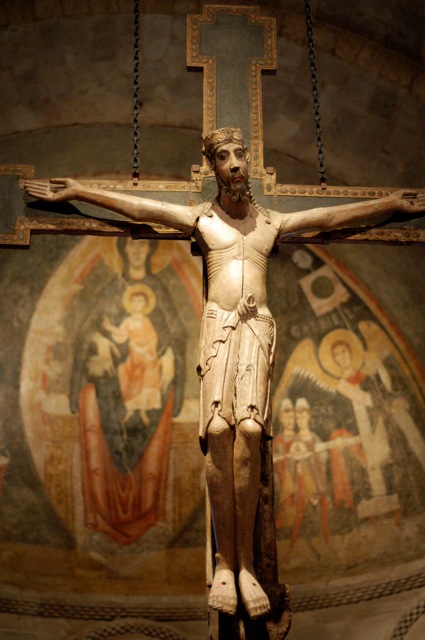
"For me, kind Jesus, was thine incarnation,
thy mortal sorrow, and thy life's oblation;
thy death of anguish and thy bitter passion.
for my salvation." --Johann Heermann tr. Robert Bridges
I.
Our culture denies death. Our culture denies death's power by saying that it is nothing, only a change. Our culture denies death's sorrow by making of it a celebration. And our culture makes of death's horror a cheap cologne that smells more like bacon than decomposition.
The challenge of Christ's death and resurrection is the greatest gift that the Christian church can give this culture, indeed any culture. But Christ without a cross, especially among his followers, dies two deaths: the actual death, and the death of relevance, for Jesus as just another man who died, another sucker whom the state overpowered, another dupe of the Caesar, no matter how many nice things he did or good things he taught, is doubly dead.
II.
The doctrine of atonement, the idea by which the death of Jesus makes good for the sins of the world, for our sins, is problematic for many to say the least. The idea that this act of Jesus, casting aside his Messianic crown for us, was in fact an act of divine child abuse, God killing God's own son, or the act of a political prisoner alone, seems to me fairly pervasive.
One powerful idea given me in seminary was that instead of a Mel Gibson-style pornographic torture fest, Christ's torture and death on the cross was an interchange of God's justice for our constitutional human injustice, happening through Jesus as through an electrical conduit. More than a felix culpa, a "happy fault," that "allows" God to build something better out of our faults, this interchange is an exchange of all that is just in God for all that is unjust in a creation that goes its own way. We get a better deal.
III.
I'm hardly a heavy-duty theologian, or a student of literature and art and cinema who can quote all of the concepts that I'm referring to here in the history of human achievement. But it seems pretty clear to me that many in the church, uncomfortable as we are with death, might seek to hide Jesus's death behind bunnies, eggs, candy, and parades.
What is an age-appropriate explanation of the crucifixion and resurrection to children? I'm by no means an expert, but talking directly about Jesus dying, and God bringing Jesus back from the dead, seems like it could be very powerful for those whom we often forget about when tragedy happens, because it seems even more difficult to explain it to children, who know something bad when they see, hear, feel, and experience it.
It seems to me that Christ without a cross dies twice, as I said above: his actual death, and the death of his relevance to us as Christians and to our or any culture, time or place. Our culture is not exclusively Christian, but it is one to which we might share a word from this perspective of death and resurrection, and at that a word of hope. Jesus without resurrection is Jesus without hope.
Perhaps we are ashamed because we cannot explain God's place in evil, either the evil of the crucifixion or the evil of natural disaster, war, famine, and other engineered acts of evil that we humans perpetrate on other humans?
Perhaps it is so difficult to believe in the resurrection that it is easier to sugarcoat it than try to explain it to others, much less ourselves and our own people? I can't say I understand the death and resurrection of Jesus all that well, but something in me believes beyond the need to sugarcoat my own impending death with the cross, to use the cross as a means of escape from reality, as must appear to many who do not share this same belief.
A church that sugarcoats the death and resurrection of Jesus with the candy of culture may well be as odious as a believer who uses the cross to deny his or her own death. But as Dietrich Bonhoeffer said famously in Cost of Discipleship:
"As we embark upon discipleship we surrender ourselves to Christ in union with his death--we give over our lives to death. Thus it begins; the cross is not the terrible end to an otherwise godfearing and happy life, but it meets us at the beginning of our communion with Christ. When Christ calls people, he bids them come and die....In fact every command of Jesus is a call to die, with all our affections and lusts. But we do not want to die, and therefore Jesus Christ and his call are necessarily our death as well as our life. The call to discipleship, the baptism in the name of Jesus Christ means both life and death" (Dietrich Bonhoeffer, The Cost of Discipleship, 89-90. New York: Macmillan, 1959, Touchstone ed. 1995).
There is a broader point of forgiveness and mutual burden-bearing to Bonhoeffer's message here, but the necessity of death, and of death in Christ for a Christian, is of central moment.
Any version of Christ that can escape the tomb without the cross is not the Christ. Any version of Christ that gets caught in torture without the work of God in resurrection from the tomb is not the Christ. But my sense is that our human tendency is more to liberate Christ and ourselves through him without taking the hardest steps to and through the cross.
IV.
I wonder if a failure to encounter Jesus in all of his shame on the cross, around the crucifixion, and jumping right to the resurrection, may not be an element of what has chased people away from church by the droves?
Not only has there been a cultural shift since the 1960s that shows a marked decline in the relevance of church in much of American society, but perhaps the church itself has aided in people leaving it through downplaying its own relevance through its core concepts, and through becoming a place of trying to make people feel good about themselves in a way that a gin and tonic could do much better.
As a kid, and as an adult, direct talk has engaged me much more than beating around the bush. I don't want to hear about a Jesus who is merely a glory-machine, triumphing over death without experiencing it. That kind of Jesus doesn't make much difference to me or anyone else.
I want to hear about a Jesus who went all the way, who experienced everything I have experienced, and who came through it in a way that I can know meant a lot to him, not only an insignificant key change in the tune he was whistling, but a whole shift in the reality of what death and our relationship with God means to me and to humanity.
We crucify Christ again by forgetting the cross. We crucify Christ again by forgetting the tomb. We crucify Christ again by forgetting the resurrection. It is only with each of these elements, and by accompanying Christ in these places, and in teaching this to our children, and in insisting on our reality to the wider culture, challenging first its denial of death, that we respect most profoundly the God who has given us Godself in human form, and who has loved us so much that even death can't separate us from God.
Loving Jesus, the tomb awaits, but not yet. Nor your glorious resurrection. Not yet. Keep me for a moment from it, that its power and glitter not overwhelm me. Keep me for a moment with you in death's embrace. Amen.
Tuesday, April 19, 2011
"The Stone that the Builders Rejected"
"The stone that the builders rejected has become the chief cornerstone." --Psalm 118:22
I.
For some reason, I thought this line appeared at some point during the Holy Week readings, but as it is, the only time we who follow the Revised Common Lectionary will be hearing it this year is on Easter.
Yet this phrase informs the whole Holy Week leading up to the crucifixion of Jesus, and particularly what happens through God's raising of Jesus on the third day. The stone, which didn't look like much, which was mis-shapen, mistaken, mis-heard, the stone that rolled the wrong way down the hill, that didn't quite seem to fit the tomb, those stones from which God would raise up children, all these stones were rejected. Those in charge, the builders, didn't happen to think the stones would fit, or that they should properly be included in the plans for such a magnificent building.
Not only did the rejected stone end up being used, but it became the most important stone of all, on which the entire edifice was built. What this edifice is, who the builders were, who the stones were, is all part of the Christian faith tradition, and important questions to wrestle with. But for now, simply, I'm hearing the stone that was rejected, and marveling at how it became a cornerstone.
II.
It's hard not to read myself into this line, and perhaps a bit perilous at the same time. We all experience rejection, and few are probably really spectacularly happy at being rejected. I fear reaching out to people whom I think might reject me, because that has happened plenty. I'm cautious of putting my written work out there in the fear that it might be rejected, which is pretty much what generally happens to written work for which people seek publication. I'm self-conscious about talking about a faith in a loving and graceful God that challenges the view of God and Jesus presented by many who go by the name "Christian," even though sharing that graceful vision of God is more vital now, more life and death, than ever.
The stone has been rejected. Accounted unworthy by those who are supposed to know what is worthy and what isn't. Rightly tossed to the side, and thankfully out of the way.
I would not be the only person who has been at some point rejected, in many ways, not least of which by the church. I have also been accepted in many ways, by many people, and not least of which by the church.
But instead of the rejection stopping the stone, it becomes the cornerstone. It risks everything and comes out ahead. I don't know if I'm that adventuresome, or just wish to hold on to what I have, modest as it might be. The stone could have stayed stuck.
The time comes to risk it all does come, and at that point, rejection cannot be a defining issue.
III.
I've been questioning lately whether that time is coming for me. My job, at which I'm gratefully accepted, will not last forever, and I must find new employment in the next 6 months. Plenty of time not to have that end come as a shock, but I need to get serious about ministry, if that is to become the calling in reality for which I've been called, educated, and sent into a land of limbo. This is not so different from a lot of people who have been affected by the down economy of the last 3 years. To have employment has been a blessing that I am not unaware of.
Many of us, no matter our sexual orientations, have faced this challenge of being rejected in many ways at many times.
I've recently become aware that a lot more people than just myself have been waiting for years for their first calls to become pastors in the ELCA. A number of these people mention how difficult it has been to piece together a life while trying to retain hope that God indeed is back there somewhere, having something to do with this lengthening road that seems not to be leading anywhere.
In times when you still hear that there's a clergy shortage, we would be hard-pressed to understand why, when sitting as rejected stones next to the road. But perhaps we will become the cornerstones of the new buildings, the new ways in which the church will need to be in the time to come?
IV.
Many question, rightly, the place and shape of the church in the years to come. My work church is joining my worship church and another church in a 3-way configuration in which each church will have its own worship space, retain its own identity, and share space. The reason is because each of these churches built their buildings and envisioned their futures with about 90% more people than they have now. The old ways, as the old buildings, are crumbling. New people with new ideas are going to be key in bringing the Gospel to new generations who will not be content just to debate the curtains in the library or whether or not mums should be the flower on the altar Sunday mornings.
What are the words that we stones, whether we've been rejected, included, or are yet becoming, can speak to a church that often seems to stand in stone-deaf silence to the needs of its people?
I was grateful the other day to share an idea for a welcoming church start in an area that has no LGBTQ-publicly welcoming Lutheran churches with the bishop of the local ELCA synod here. He listened patiently, kindly, and said that my idea would be hard to implement. I responded that truth that what would make it a hard proposition is what would make it especially necessary.
Congregations that proclaim their welcome most earnestly, and are often welcoming in many ways, often fall short when it comes to LGBTQ people. That is one reason why there are still only about as many ELCA congregations that are publicly welcoming of LGBTQ people as there were congregations that left the ELCA in order to be particularly unwelcoming or because they felt the ELCA had abandoned its Biblical principles.
What God will make of us stones is yet to be seen. But our church needs us, as it needs every potential leader, ordained or lay, who prayerfully feels compelled to make a difference, because the time for that difference to be made is passing us by.
If we do not wish harsher varieties of Christianity to control the public perception of "Christian" for good, some of us have to start speaking up more, and some of our churches and denominations need to get behind us and figure out how best to use our gifts.
In the meantime, this stone is open to being included, open to listening to other stones that have been or have felt rejected, as well as to pushing his agenda for God's grace and justice onto the builders who need to hear it.
Gracious God of all that we are and all that we can ever be, lift us up to be there for your people who are lost in the night, who wait for you as watchers wait for morning, who feel that you hate them, that your are angry at them, that you wish them destruction, that you are damning them to an eternity of torment for some arbitrary reason. Is this your will, God, that people doubt you because you seem cruel and whimsical? I have a harder time believing that than that you do not exist at all. In whatever way you can, work through each of us to raise up another dear stone who has felt rejected, that we might build up your cathedral of grace on earth as it is in heaven. Through Jesus, the rejected stone who became the chief cornerstone in your plan for reconciliation, we pray. Amen.
Monday, March 28, 2011
A Spontaneous, Inexhaustive Lutheran Credo
One of my friends posted a question on what her statement of "What Lutherans Believe," and in thinking of it, I was struck with a flurry of spontaneous Lutheran credology. My favorite statement here is the last. Here it goes:
- Lutherans believe that Christ is the center and the center will hold.
- Lutherans believe that no sin is original--they've all been tried before.
- Lutherans believe that Christ showed his true colors on the cross, and we showed ours, yet God is above all seen in a rainbow of all colors.
- Lutherans believe that "Love your neighbor as yourself" does not mean to keep using Jesus' name to attack that neighbor for any reason whatsoever.
- Lutherans believe that the New Commandment doesn't supplant the 10 Commandments, but rather interprets law through the prism of the Gospel.
- Lutherans believe that God forgives you first, and then you respond with works of charity and compassion out of thankfulness, rather than trying to buy God's favor through good works, which doesn't work anyway.
- Lutherans believe that faith is a gift of the Holy Spirit and not a work that one Christian is better at than others.
- Lutherans believe that humans are not fully good or fully bad, but fully both.
- Lutherans believe that Jesus, and not Rob Bell, emptied hell of all sinners past, present, and future.
- Lutherans believe that human beings struggle and are not perfect.
- Lutherans believe three solas ("alones"), grace, scripture, and faith, but these are neither mutually exclusive nor exhaustive.
- Lutherans believe that doubt is an asset, and not a liability, to faith.
- Lutherans believe that Jesus really is present in communion, not just a memory.
- Lutherans believe that God is gracious, even in judgment.
- Lutherans believe that the Holy Spirit works today, and that God was not buried in the Bible.
And, most importantly:
- Lutherans believe that God is still speaking, even if some Christians never shut up.
Monday, August 23, 2010
ELCA Churchwide: One Year Later, and Still Waiting
Last Friday marked one year since last year's vote at the ELCA Churchwide Assembly on allowing open and partnered gay and lesbian persons to serve officially as pastors, without the fear of being witch-hunted out, put on trial, and defrocked ("derostered").
In reality, not a huge number of people or congregations have left the church, but although the laws of the ELCA have changed, the reality for gay and lesbian pastors, I'm guessing particularly for those awaiting their first calls like myself, is still "in process."
Today, Minnesota Public Radio's News-Q posted a series of reflections on what life is like in the ELCA now, at the One-year mark. It includes a brief piece on me, as I am three-and-a-half years into waiting for my first call, far longer than any of my seminary colleagues.
I will reflect more thoroughly in the next few days, but for now, here is the link to MPR's story. Each segment is worth a look: http://minnesota.publicradio.org/projects/2010/08/church-divided/new-welcome.shtml
Wednesday, August 11, 2010
A Repost Riff on "Bless Me Anyway"
Recently, I had the chance to watch the HBO production of Tony Kushner’s “Angels in America” for the first time. It made me recall our Twin Cities Gay Men’s Chorus experience with some of Kushner’s most powerful words. This is a reposting from 2009, which also seems apt in these days that are hopefully gathering steam to overrule all of the divisive marriage laws, after Judge Vaughn Walker's masterly decision overturning Prop 8. Here it is:
So we in the Twin Cities Gay Men's Chorus have been singing a wonderful new setting by Michael Shaieb of some words by Tony Kushner from his play "Angels in America," centered around the phrase "bless me anyway." This phrase has affected me since we began singing it. It makes me think about those plucky figures in the Bible, Jacob and the Syrophoenecian woman, one in the Old Testament and one in the New, one going up against Godself, and the other against Jesus himself, who demand blessing in their beings from the deity who in some way created them, yet who have been told that they do not deserve such a blessing, or must fight to get it.
My life has been one in which I have both been the grateful and lucky recipient of unconditional love, from family and friends, as well as the need for years and years and years to defend my own being, sensitive, gay, or otherwise, against various people and institutions who have told me that I am deeply and existentially wrong. But, you know, bless me anyway, right?
The following are some words that came out after thinking about this phrase, "bless me anyway." This is yet a work in progress.
To the totality of the world's rejections:
The minor rejections of saying 'no' to liver and eggs;
the major rejections, hearing you say 'no' to me.
To the 'yous' who have told me who I am,
rather than letting me figure me out for myself.
Bless me anyway.
Even if you don't consider me worth it.
Even if my skin says "liar" to you.
Even if you think my dick should not go there.
Even if the folds of my skin obliterate
the smooth straight line
that you suppose would make me beautiful.
Bless me anyway.
What does a blessing cost you?
Does a blessing cost you your life?
Your job?
Your wife?
Does a blessing cost you your country?
Your place in the world?
Bless me anyway.
For I will have worth without it,
but with it,
we can love those we were meant to love,
in the open.
We can bless the skin that contains
our bones
our life
our blood,
if not our souls.
Bless me anyway.
It costs less than a tower,
less than a bomb,
less than a college education,
less even than an egg
from which life can come.
Bless me anyway.
But blessing is powerful.
Yes, blessing costs more than money,
more than position, power,
and all the water in the world.
Bless me anyway.
Bless the water that makes me more
than a pile of dust, more
than a pile of crap, more
than a pile of me that makes you weary,
that you wish would go away
sometimes.
Bless that shit machine
that embarrasses you.
Bless that $22.95 in basic elements,
not quite enough to buy Manhattan
four hundred and fifty years ago,
but enough to pay off the sum total
of a pile of humanity.
Bless me anyway.
More than the sum total,
more than the blue of my eyes,
more than the gnarled toenails,
the middling nipples,
the less-than-perfect hairline,
the zit on my left temple.
Bless me anyway.
The Jewish part of my heritage,
obscured by name-changes.
The happy sodomite that would do me, maybe.
The D-student wannabe.
Bless me anyway,
and I will bless you too.
I will bless your assumptions,
your experiences,
your attempts to reach out,
that get caught in your throat.
I will bless your struggle to live
in a world that kills us all,
that resolves as we do,
into a pile of minerals.
However it turns out,
Anyway,
I will bless you.
Subscribe to:
Posts (Atom)